One single sentence about a sign became a saga of 16 emails over 10 days.
Signs keep us safe so if they pose a danger, I’m concerned. I thought others would be too, especially because it was on town property.
According to a sign by-law memo to council, “Construction Zones: Temporary routes around construction must also be accessible.”
Also, if barriers exist, the town wants to know about them, right? I’ve learned the operative word is ‘if.’
The bright yellow sign at Richmond and Bathurst grabbed my attention on June 10. I knew it wasn’t compliant with the Ontario Traffic Manual Book 7 – Temporary Conditions, which contains best practices for traffic control in work zones.
I immediately emailed the one sentence, “the attached photo of the sign at the Bathurst and Richmond intersection is not compliant” to CAO Critchley and Councillor Diane Pouget.
I usually copy the other council members on my emails, but they rarely respond. So, this time I just copied Pouget since she’s the only one who has consistently represented residents.
McArthur said, “Whether Councillor Pouget is on council or not on council, if I have a problem that I need town hall to solve, I’m going to councillor Pouget okay, and this community knows that.”
Yes, I know that.
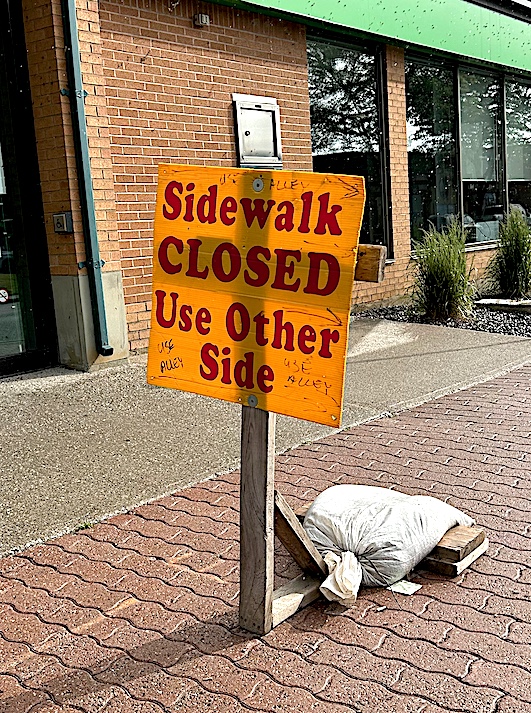
“Use alley” is added in marker on either side of the word ‘side.’
Critchley: “Thank you for your email. We will look into this today,” June 11.
Critchley: “This situation has been reviewed. There are no issues with the signage provided and it does not violate any legislation. While not a standard sign, it nevertheless conveys the messaging intended, and is placed in such a way as to provide notice to allow those using the sidewalks to transition to the sidewalks that remain open for the intended purposes.” June 15.
the burg watch: “Thanks. It’s unfortunate that the town is ok with non-compliant signage that creates a barrier for people with vision disabilities and therefore does violate legislation.” June 15.
Critchley: “This initial sign is a warning that the sidewalk is closed beyond. If you carry on beyond that signage you will see a full barrier and fencing, closing off the area that someone with a visual impairment would identify with their cane when approaching. There are often practical limitations to the possible scenarios that may exist with a given solution in the world, but the Town follows best practices, provincial regulations and the guidance of upper levels of government in its actions.” June 15.
the burg watch: “A person with a visual disability would encounter the barrier at the initial non-compliant sign. Best practices include compliance with the Ontario Traffic Manuals.
As you know, MTO-approved traffic signs follow precise guidelines outlined in Ontario Traffic Manuals (OTM) that make signs legally enforceable.
Under OTM Book 7, temporary construction signs must strictly use black text on an orange retroreflective background, or black text on a white background for specific regulatory tabs. Red text on yellow does not adhere to official MTO/OTM standards and is a barrier for some people with vision disabilities.
For a proper sidewalk closure, the correct standard is to use the TC-40 “Sidewalk Closed” warning sign or the TC-40T “Sidewalk Closed” tab.
The TC-40 must be accompanied by a directional arrow (left or right) to guide pedestrians safely toward an alternate route.
OTM compliance would optimize pedestrian safety and reduce liability risks. June 15.
Critchley: “This sign is NOT a Town sign and has been placed in relation to a private project. As such, the sign does not have to follow MTP standards. If you have an issue with the sign, please reach out to the contractor doing the work. June 16.
the burg watch: “Thanks. Given that the sign is on town property directing town residents, I assumed the town would take an interest in ensuring compliance and pedestrian safety, including persons with disabilities.” June 16.
the burg watch: “Out of concern for pedestrian safety, including persons with disabilities, I’d like to contact the contractor. Would you please provide me with the contact information. Thanks” June 17.
the burg watch: “You advised, if I have an issue with the sign to reach out to the contractor. I have an issue but I wonder if the town and town council share my concern about the safety of persons with disabilities on town property. So, this afternoon I spoke to the contractor, who told me the town approved the project and supplied the signs, which he showed me. As I pointed out to you, the signs are not compliant so why is the town providing non-compliant signs that potentially endanger pedestrians?” to Critchley and all council members this time on June 18.
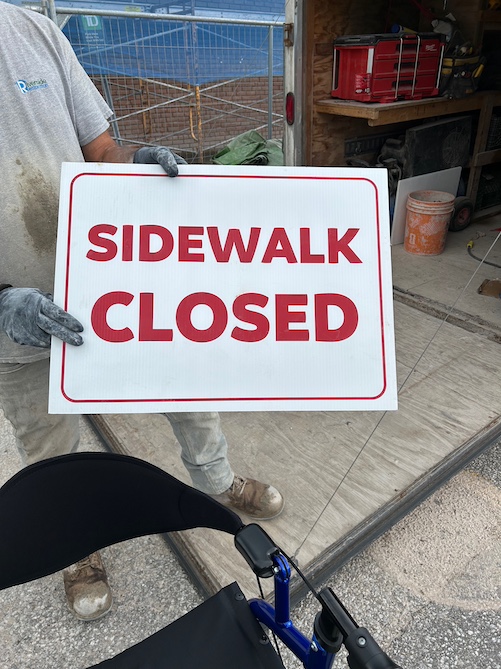
Contractor holding sidewalk closed sign provided to him by the town.
Councillor Pouget: “When time permits, will you please advise if the signs, that Mrs. Saxon is referring to is compliant to keep our residents safe, especially those with disabilities? Are these the Town signs and if not compliant, will they be replaced for safety reasons?” emailed Critchley, copied council, on June 19.
Critchley: addressed to Pouget without acknowledging her title: Good Morning:
The sign is actually the responsibility of the contractor. However, as I have told Ms. Saxon, the sign is compliant.
Critchley: to me, cc council, “Good Morning:
As originally relayed, while the sign is non-standard, it is not “non-compliant.” Compliance refers to a legal requirement, the OTM is a guideline. In this instance, the contractor did not have a sign, and asked for this to be provided to assist their works. As the sign exists 10 feet behind a saw horse with retror-eflectivity barring the path, and fencing secures the entirety of the site, staff we comfortable utilizing it for this purpose. As you may not be aware, retro-reflectivity is used for headlights and other typically street based conveyances. As it is not typical for headlights to be on sidewalks, it does appear that the safeguards staff authorized are both adequate and appropriate.
Thank you for your concern. June 19.
the burg watch: “The non-compliant signs are a public safety hazard as well as non-compliant with the AODA. Why wouldn’t the town ensure the safety of its residents and mitigate all potential risks to the town? Why wouldn’t the town just implement best practices like so many other municipalities?
It has been claimed that input on barriers in the community are welcome and will be addressed yet once again it appears accessibility is not a priority.” June 19.
Critchley: Madam:
“The signs are not a public safety hazard.
If you can provide a reference to the section(s) of the AODA that you are concerned about we would be happy to review that.” June 19.
the burg watch: “Madam,
The signs are a public safety hazard if they are not legible, are not the correct colours, incorrect contrast, do not contain arrows directing pedestrians to an alternate route, and are a tripping hazard – those are the facts. I notified the town of the barrier and then it’s the town’s responsibility to address the concern. The AODA is readily available online for you to review.” June 19.
I noticed different signs on June 26.
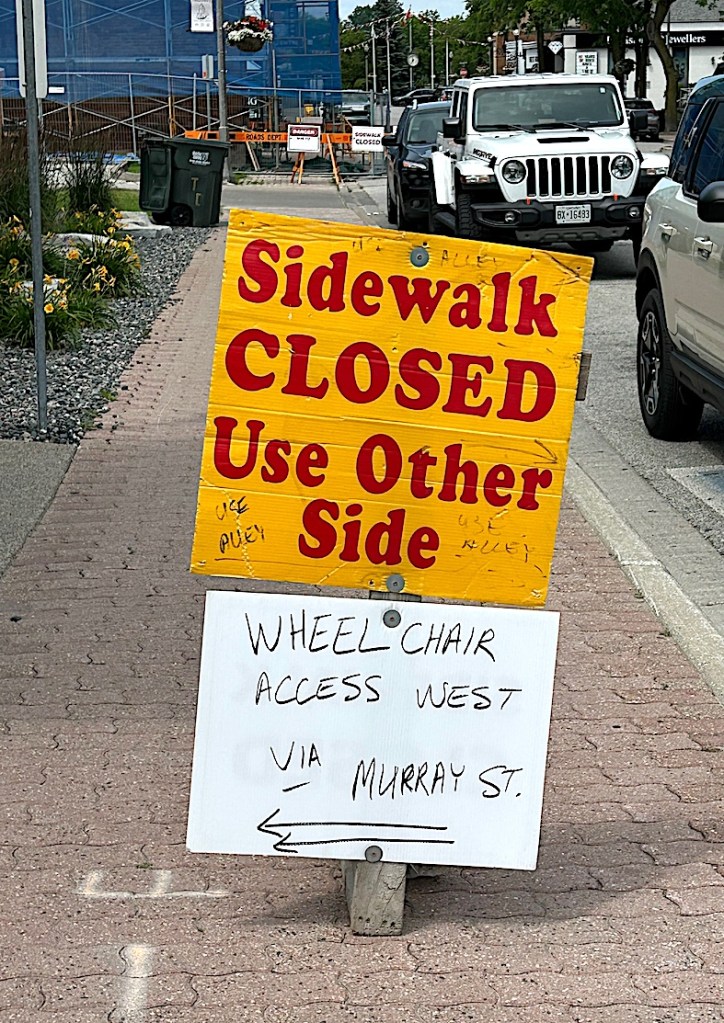
Hand printed sign on Richmond Street and Bathurst stating use other side but wheelchair access is via Murray St. As a reader pointed out, Murray Street only has one useable sidewalk – on the north side – between Bathurst an dRamsay and it’s not in good condition either.
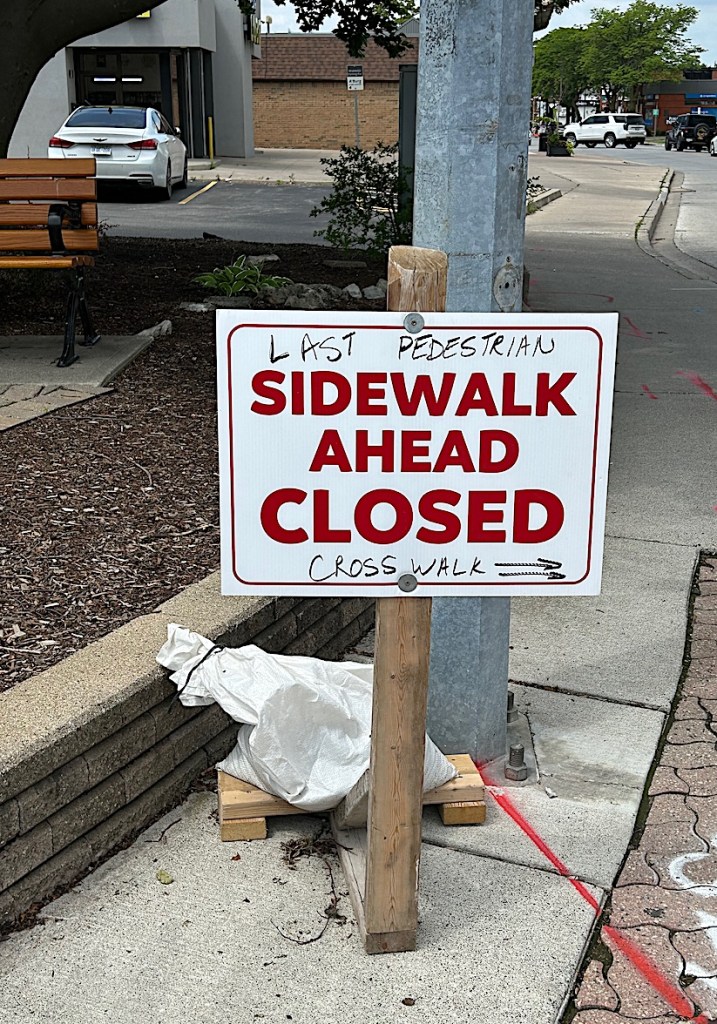
Hand printing on sign indicates last pedestrian crossing at Sandwich Street at Richmond next to the library.
I have submitted a freedom of information request for all the contractor’s documents/applications the town approved.

