About theburgwatch

Amherstburg's first local blogger since 2011, writing about town council and issues.

Update: Amherstburg’s CAO Defends Closed-Door Training—And Mayor-Elect Gibb Stays Silent

By: Linda Saxon, The Burg Watch

In my previous post, I shared that Amherstburg’s incoming council has five separate orientation and training dates scheduled—November 24, November 30, December 1, December 3, and December 7—and every single one is being held behind closed doors.

Following that email, I sent a formal reply to Chief Administrative Officer (CAO) Valerie Critchley and copied both the town clerk and Mayor-elect Chris Gibb, who were included on the CAO’s original message.

In my follow-up, I reminded administration that the Ontario Ombudsman’s April 29, 2024 report explicitly suggested Amherstburg formalize the practice of treating training sessions as open public meetings to improve transparency. I also asked two direct questions:

  1. Whether council will pass open-session resolutions disclosing the general nature of the training topics beforehand, as required under the Municipal Act.
  2. Which of the five dates covers mandatory training under the Accessibility for Ontarians with Disabilities Act (AODA) and the Ontario Human Rights Code, and who is delivering the curriculum.

What the CAO’s Reply Actually Revealed

CAO Critchley replied to defend keeping the sessions closed. Her response—sent in red coloured text, despite my explicit request to her in August 2025 not to use coloured text —revealed three major takeaways:

  • A Sudden Legal Pivot: In her first email, the CAO stated the sessions would be closed “in accordance with section 239 (3.1) of the Municipal Act.” Yet when asked about the open-session resolutions required under that rule, she changed her argument. She claimed that because educational sessions do not materially advance council business, they do not meet the legal definition of a “meeting” and require no public resolution at all. She ignored the Ontario Ombudsman’s transparency recommendation completely.
  • Recycling the Outdated 2022 Training Package: Regarding mandatory AODA and Human Rights education, she wrote: “This training is provided separately from the Council orientation dates and via the Town’s training software. I believe you have a copy of the version of that training already in your possession from the last Council orientation.” That confirms our incoming council is still receiving the exact same outdated curriculum from 2022—the one that required a Freedom of Information request to uncover and featured a 30-minute Folk Music Ontario video from July 2014.
  • Ignoring Digital Accessibility Requests: Answering an accessibility watchdog’s email in red text—after being asked in August 2025 not to use coloured text—shows how lightly basic digital accessibility is treated at the top of Town Hall.

Mayor-Elect Gibb’s Silence Speaks Volumes

Just as telling as the CAO’s defence is the complete silence from Mayor-elect Chris Gibb.

Gibb was copied on the entire email exchange. He saw administration’s plan to lock the doors for five training sessions. He saw the reminder about the Ontario Ombudsman’s 2024 transparency advice. And he saw the CAO defend keeping taxpayers out before the new term even begins.

So far, he has said nothing.

During the recent election campaign, Gibb defended traditional municipal processes. By remaining silent while administration shuts the public out of council orientation, our incoming mayor is effectively condoning business as usual before even taking the oath of office.

Transparency Is a Choice

Even if administration argues these orientation sessions fall outside formal meeting rules, keeping the doors locked remains a choice, not a legal requirement. Other Ontario municipalities—like the City of Cambridge—actively welcome residents to observe open portions of council-elect training on governance and community priorities.

Ultimately, staff do not own the council table—elected officials do. Once the new council is sworn in, any member can put forward a motion to open these sessions to the public and formally adopt the Ontario Ombudsman’s April 29, 2024 report recommendation into the town’s Procedure By-law.

The Burg Watch will continue tracking how our newly elected officials handle transparency and accessibility from day one. When lawmakers start their term behind closed doors using decade-old training materials, taxpayers deserve to know.
Closed Doors Before Day One: Amherstburg’s New Council Training Sessions Shut Out the Public

By: Linda Saxon, The Burg Watch

Before our newly elected council even settles into their chairs for the next four years, Town Hall is already locking the doors.

Recently, I emailed Amherstburg’s Chief Administrative Officer (CAO) Valerie Critchley asking to be notified of the upcoming orientation and training sessions for the incoming council. Here is the exact response I received:

“Good Morning:

There will be internal training and education sessions held on November 24 and 30, December 1, 3 and 7. These sessions will not be public meetings in accordance with section 239 (3.1) of the Municipal Act.

Regards,”

Five separate training dates—November 24, November 30, December 1, December 3, and December 7—and every single one of them is being held behind closed doors.

Notably, the CAO copied both the Town Clerk and Mayor-elect Chris Gibb on the reply—meaning our incoming mayor is already aware that these sessions are being closed to the public.

We Have Seen This Exact Playbook Before

This is not the first time administration has put up unnecessary roadblocks around council training.

Following the 2022 municipal election, I asked CAO Critchley when council received accessibility training. She told me it happened on November 29, 2022—yet I could not find accessibility listed on that day’s Council Workshop Agenda. When I asked her to simply email me copies of the training materials provided to council, her response was:

“With respect to your request for documents, please file a Freedom of Information Request.”

I filed that formal FOI request. When I finally received full disclosure, the “secret” training package consisted of just three items:

  • Accessible Customer Service Standard (a public policy already posted on the town’s website)
  • Integrated Accessibility Standards Regulation Policy (another public policy already posted on the town’s website)
  • AODA – Accessibility for Ontarians with Disabilities Act 2023 (a slide deck that referenced a 30-minute Folk Music Ontario AODA Customer Service Video from July 2014)

Forcing a resident through an FOI process just to hand over two public town policies and a decade-old music organization video proves that closing these sessions has nothing to do with protecting confidential municipal secrets. It is simply a barrier to transparency—and it raises serious questions about the quality of education our lawmakers are actually receiving.

Legal Does Not Mean Mandatory

Let’s be clear about what the law actually says. Under Section 239(3.1) of Ontario’s Municipal Act, a municipality is permitted to close a meeting to the public for the purpose of educating or training council members, provided no member discusses or advances municipal business or decision-making.

However, closing those doors is a choice, not a legal requirement.

Nothing in the Municipal Act forces a town to hide council orientation from taxpayers. In fact, other Ontario municipalities—such as the City of Cambridge—actively invite residents to observe open portions of their council-elect training on governance and community priorities.

Even more telling is Amherstburg’s own track record. Following a previous closed training session here in town, the Ontario Ombudsman issued a formal report on April 29, 2024, explicitly suggesting that the Town of Amherstburg formalize the practice of treating training sessions as open public meetings to improve transparency.

Two years later, administration is ignoring that recommendation and keeping the doors locked.

The Rules Town Hall Still Has to Follow

Even when a municipality chooses to use the Section 239(3.1) loophole to exclude the public, the law still sets strict boundaries:

  • No Policy or Decision-Making: The Ontario Ombudsman interprets the training exception very narrowly. These five sessions cannot be used to review policy options, debate upcoming town files, or lay the groundwork for future council votes.
  • Mandatory Public Notice: Unlike the missing agenda item in November 2022, council is legally required to pass a resolution in an open public meeting beforehand stating the fact of the closed session and the general nature of the subject matter being covered.
  • Mandatory Accessibility Training: Under provincial law, newly elected officials must receive training on the Accessibility for Ontarians with Disabilities Act (AODA) and human rights obligations. Taxpayers have a right to know how our new council is being educated—especially in a town where the outgoing mayor openly admitted we are not compliant.

What The Burg Watch Will Be Tracking

Transparency is not something politicians should only talk about during an election campaign. It starts with letting residents see how their elected officials are being trained to govern.

I have already sent a follow-up email to the CAO—with the Town Clerk and Mayor-elect Gibb copied or informed—reminding administration of the Ontario Ombudsman’s 2024 transparency recommendation and asking which of these five dates covers mandatory AODA training and who is delivering the curriculum.

The Burg Watch will also be checking the upcoming council agendas to ensure formal public resolutions are passed disclosing the general topics for all five dates. The new term hasn’t even officially started, and the habit of operating behind closed doors is already back in full swing.


Parkland Washroom Audit: Existing Data, Portable Toilets, and Another Multi-Year Wait

By: Linda Saxon, The Burg Watch

When a politician brings forward a motion on accessibility, it is easy for casual observers to applaud it as a heroic step forward.

Last month, Councillor Molly Allaire told council and the local press that recovering from knee surgery on crutches made her realize “how inaccessible our town is.” While that realization may look like leadership on the surface, it is a textbook example of conditional empathy—only noticing a systemic barrier once it affects you personally.

Allaire sat at the council table for four years while residents delegated and sent emails about these barriers, and she ignored The Burg Watch pre-election accessibility audit entirely.

In response to her motion, council bounced the issue down to the Accessibility Advisory Committee. On November 10 the committee finally met to discuss it, and what unfolded put Town Hall’s administrative stall loop on full display.

What Actually Happened at Yesterday’s Meeting

  • Staff Already Had the Data: Parks Director Heidi Baillargeon presented a complete inventory of 26 parks and already had an exact quote of $7,018.82 to install automated door openers at Toddy Jones Park. Administration did not need a months-long mission to discover where the barriers are.
  • Outdated Building Standards: Staff openly admitted that while our 40-year-old park washrooms meet older Ontario Building Codes, they do not fully comply with current accessibility standards or the town’s own Facility Accessibility Design Standards (FADS). Many buildings have narrow doors and lack the interior space for full compliance.
  • The Porta-Potty Band-Aid: Six parks—Anderdon, Beaudoin, Jack Purdie, Larry Bauer, Malden Centre, and Thrasher—currently rely on portable toilets. Staff admitted that portable units are not permanent solutions, noting that major hubs like Malden Centre and Larry Bauer parks require permanent, compliant buildings.
  • The committee discussed a potential $50,000 accessibility budget for parkland that may stretch into 2027, along with potential 2027 EAS grants.
  • More Review: Instead of pushing for immediate funding to install automated doors where possible, the clerk stated, “At this time, it would be appropriate if the committee wanted to that you could add this to the multi-year plan, or recommend that Council add this to their multi-year plan as targeted objective, and you could then drill down, and that will make sure that it’s a standing item that you continue to come back to as money becomes available. It’ll be sort of a highlighted bullet point…when the director is preparing budgets, of course, that’ll be one of the things to consider in terms of are we are we moving ahead those goals?”

Christine Easterbrook asked if she could make a motion then to do that.

The clerk worded the motion, “Just to capture the spirit of it, if I may, and of course you can identify any changes that are required. That the accessibility of washrooms in the town of Amherstburg Park System be reviewed, and identify changes for targeted improvements be brought back for consideration.” Carried.

What Happens Next

Residents with disabilities should not have to wait until 2027 or rely on temporary portable toilets while Town Hall debates whether removable grab bars and automated door openers are “cost-effective.”

The Burg Watch will be tracking the upcoming Malden Park washroom grant proposal when it goes before council, and I will be tracking how our newly elected officials vote when it comes time to fund actual, immediate compliance.


Beyond the Ballots: What the Election Results Mean for Amherstburg’s Disability Community

By: Linda Saxon, The Burg Watch

Now that the initial election excitement has settled and elected officials have been certified, we need to talk about what these results actually mean for the everyday lives of Amherstburg residents with disabilities.

Looking past the victory speeches and the political spin, last week’s vote completely reshaped our local council and brought the town’s structural approach to civic accessibility into sharp focus.

First, let’s look at the tremendous victory. Jen DeLuca capturing the absolute top spot in the councillor race with 5,597 votes is not just a personal win—it is a historic public mandate.

The community voted for change, sending a clear signal that table-level accountability matters.

With Keith Boussey also securing a seat, the disability community now has two clear, verified allies holding actual legislative power to introduce motions, demand compliance, and challenge municipal barriers from day one.

However, because Jen DeLuca owns the Waterfront Ice Cream parlour downtown, she will have to declare a conflict of interest under the Municipal Conflict of Interest Act whenever Open Air street closures or downtown business layouts are discussed or voted on.

This means that while she is a powerful ally for town-wide policy, the specific fight for downtown sidewalk layouts and Open Air barriers will require Keith Boussey to take the lead, backed by the pressure of public watchdog tracking.

But we must also face the stark reality of the rest of the ballot.

The Burg Watch accessibility audit concluded that Mayor-elect Gibb and Councillor-elect Ewer chose to defend the traditional status quo – passing files back to a powerless accessibility advisory committee or waiting for staff reports before acting.

This defensive script played out on Wes Ewer’s campaign page. When The Burg Watch commented about his willingness to maintain a 24-year-old accessibility committee structure and the outgoing Mayor’s declaration that the town failed to be compliant, Ewer seemed impatient.

Instead of addressing the structural failure of the status quo, he chose to tone-police the scrutiny.

He then relied on the ultimate establishment shield, arguing that the watchdog does not speak for every person with a disability and pointing to the volunteers on the town’s Accessibility Advisory Committee who believe in the process.

This is a classic example of toxic positivity in Amherstburg politics. Weaponizing local volunteers to defend a system that has failed for 24 years is just a shield, not a solution.

When an elected official claims they want to work together but treats baseline policy criticism as a personal attack or a semantic disagreement, it proves how deeply entrenched the gatekeeping remains. Listening doesn’t mean passing the buck back to a powerless advisory loop.

The real mystery of this council lies with the block of candidates who chose to ignore The Burg Watch accessibility audit entirely.

Together, Bill Petruniak, Molly Allaire, and Peter Courtney command a huge portion of the voter turnout, yet they chose not to make any concrete accessibility commitments. Courtney committed to participating in the accessibility audit but failed to do so.

We are already seeing what this wall of silence and conditional empathy looks like in practice.

Looking back to her previous term on council, Allaire raised public concerns regarding accessibility issues at our local library. Yet she repeatedly ignored direct questions seeking the actual factual basis for those library statements and has continued to ignore some community comments on her Facebook page.

When directly questioned in an email regarding downtown Open Air barriers, her written response was a shocking admission of political avoidance, stating: “Open air does remain a contentious issue. You mention barriers that deny people with disabilities equal access to the community. I do not know of these specific barriers you speak of. Could you please explain so I can make an educated response.”

The irony here is alarming. Allaire is the councillor who previously made the motion to refer the town’s Open Air resident survey to the accessibility committee—a survey where accessibility was explicitly listed as the number one complaint in town.

Furthermore, Allaire sat at that council table for four years while I delegated and sent detailed emails explicitly pointing out systemic physical barriers, including emails to CAO Critchley regarding the Movati pool barriers.

She had full access to years of data that remained unaddressed until she personally experienced a temporary injury and needed crutches.

The recent River Town Times article regarding park washrooms exposes the flaw in this approach.

In a CTV interview during her campaign, Allaire explicitly stated, “I started by focusing on improving our parks and green spaces, and now I’m ready to take on bigger priorities like roads and infrastructure.”

Despite spending four years on council focusing on parks, handling surveys where access was the top complaint, receiving emails regarding barriers, and Mayor Prue declaring the town was not compliant by the 2025 AODA deadline, Allaire’s surgery suddenly made her realize how “inaccessible our town is.”

Even more frustrating is the bureaucratic response from town hall. According to town staff, the accessibility advisory committee is a “legislated committee” that will continue to meet if there is a triggering condition.

Let’s be completely clear: being a legislated committee simply means the town is legally required by the province to have one. It does not change the fact that it remains a purely advisory body. It has zero legal authority to pass by-laws, enforce budgets, or order a single door button to be installed. Its only role is to advise.

Instead of council simply using its own actual legislative power to order the automated buttons installed, the file was bounced down to a committee under the guise of conducting a parkland audit.

The director of parks even admitted that administration already knows exactly which buildings lack automated door openers.

Why are we sending an advisory committee on a washroom-by-washroom mission when administration already possesses the data?

Public records reveal that on May 4, 2022, the Amherstburg Accessibility Advisory Committee explicitly discussed these parkland audits, with the town clerk stating at the time that creating the resource was a goal of his.

Bouncing the file back down over four years later to “study” it is the ultimate delay tactic.

When an elected official claims they “do not know” about systemic barriers that have been presented to them via public surveys, emails and delegations for years, it raises a massive red flag about true transparency.

Taxpayers did not elect individuals to sit in silence, plead ignorance, or hide behind endless audits. Since these non-participants chose to remain quiet during the campaign, The Burg Watch will be documenting their very first council-table votes with absolute transparency.

So, what does this mean for the next four years?

It means the issue of physical and digital access in Amherstburg is now directly on the council floor. Voters have placed specific individuals at the table who have publicly committed to change, but whether those commitments translate into real action remains to be seen.

Because the council remains deeply divided on these issues, The Burg Watch will be keenly watching every single vote.

Every infrastructure budget, every sidewalk configuration, and every transit review will be tracked by its actual impact on residents with disabilities—not by political rhetoric.

The election is over, but the tracking of our new lawmakers starts today.

Curated Town Photos vs. Actual Accessibility: The Gingerbread House Reality Check

Now that the election is over, the standard public relations scripts are already rolling out, with a defeated candidate sharing his own post highlighting local volunteer recruitment to keep up appearances.

But we need to look past the glossy town photo and look at the actual municipal building being promoted.

Recently, Dhaval Prajapati shared a post advertising that approximately 5,000 people visited the Gingerbread Warming House at Toddy Jones Park last year, inviting more families to stop by this season.

While encouraging volunteers and supporting youth camps is always positive, inserting oneself as an outside coordinator to organize local volunteers provides a highly political backdrop that ignores a massive, ongoing barrier—one that The Burg Watch exposed last year, pulling in over 10,000 views according to Facebook page insights.

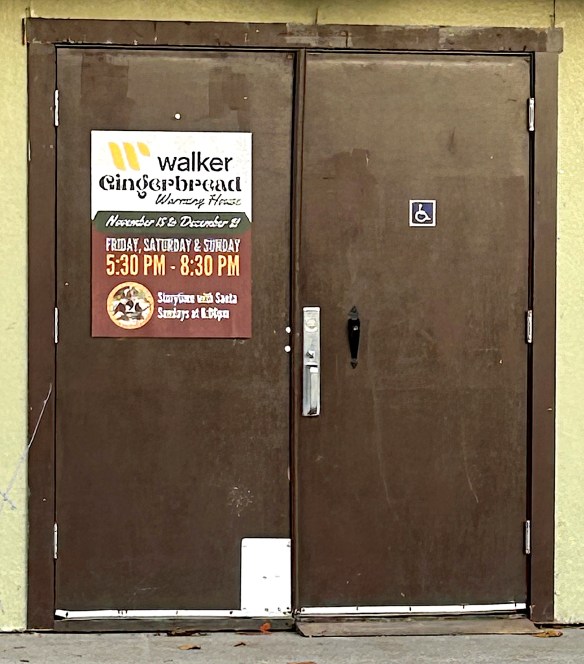
The Gingerbread House features the blue International Access Symbol sticker prominently displayed right on the front door. Yet the pavilion completely lacks an automated push-button door opener.

International wheelchair access symbol sticker on heavy entrance door to gingerbread house in Amherstburg Ontario

When the town’s official communications channels promote these spaces, and defeated candidates pass those curated images along without addressing the physical barriers, it normalizes performative compliance.

Slapping an accessibility sticker on a heavy door without installing the actual mechanics to open it tells residents with mobility devices that they are accommodated on paper, but leaves them physically locked out in reality unless they have someone to open the door for them.

If a public pavilion expects thousands of visitors, accessibility cannot be treated as a decorative sticker. Amherstburg does not need more staged municipal photo ops.

We need systemic, table-level enforcement that ensures public buildings are actually accessible, not just treated as backdrops for political public relations.

The Shocking Deputy Mayor Upset: Petruniak Out-Polls the Mayor

Let’s talk about the absolute biggest story of election night in Amherstburg—and it isn’t the Mayor’s race.

In a massive political upset that has left Town Hall insiders completely stunned, newcomer Bill Petruniak soundly defeated the heavily favoured Linden Crain for the Deputy Mayor seat.

Petruniak didn’t just win; he captured the second-highest seat in our municipality with an overwhelming 5,146 votes, leaving Crain far behind at 3,590.

But if you look closely at the data, the real story is the staggering gap between our top two new leaders.

As a newcomer to the council table, Petruniak actually out-polled our incoming Mayor, Chris Gibb, by a massive 1,218 votes.

Think about that for a second. While Gibb managed to squeeze through a three-way mayoral race with 3,928 votes, Petruniak walked away with a dominant, town-wide mandate from over 5,000 taxpayers.

This enormous gap sends a clear message about the true mood of Amherstburg voters.

By completely rejecting incumbent platforms like Crain’s, voters demanded independent, new leadership at Town Hall.

Chris Gibb may hold the Mayor’s gavel, but Bill Petruniak holds the true mandate of the people.

The Burg Watch will be watching very closely to see how this dynamic plays out at the council table!

Linden Crain: Votes, Decisions, and Controversies

As the election approaches, voters are analyzing the public records of candidates running for higher office. Councillor Linden Crain—currently campaigning to become Deputy Mayor—has generated several prominent debates regarding transparency, procedural rules, and public access during his term.

While independent regulatory reviews confirmed that Crain did not violate the town’s Code of Conduct rules, voters are looking at his voting history, campaign actions, and communication choices to evaluate his approach to leadership.

1. The Stance on Spontaneous Delegations

A central point of discussion during Crain’s term has been his approach to public participation inside council chambers. Under Amherstburg’s current procedural by-law, gallery members cannot spontaneously speak on an agenda item unless council votes unanimously to waive the rules. (Under the previous by-law, only a simple majority vote was required).

  • The Record: Prioritizing the agenda.
  • The Inconsistency: Residents have noted that Crain departed from this strict procedural stance on a limited number of occasions, voting in favour of waiving the rules to allow specific individual gallery members to speak, which raised questions from critics regarding the consistent application of council protocols.

2. Administrative Alignment vs. The “Homework Assignment”

Beyond the debate over spontaneous delegations, observers have noted a distinct pattern in Crain’s approach to town hall bureaucracy.

  • The Administration Record: Throughout his term, Crain has demonstrated a strong penchant for supporting administration recommendations and relying on staff-led reports.
  • The Reporting Pushback: However, his support for administrative processes stopped at requiring council members to produce their own reporting. When a policy was debated requiring councillors to submit formal summaries after attending municipal conferences, Crain strongly opposed the mandatory paperwork.
  • The Council Chamber Quote: Quoting the draft policy directly on the floor, Crain stated:

“It says here, the report shall include, at a minimum, the name and date summary of the seminars, workshops and or sessions attended. Feels like a homework assignment.”

  • The Public Reaction: While supporters saw this as a practical rejection of redundant paperwork for part-time elected officials, critics noted the irony of a councillor who routinely relies on administrative reporting pushing back against completing basic transparency logs himself.

3. The Open Air Format and Public Input

Amherstburg’s Open Air Weekends have been a significant point of discussion regarding downtown accessibility for seniors and residents with mobility disabilities.

  • The 2022 Stance: When asked by The Burg Watch in 2022 if he would remove Open Air barriers that block people with disabilities from navigating town, Crain responded directly: “Yes. It is important that all members of the community can experience Open Air. If there are particular barriers in place, I am more than willing to investigate further and help find a solution.”
  • The Term Lock-In: Once elected, Crain’s approach shifted from investigating solutions to preserving the status quo. He introduced a motion to maintain the Open Air setup completely unchanged until the end of the council term.
  • The Impact: By cementing the program through the end of the term, the motion effectively prevented further public delegations from formally addressing council on the matter. This locked out individuals with disabilities from presenting ongoing feedback regarding downtown physical obstacles—a stance mirrored by his choice not to participate in the recent candidate accessibility audit organized by The Burg Watch. This legislative lock-in occurred despite municipal survey data revealing that accessibility was the number one resident complaint regarding the Open Air format, a file on which council took no meaningful corrective action.
  • The 2026 Stance: Four years later, Crain’s public rhetoric maintains the exact same conditional framing, deflecting the documented reality of the town’s own survey back onto the public: “I am absolutely open to removing barriers if they exist. Accessibility and inclusion are important. Could you please share the barriers you believe exist during Open Air? You asked if I would remove barriers, but you haven’t explained what those barriers are.”

4. Campaign Protocols: The Malden School Visit

Crain’s campaign actions also drew scrutiny regarding a visit to Malden Central Public School. Following public inquiries, the Greater Essex County District School Board confirmed that established board protocols regarding political campaigns were not followed, issuing the following formal statement:

“We have reviewed the school visit you referenced and determined that established guidelines and procedures were not followed.

The school has been advised that the appropriate protocols were not adhered to, and we requested that the photographs from the visit be removed from social media. We can confirm that the photographs have since been removed.

A reminder will be sent to staff this week reinforcing the Board’s position regarding the distribution of campaign materials in schools during an election period.” – Madeline McEachern, Communications Officer, Greater Essex County District School Board

5. Intergovernmental Communications: Ford and Dilkens

Crain faced pushback from fellow council members for independently engaging with external political figures outside of standard municipal channels.

  • The Windsor Policing Meeting: Crain and Deputy Mayor Chris Gibb met privately with Windsor Mayor Drew Dilkens to discuss regional policing options. While a motion to launch a formal integrity review was defeated by council, the controversy led to a unanimous vote to make all previous private policing discussions public.
  • The Doug Ford Call: Crain independently contacted Ontario Premier Doug Ford regarding the economic impact of the Diageo plant closure. A subsequent independent review regarding his authority to speak on behalf of the town concluded that his actions were fully compliant with municipal codes.
  • The Burg Watch Interview: Crain’s response to an interview request was, “I really appreciate your interest, but I respectfully decline the interview at this time.”

6. Chamber of Commerce Sponsorship Vote

In early 2026, questions were raised regarding Crain’s participation in a vote to approve a $500 municipal sponsorship for the local Chamber of Commerce’s Business Excellence Awards, given his personal business ties to the organization. The Integrity Commissioner reviewed the matter and ruled that his standard membership ties did not constitute a financial conflict of interest, confirming his participation in the vote was procedurally correct.


The Choice for Deputy Mayor: An Established Municipal Record vs. A Newcomer Perspective

This factual record sits at the center of the race for Deputy Mayor. With Crain’s opponent entering the race without prior municipal council experience, voters are presented with a clear contrast in leadership backgrounds:

  • Evaluating the Incumbent: Voters can judge Crain based on a definitive four-year paper trail. His record demonstrates a clear preference for strict agenda management, specific intergovernmental networking choices, and locked-in program formats. For some residents, this represents structured governance; for others, it represents an unnecessary restriction on public feedback.
  • Evaluating the Newcomer: Choosing his opponent means electing a candidate with a clean slate regarding municipal governance. While they carry none of the procedural controversies or voting baggage detailed above, they also lack a public voting record, meaning voters must weigh campaign platforms without a historical legislative baseline to verify how they will govern.

Ultimately, Amherstburg voters must decide whether to cast their ballots based on an established, debated municipal record or a fresh perspective.

Opinion: Linden Crain’s School Visit: A Failure of Campaign Due Diligence

By Linda Saxon, The Burg Watch

As we head into the final days before the October 26 municipal election, accountability remains a priority for Amherstburg voters.

Recently, Deputy Mayor candidate Linden Crain’s visit to Malden Central Public School sparked justifiable community concern regarding where campaign boundaries start and stop.

In online discussions, some defenders have asked how a candidate could possibly be expected to know the intricate ins and outs of school board rules.

Under Ontario law, ignorance of election guidelines is never an acceptable defence—especially for an incumbent politician.

Two Hats of an Incumbent

Linden Crain is not an inexperienced candidate launching a first-time campaign. He has spent the last four years sitting at the Amherstburg council table.

He has visited local schools in the past, so he is well aware that entering a public school requires strict clearance, formal office check-ins, and a completely non-political presence.

However, when you go from being a neutral town councillor to actively campaigning for Deputy Mayor, the rules change drastically under Ontario’s Municipal Elections Act. A candidate cannot simply be a visitor while simultaneously using public school classrooms and student faces as promotional content for an active election campaign.

The Legal Framework

There is a strict, legally mandated framework designed to ensure every single certified candidate understands where they can and cannot campaign:

  1. The Statutory Deadline: Under Section 88.18 of the Municipal Elections Act, the Greater Essex County District School Board (GECDSB) is required by provincial law to have its specific election resource rules finalized, locked in, and publicly available before nominations even open.
  2. The Clerk’s Information Package: When any candidate files their nomination papers at Town Hall, the Municipal Clerk hands them an official candidate package. This package explicitly lists resources, including the Education Act.
  3. The Standard Vetting Protocol: Experienced campaigns know that school board properties must remain strictly non-partisan. To protect student privacy, compliant campaigns maintain a zero-tolerance policy against uploading pictures of minors to active political pages. If an invite is issued by a teacher or parent group, standard protocol dictates routing it through the Principal and Board Communications for formal administrative sign-off first.

The Bottom Line

The ultimate proof that a boundary was crossed does not come from political discourse—it comes from the school board itself.

Following the classroom visit, the GECDSB issued a formal written finding confirming that “established guidelines and procedures were not followed”. The board subsequently requested the immediate removal of the political materials and student imagery from the campaign’s social media platforms.

Part of basic campaign due diligence is verifying where you are legally permitted to campaign.

Public school classrooms are never on that list, and our elected officials must be held to the standard of knowing better.

Opinion: TJ Botsford and the Spousal Gatekeeping Issue

By: Linda Saxon, The Burg Watch

Let’s talk about a growing trend in Amherstburg politics that should have every taxpayer paying close attention.

We all know it is completely normal for a spouse to help out on the campaign trail, hand out flyers, or knock on doors.

But lately, the line between a candidate and their partner has started to look thin.

Over the last weekend, The Burg Watch faced some serious tone-policing and defensive pushback from a candidate’s wife.

This occurred simply because I responded to her comment on her husband’s campaign Facebook page.

Looking closely at the digital trail, it appears the candidate himself actually shared her post directly from her personal page.

Candidate TJ Botsford prefaced his wife’s shared post on his official campaign page by writing: “You know your wife has your back when she makes it FB official.”

When a candidate shares a spouse’s personal commentary directly onto an official campaign page, the line between private family support and public political platforms might be blurred.

The public needs to remember a fundamental rule of democracy: we do not vote for the spouse.

A spouse takes no official oath of office, is not bound by the municipal Code of Conduct, and cannot be held legally accountable under the Municipal Act.

Yet, when we see campaigns like the deeply intertwined political operations of Chris and Sarah Gibb, or inner-circle deflections from campaign teams—it raises a red flag about how town business will be conducted after the election.

When a candidate’s family member steps in to address civic scrutiny during a campaign, it raises an important question for taxpayers: how will the boundaries of independent decision-making and public accountability be maintained at the council table once elected?

Around The Kitchen Table

The issue with spousal gatekeeping isn’t just the tone-policing we see on Facebook.

In a candidate profile interview with the River Town Times, Candidate TJ Botsford explicitly confirmed the origin of his political aspirations: “I’ve been living here for six years. I’ve been coming to town for 12 years… I have friends who like politics and we talk about things. My wife said I should consider running for council.”

When a candidate openly acknowledges that their spouse said they should consider running, the public has a right to question where that spousal direction ends.

Deflection and Speculation

What makes this spousal tone-policing particularly notable is its reliance on pure speculation to shield politicians from transparency.

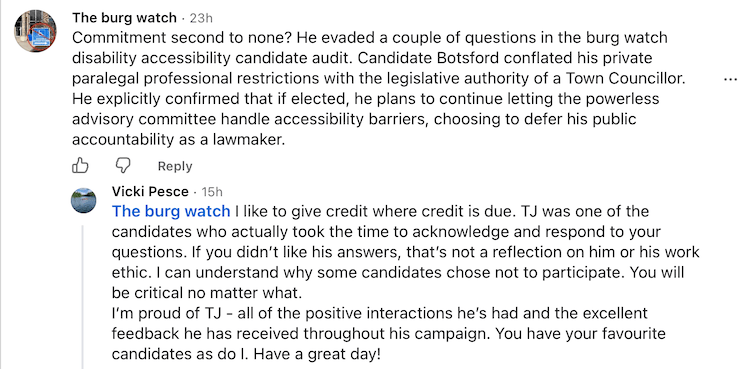
In the comment exchange below, the candidate’s spouse openly defended the 10 non-responsive candidates to the burg watch accessibility audit.

She claimed she “can understand why some candidates chose not to participate,” asserting that I would “be critical no matter what.”

In reality, a candidate’s decision to ignore a structured human rights audit is their own choice.

A campaign family member—who has never met the author of this blog—cannot possibly speak for the inner workings of ten separate independent candidates.

The Independent Leadership Standard

Running for council means you have to be ready to stand on your own two feet.

But when a candidate’s spouse jumps into the comment section to tone-police the community because she cannot handle evidence-based civic scrutiny of his platform, it blurs the lines of accountability.

Taxpayers have a right to wonder how a candidate will maintain clear, independent boundaries at a $65-million council table if their inner circle steps in the moment a difficult policy question is raised.

When The Burg Watch replied to a public comment with an evidence-based human rights analysis of Candidate TJ Botsford’s verbatim accessibility audit response—pointing out how he conflated private paralegal restrictions with a lawmaker’s authority—his spouse immediately doubled down.

Instead of addressing the actual municipal policy, she implied that I should feel honoured that he simply took the time to acknowledge and respond to the audit, arguing that any criticism of his answers was just a personal lack of “liking” his platform.

Copy of exchange between the burg watch and TJ Botsford's wife on his campaign Facebook page.
TJ Botsford’s wife’s comment on his campaign Facebook page

Amherstburg does not need campaigns where family members intercept public questions, or treat human rights audits like participation trophies.

We need elected officials who can stand on their own two feet, answer for their own policy words, and face the public on their own.

When you cast your ballot, look closely at the independent leadership of each candidate and consider how they plan to maintain clear, transparent boundaries at the council table.


Linden Crain School Visit Controversy

In response to an inquiry from the burg watch, Madeline McEachern, Communications Officer for the Greater Essex County District School Board emailed the following:

“We have reviewed the school visit you referenced and determined that established guidelines and procedures were not followed.

The school has been advised that the appropriate protocols were not adhered to, and we requested that the photographs from the visit be removed from social media. We can confirm that the photographs have since been removed.

A reminder will be sent to staff this week reinforcing the Board’s position regarding the distribution of campaign materials in schools during an election period.”