When a politician brings forward a motion on accessibility, it is easy for casual observers to applaud it as a heroic step forward.
Last month, Councillor Molly Allaire told council and the local press that recovering from knee surgery on crutches made her realize “how inaccessible our town is.” While that realization may look like leadership on the surface, it is a textbook example of conditional empathy—only noticing a systemic barrier once it affects you personally.
Allaire sat at the council table for four years while residents delegated and sent emails about these barriers, and she ignored The Burg Watch pre-election accessibility audit entirely.
In response to her motion, council bounced the issue down to the Accessibility Advisory Committee. On November 10 the committee finally met to discuss it, and what unfolded put Town Hall’s administrative stall loop on full display.
What Actually Happened at Yesterday’s Meeting
Staff Already Had the Data: Parks Director Heidi Baillargeon presented a complete inventory of 26 parks and already had an exact quote of $7,018.82 to install automated door openers at Toddy Jones Park. Administration did not need a months-long mission to discover where the barriers are.
Outdated Building Standards: Staff openly admitted that while our 40-year-old park washrooms meet older Ontario Building Codes, they do not fully comply with current accessibility standards or the town’s own Facility Accessibility Design Standards (FADS). Many buildings have narrow doors and lack the interior space for full compliance.
The Porta-Potty Band-Aid: Six parks—Anderdon, Beaudoin, Jack Purdie, Larry Bauer, Malden Centre, and Thrasher—currently rely on portable toilets. Staff admitted that portable units are not permanent solutions, noting that major hubs like Malden Centre and Larry Bauer parks require permanent, compliant buildings.
The committee discussed a potential $50,000 accessibility budget for parkland that may stretch into 2027, along with potential 2027 EAS grants.
More Review: Instead of pushing for immediate funding to install automated doors where possible, the clerk stated, “At this time, it would be appropriate if the committee wanted to that you could add this to the multi-year plan, or recommend that Council add this to their multi-year plan as targeted objective, and you could then drill down, and that will make sure that it’s a standing item that you continue to come back to as money becomes available. It’ll be sort of a highlighted bullet point…when the director is preparing budgets, of course, that’ll be one of the things to consider in terms of are we are we moving ahead those goals?”
Christine Easterbrook asked if she could make a motion then to do that.
The clerk worded the motion, “Just to capture the spirit of it, if I may, and of course you can identify any changes that are required. That the accessibility of washrooms in the town of Amherstburg Park System be reviewed, and identify changes for targeted improvements be brought back for consideration.” Carried.
What Happens Next
Residents with disabilities should not have to wait until 2027 or rely on temporary portable toilets while Town Hall debates whether removable grab bars and automated door openers are “cost-effective.”
The Burg Watch will be tracking the upcoming Malden Park washroom grant proposal when it goes before council, and I will be tracking how our newly elected officials vote when it comes time to fund actual, immediate compliance.
Chris Gibb can’t have it both ways—showcase his family and call his wife his ‘wingman,’ only to tell a curious voter to “leave my family out of it.”
Under standard media rules like the Society of Professional Journalists (SPJ) Code of Ethics, private citizens deserve their privacy. But the rules change when a family member decides to step into the public spotlight.
If a politician’s spouse runs a public blog, gives opinions on town decisions, or acts as a political partner, they aren’t just a private family member anymore. They have joined the political game, and that means facing the same public criticism as anyone else.
Sarah Gibb, the wife of Deputy Mayor and mayoral candidate Chris Gibb, has been blogging for ten years. As the self-proclaimed ‘Amherstburg’s local blogger,’ she analyzes and comments on town council proceedings and agenda items.
In fact, she has long been a visible part of the local political scene; she was prominently featured in a 2015 Windsor Star news photograph alongside other ‘Council watchers’ after challenging town hall’s transparency protocols during closed-door sessions.
The “Wingman” Label
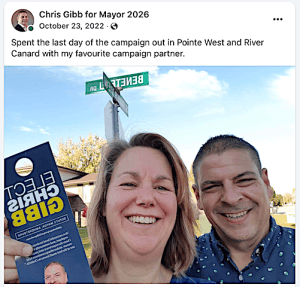
Right before the 2022 municipal election, the then-deputy mayoral candidate explicitly showcased his wife on Facebook as “my favourite campaign partner,” featuring a photo of the couple holding an Elect Chris Gibb door hanger.
October 23, 2022 Facebook ‘my favourite campaign partner’ post.
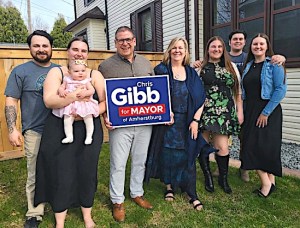
He kicked off his 2026 mayoral run on May 2, 2026, with a family photo on his campaign Facebook page.
Chris Gibb’s family photo and 2026 candidacy for mayor announcement on his Facebook page.
Just two weeks later, on May 16, 2026, he published a campaign video using his marriage timeline to establish his local roots before he even touched on his work credentials. With his wife physically behind the lens, he tells the camera:
“Something stereotypically Amherstburg about me is I met my fantastic wife and current camera person at Shooters in Amherstburg. So that’s that’s pretty Amherstburg right there. We bought our first house in the Monopoly subdivision. Then a few years later, we built a house in the Crown Ridge subdivision where we raised our children.”
By late summer, the double standard became undeniable. On August 20, 2026, The Burg Watch left a comment on Chris Gibb’s campaign page asking a straightforward question:
“I’d like to know how involved your family will be in your campaign and, if elected, your position as mayor.”
Instead of answering, Gibb snapped: “How about we leave my family out of it.” The comment appears to have since been deleted.
Screenshot of Chris Gibb’s August 20 leave my family out of it comment
Yet, that defensive boundary vanished just six days later. On August 26, 2026, Chris Gibb responded to a different Facebook commenter by doubling down on his wife’s public campaign status, casually writing: “LOL that’s my wife. She’s my wingman out there.”
Chris Gibb laughing off his spouse’s public role on August 26, 2026, less than a week after snapping at an independent voter’s inquiry.
To ensure the family messaging stuck with voters heading into the final stretch of the election, Gibb re-posted his identical May 2 family launch photo on October 1, 2026.
He doubled down on this exact narrative just a few days later. On October 8, 2026, during the Amherstburg Chamber of Commerce Candidate Night, Gibb took to the microphone and repeated his family timeline script almost word-for-word to the local business community:
“I’m an Amherstburg guy. I’ve lived my whole life here… I met my wife in Amherstburg, probably in the most Amherstburg way possible. I met her at Shooters on a Friday night. We got married. We’ve raised three children here. They all still live here. We now have another generation—a granddaughter who’s going to be a year old—here in Amherstburg.”
Journalism experts at the Poynter Institute agree that when a politician names a relative as a key partner and features them in campaign media, that relative’s role becomes a matter of public interest. A candidate cannot use their “wingman” to boost their public image on one hand, and then shut down a fair voter’s question about her political involvement on the other.
Selective Access as a Campaign Strategy
This “wingman” label isn’t just for show—it is a clear strategy for how Chris Gibb handles local media. Look at the numbers from the 2022 municipal election. Candidate Chris Gibb answered every single campaign question his wife’s blog sent to the candidates. How many did he answer for The Burg Watch? Zero.
This isn’t about sour grapes; it’s a matter of fact. When a candidate uses their spouse’s platform to push their campaign message while completely shutting out independent local outlets, that blog stops being a private hobby. It becomes a direct arm of the campaign.
Open Air, Belle Vue, and Public Influence
During a past council debate regarding taxpayer spending on the Belle Vue property, Gibb publicly confessed to a major policy flip-flop. He stated he had originally promised never to spend taxpayer money on the site, but explained his change of heart by telling council that his wife had reminded him many times throughout their marriage that stubbornly sticking to your point when things change isn’t the wisest idea.
The couple also heavily promotes Amherstburg’s Open Air Weekends—an event that has deeply divided our town, especially for local businesses trying to survive. Yet, Deputy Mayor Chris Gibb always votes to keep the 14-weekend setup, while Sarah Gibb uses her blog to defend it online.
Coordinated Talking Points and the Use of “We”
The political synergy between the candidate and the blogger is most visible in how they defend Open Air Weekends. When the public raised serious concerns about accessibility, both Gibbs deployed the exact same highly specific family anecdote to public forums.
During a February 22, 2023, council meeting, Deputy Mayor Chris Gibb used his official speaking time to defend the event’s accessibility. He stated that his in-laws live at Richmond Terrace, noting:
“I’ve personally pushed a wheelchair from Richmond, well, one of their each wheelchairs from Richmond Terrace downtown, and I’ll tell you, you cannot believe the relief to be able to get off of our uneven sidewalks… To me, Open Air makes the downtown more accessible for people… in at least in wheelchairs. …So we enjoy bringing them for Open Air because we don’t have to worry about trying to maneuver the wheelchair on a narrow uneven sidewalk so that’s I just want to put my two cents in there.”
Fast forward to September 2026, and Sarah Gibb was on candidate’s campaign Facebook page echoing her husband’s council speech. She commented: “I also have parents and other relatives with mobility issues, ranging from needing a cane, to a walker, to a wheelchair. In our experience, Open Air makes it much easier to navigate the downtown core.”
Look closely at the pronouns chosen by both public figures: his collective “we” in the council chamber and her matching “our” on the campaign trail.
The choice of the word “we” in the council chamber is notable. In municipal governance, an elected official holds an individual seat, an individual vote, and individual accountability. Yet, in defending a controversial town policy on the council floor, the Deputy Mayor used his family’s personal routine—their collective “we”experience—as the primary evidence to validate his political stance.
When a public official relies on a collective family dynamic to justify a policy position at town hall, and his prominent blogger spouse echoes that exact narrative framework using “our” on a campaign page, the boundary naturally blurs. A candidate cannot easily bring their family’s shared experiences to the microphone to score points or defend a vote, and then claim that same dynamic is entirely insulated from voter scrutiny.
The Cost of Rough Politics
During a past town scandal over leaked documents, journalist Anne Jarvis reported in a prominent Windsor Star article that town blogger Sarah Gibb was “calling for more blood on the floor.”
If Sarah Gibb were just a regular resident venting on Facebook, people might ignore it. But she is an influential blogger of ten years married to a man running for the highest official seat in town.
Amherstburg politics affect real local businesses and real families. The Burg Watch believes we shouldn’t treat powerful political partners as untouchable private citizens. If you choose to step onto the playing field, feature yourself on campaign pages, and shout through a megaphone, you have to be ready for people to talk back.
My defamation lawsuit against the town clerk and town of Amherstburg is the result of my disability advocacy four years ago.
In January 2022, I critiqued the draft multi-year accessibility plan council approved in December 2021.
I submitted what I perceived to be deficiencies of the draft plan to council, as I had done for decades.
I conveyed my concerns about the plan, council’s approval of the traditional voting method for 2022 and highlighted some barriers.
I provided input on the town’s accessibility plans since the Ontarians with Disabilities Act (ODA) 2001 required organizations to create them annually.
The ODA’s purpose was to “improve opportunities for persons with disabilities and to provide for their involvement in the identification, removal and prevention of barriers to their full participation in the life of the province.”
The ODA mandated plan contents.
Plans were to include a report on measures taken, measures in place, and the next year’s measures to take to identify, remove and prevent barriers.
The town was also required to assess, review and list its by-laws, policies, programs, practices and services to identify barriers.
I delegated to council and the accessibility committee; I emailed and wrote letters to the editor to help raise awareness of some barriers.
I had already advocated for ten years for an accessible library, but the town remained silent.
Throughout the decade the town pursued funding for other projects like a marina and arena, despite the provincial government’s grant stipulation that accessibility was the number one priority.
Finally, my human rights complaint against the town was settled and an elevator was installed in the library along with accessible parking spaces.
The town installed a plaque in the library lobby crediting others with my accomplishment.
I reiterated some of the barriers that were either not included in the plans or were not removed when they could have been.
For example, an accessible town website was relegated to year 3 of the town’s first accessibility plan, then listed as a priority for 2005, and then 2006.
A 2007 report informed council that the website was compliant with W3C accessibility standards but it wasn’t, according to an external expert.
In 2009, a newly designed website was unveiled and problems continued.
In 2011, I mentioned difficulty navigating the website.
In 2014, Amherstburg was invited to hire esolutions when Essex County redesigned its site to meet accessibility standards; Leamington and Essex had already hired the company, but Amherstburg declined.
According to the town’s site, esolutions redesigned Amherstburg’s site in 2016, although it still had issues.
Thousands of dollars and redesigns later, in 2020 administration recommended, and council agreed, to request the province to extend the AODA January 1, 2021 website compliance deadline to at least January 1, 2022 due to COVID-19.
Following the January 1, 2022 deadline extension request, the province agreed the town’s work should be completed prior to December 31, 2024.
The new website redesign and refresh was not to exceed $70,000, excluding HST.
The AODA 2005 now requires organizations to review their multi-year plans every five years but report annually on barrier removal progress.
Although the town’s plan review is due by December 2026, the town posted a 2026 Multi-Year Accessibility survey on January 26, 2026.
The survey introduction states, “The Town’s Multi-Year Accessibility Plan outlines the outcomes and initiatives that reaffirm the Town’s commitment to an accessible community and to building an equitable and inclusive society that values the contributions of people with disabilities.”
I do not feel like my contributions have been valued – my decades of input parallel decades of barriers.
Despite my repetitive requests for a strong commitment to accessibility, the town failed to meet the 2025 AODA compliance deadline.
In fact, Mayor Prue even declared, ‘this town has not been compliant.’
In 2011, right after the 2010 election, I became Amherstburg’s first local blogger. Having a record to review to make more informed decisions about future candidates was my goal.
I was also the first one to facilitate questions to the candidates, for which I endured threat of legal action and harassment.
Some candidates ignored me while others were happy to answer. Even though I allowed for generous deadlines, one claimed she couldn’t meet it. Funny how she posted about 45 tweets in the same time frame; I discovered just how nasty some people are.
Another candidate was nasty when I shared my observations of what appeared to be a slate. (I’m sure there will be more commonalities among candidates in 2026. The facts are not my opinion).
As a person with disabilities, and an advocate, I let candidates know about their inaccessible campaigns. Anyone excluding a marginalized community, while hypocritically campaigning to represent everyone, wouldn’t get my vote. Attitudinal barriers are obvious.
In 2014, the three candidates who created websites had accessibility issues. In 2022 more candidates used social media yet didn’t provide accessible information, even after I pointed it out to them and after they received information about conducting accessible campaigns. Lori Wightman’s website had accessibility issues in 2018 and 2022.
Noteworthy about the 2022-2026 council:
the more restrictive procedural by-law limiting citizen participation; delegates can only speak to an issue that’s listed on the agenda and if it’s accompanied by an admin report or a by-law.
Councillor Crain and Deputy Mayor Gibb voted a couple of times against audience members speaking to council.
the amount of time some council members spend on self promotion while ignoring emails from residents.
failing to meet the January 1, 2025 AODA deadline.
no decision on an inaccessible town hall.
claims of inaccessibility at the library without accountability for statements (Councillors McArthur and Allaire).
pickleball – almost $500,000.00 June 2023: ‘The motion has passed now the thorny issue of how do we pay for it?’ said Mayor Prue. (yes, money is found for some things).
a future fire hall being slowly built
Unchanged Common Themes:
lack of decorum (I blame a lack of leadership for allowing the incivility)
council 4-3 divisions
excessive kudos to staff
staff participation in council meetings
demands for FOI requests
a high number of in-camera meetings
lack of public consultation
preferential treatment (some items get moved quickly)
over expenditures
police costs
ableism
lack of commitment to accessibility – a decades old issue.
Thank you to those who continue to follow, stay connected and share my vision of a more inclusive community.
It’s been four years since I requested council create a protocol for requests for information and former CAO Miceli advised that the Town of Amherstburg was in the process of creating a Routine Disclosure and Active Dissemination Policy.
In April 2021, I repeated my request and former clerk Paula Parker advised a draft policy was in progress.
January 2022, I asked interim CAO Tony Haddad about the status of the Routine Disclosure and Active Dissemination Policy that former CAO Miceli advised the town was in the process of creating in February 2020. I received no answer.
July 2022 I reminded Critchley and council that council has disregarded my repeated requests for a Routine Disclosure policy,
In April 2022, I reminded council that it was over two years.
In January 2023, I requested that status of the routine disclosure policy and in February CAO Critchley advised the town continues to investigate a number of policies but has not adopted a specific policy.
In June, 2023, council carried Councillor Pouget’s motion to direct administration to bring back a report regarding the policy following Nancy Atkinson’s delegation on behalf of the Amherstburg Residents Forum.
December 2023, I emailed council requesting the status of, and report on, the routine disclosure policy and Critchley advised they continue to work on the Routine Disclosure issue and expect it will move forward in the new year.
Another farcical item for council’s January 29 meeting is a recommendation for council to support AMCTO’s submission regarding MFIPPA, which includes a recommendation to require municipalities to adopt a Routine Disclosure and Active Dissemination Policy (RD/AD).
During the June 2023 meeting discussion of an RD/AD policy, Councillor Pouget stated the AMCTO, the association of municipal clerks and treasurers of Ontario, do give guidelines for this policy and asked, has that been taken advantage of? Do you know if you’ve tapped into that resource?
CAO Critchley responded, as I said earlier, if this is something that council wants us to do, then we will look into it if that’s what Council directs.
Pouget then made a motion and council passed a resolution directing administration ‘to bring back a report regarding a Routine Disclosure Policy’ and the Unfinished Business list stated a report was coming to council in Q3. No policy exists.
It’s been almost four years since I requested council create a protocol for requests for information and on a few occasions I was advised that a policy was in the process of being created.
A Brief History
2020: former CAO Miceli advised, the town is in the process of creating a Routine Disclosure and Active Dissemination Policy and respecting the MFIPPA process is best for all parties.
2021: former Clerk Parker stated, the Town does have a draft of the policy in progress.
2021: I asked if council directed administration to create this policy.
2021: Former Mayor DiCarlo advised, this policy is being created as part of ongoing policy review of all of the town’s policies, not from a specific council direction.
2021: I asked then-Councillor Prue if he would know the status of the policy; he did not answer the question.
2022: I emailed Interim CAO Haddad to inquire about the status of the policy; no answer.
February 7, 2023 CAO Critchley advised the town has not adopted a specific policy.
June 13, 2023 Nancy Atkinson, on behalf of the Amherstburg Residents Forum, raised three items including the Routine Disclosure Policy.
June 13, 2023 Councillor Diane Pouget’s motion to direct administration to bring back a report regarding the disclosure policy was carried.
December 1, 2023 I emailed council again requesting the status of, and report on, the routine disclosure policy.
December 13, 2023 follow up email requesting the status of, and report on, the routine disclosure policy.
December 18, 2023 CAO Critchley advised, we continue to work on the Routine Disclosure issue and expect it will move forward in the new year.
While the Amherstburg Accessibility Advisory Committee spent about half of the meeting discussing the proposed new LCBO, it took about two minutes for the clerk to provide a background and for the committee chair to note it looks amazing and should be standard.
The clerk advised that for a second time the Town of Amherstburg received funding through the Enabling Accessibility Fund – Youth Innovation Component and they may have to recognize the individual’s support for the community and for being such a forward thinking youth to continue to drive forward the town and its initiatives.
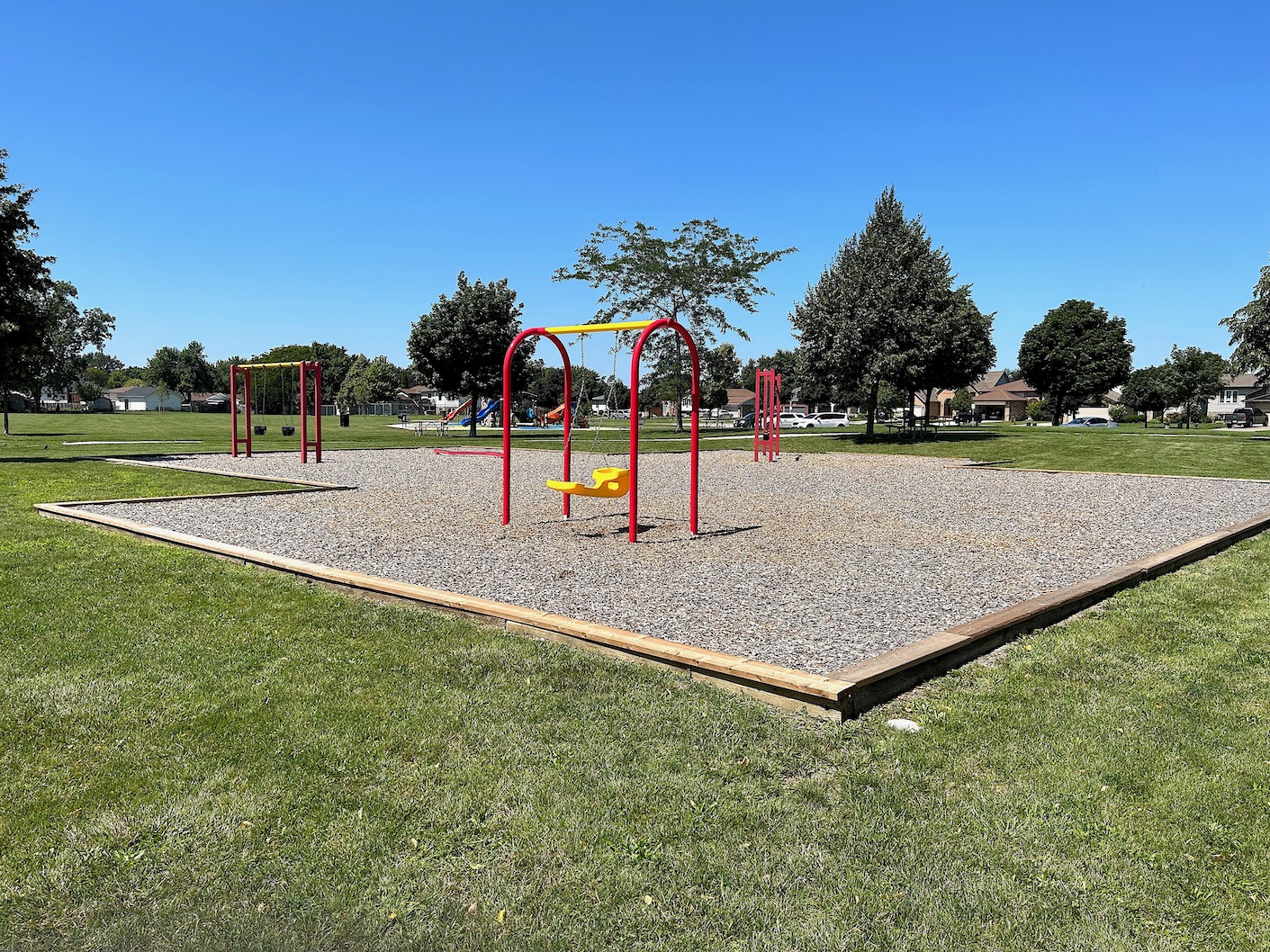
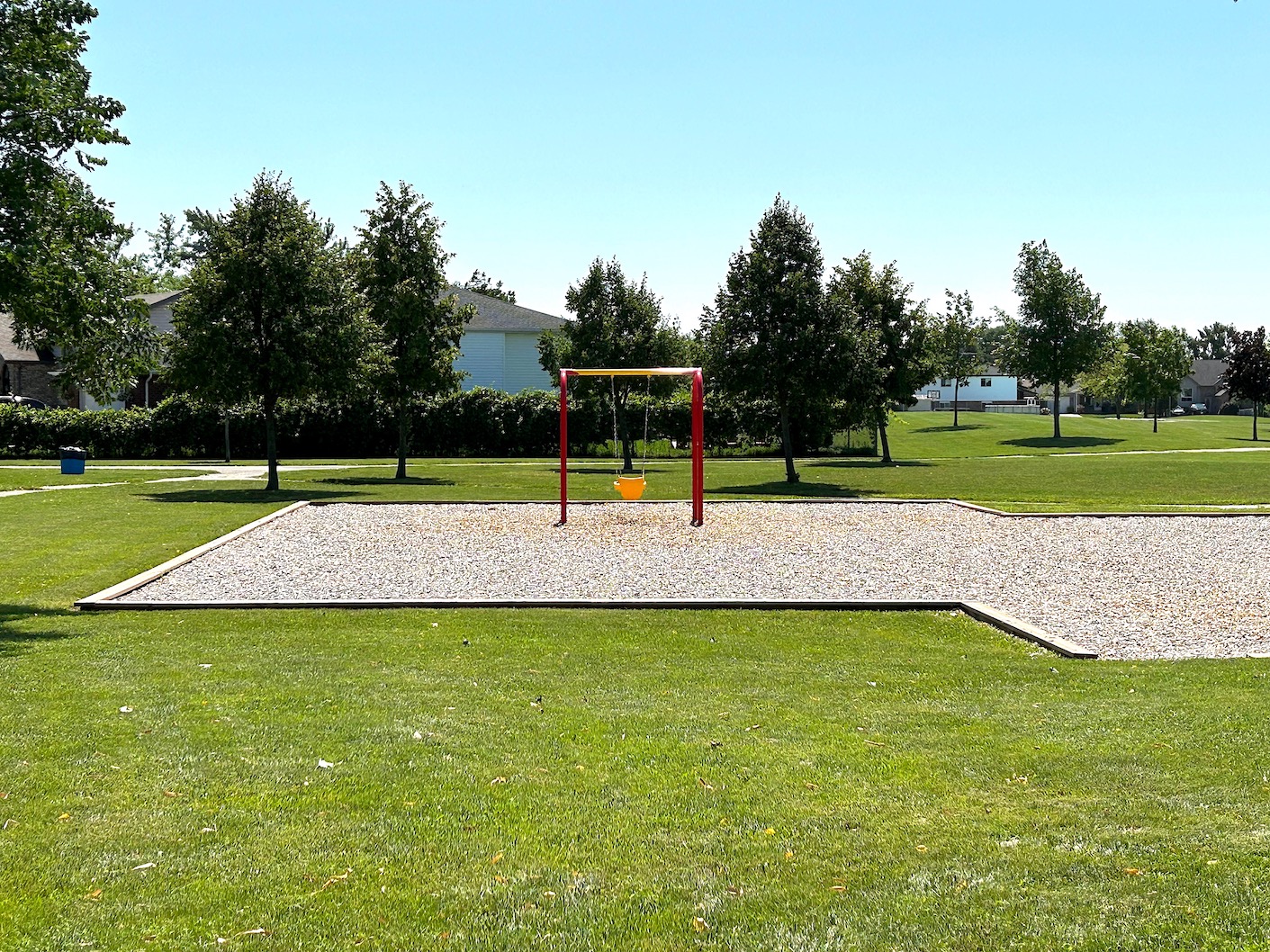
The agenda attachment notes, ‘We are excited to announce the ‘swing along’ installation in Jack Purdie Park, which is already getting lots of use! This multigenerational swing allows children ages 5 and under to sit face-to-face with and in close proximity to a sibling, parent or caregiver. This configuration promotes social, emotional, visual, vestibular, proprioceptive and language skill development and is a great way to teach little ones how to swing.’
My critique? The swing limits use to under age 5. Stats Canada states in 2021 there were 745 children age 0 to 4; so what about the 1670 children ages 5 to 14 who want to swing? The swing is segregated; I question how that promotes social skill development. There is no sidewalk leading up to it. The surface is soft and uneven. There is no shade. And, as mentioned in this post,
‘When adapted or specialized equipment is made available, it is often limited in quantity and engaged with alone, thereby highlighting the functional limitations of that child and further segregating them from their peers.’
canadian public health association accessibility and usability of play spaces march 2019
How accessible is a hotel that provides no accessible parking and stairs?
Last fall I askedwhat accessibility guidelines the town provides to developers? who ensures accessibility is included in the site plan review?
Deputy CAO Osborne wrote, in part, that Administration reviews site plans and drawings for compliance with legislative requirements.
While I awaited administration’s answer, I emailed Architectural Design Associates (ADA) about the proposed hotel: one of the pictures depicts stairs at the rear entrance to the building. how accessible will the stairs be? also, how many accessible units are proposed?
I followed up with ADA but still received no response.
Following the mandatory April 11, 2023 4:30 pm meeting, I have more questions about public safety and accessibility:
How will council be satisfied that undue traffic hazards would not arise?
Did Windsor Police Service provide a ‘fulsome’ report?
Was public safety regarding the rental of electric scooters considered?
Were municipalities like Toronto and Paris that banned electric scooters compared?
Were statistics regarding the number of injuries and deaths from electric scooters considered?
How will bike rentals be accessible if they are located downstairs?
How will people using mobility devices access the restaurant at the back of the building if stairs pose a barrier?
How would a person using a mobility device exit through the back stairs in an emergency?
How is the restaurant accessible if people with hidden disabilities have to travel to the front building entrance?
How will ‘fully accessible’ be interpreted, by whom and by what standards?
If the hotel has two accessible rooms, where will people with disabilities park?
Has walking distance from available parking for persons with various types of disabilities been considered?
If streets are not closed, and a person with a disability is dropped off in front of the hotel, will curb cuts be installed to enable access by persons with disabilities who use wheeled assistive devices?
Does the magnitude of the development warrant the provision of parking spaces for persons with disabilities?
Has public health and safety concerns, as mentioned in the Provincial Policy Statement, been addressed?
Has ‘improving accessibility for persons with disabilities and older persons by addressing land use barriers which restrict their full participation in society’ as mentioned in the Provincial Policy Statement been considered?
As mentioned in the Official Plan, in reviewing development applications, has serious consideration been given to the creation of a barrier free environment?
Also as mentioned in the Official Plan, has the town encouraged developers to provide barrier free developments?
Do Zoning By-law parking requirements for 1.25 spaces per unit of a hotel conflict with the Official Plan?
It’s been three years since I requested council create a protocol for requests for information; a good indication of open government.
In February 2020, then-CAO Miceli advised, that the Town of Amherstburg was in the process of creating a Routine Disclosure and Active Dissemination Policy and that I might wish to review the policy when it appears on the agenda for Council’s consideration and approval in the near future.
Current CAO Critchley now advises: the Town continues to investigate a number of policies and their associated role within the organization but at this time the Town of Amherstburg has not adopted a specific policy to govern the many ways in which the Town actively disseminates and routine discloses information to the public.