Social media has become the new town hall. Political candidates share their ideas, debate town issues, and—most importantly—answer questions from the people they want to represent.
But my recent experience with council candidate Lena Lazanja points to a bigger problem: candidates using social media settings to filter who gets to hold them accountable.
The May Question
This situation started back in May, when I first engaged with Ms. Lazanja to ask a question about removing barriers for Amherstburg’s Open Air weekends. In her email response she explicitly stated:
“I hope this answers your question. Also, I would be willing to continue to participate in your blog postings by answering any questions you might have throughout the campaign months ahead.”
The July Block
On July 14, I participated in a discussion on her campaign page, replying to a comment left by Arms Bumanlag. Shortly after posting, the burg watch was completely blocked, and my comment was deleted.
To ensure I had my facts straight, I verified the block by checking the page from a personal account and having another local user confirm the deletion. I immediately sent Ms. Lazanja an email on July 14 to establish the facts:
“This will confirm that earlier today, July 14, 2026, I commented on the Lena Lazanja for Amherstburg Council campaign facebook page in response to Arms Bumanlag’s comment. Shortly thereafter, I was unable to access the above page as the burg watch. I visited the page using my personal facebook page and observed my comment was deleted. While still on the campaign page, I switched back to the burg watch and a notification appeared, stating the content was no longer available. Another Facebook user verified that my comment was deleted. I believe I have verified that, as the burg watch, I was blocked from accessing the campaign page of Lena Lazanja.”
Three days later, on July 17, she finally responded. Rather than deny the block, she pointed to a rule she set for herself, stating that she pinned a post explaining she blocks pages designated as “Political Organizations” because she is not affiliated with them.
“As I stated to the public in my last post on this matter, which is pinned at the top of my campaign page, I have blocked social media pages designated as ‘Political Organizations’, as I am not affiliated with any political organizations as an Amherstburg Councillor candidate.”
On paper, that might sound like a candidate trying to stay independent. But in practice, it’s just splitting hairs. A page label doesn’t change the fact that a real local resident is behind the account asking genuine questions about our town.
The September Contradiction
Fast forward to September 24. It turns out that Ms. Lazanja’s rule about avoiding “Political Organizations” only applies to some pages, but not others.
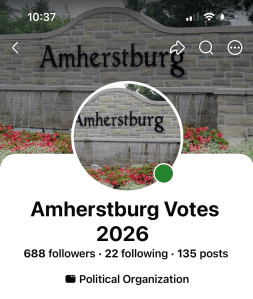
She has commented and engaged on Amherstburg Votes 2026. Up until last week, that page was publicly and clearly categorized as a “Political Organization”—the exact type of page Ms. Lazanja claimed she absolutely could not be affiliated with.
What makes this even more troubling is the issue of anonymity. While the burg watch is run openly by me, a local community member, Amherstburg Votes 2026 is completely anonymous. The public has no idea who is actually running it, yet Ms. Lazanja has chosen to legitimize that platform with her engagement while locking out a transparent community watchdog.
Seeing the clear double standard, I emailed her on September 24 asking a simple question:
“You stated to the public in your pinned post at your campaign page that you have blocked social media pages designated as ‘Political Organizations’, as you are not affiliated with any political organizations as an Amherstburg Councillor candidate. However, you’ve answered on the anonymous Amherstburg Votes 2026 which is clearly publicly categorized as a political organization. Would you explain the inconsistency?”
While I received no reply to my email, the anonymous page itself suddenly reacted. On Monday, September 28, just days after my private inquiry to the candidate, Amherstburg Votes 2026 quietly altered its description. It now claims it is “not a political organization, not a club, not a group – just an information hub for Amherstburg politics.”
Fortunately, the burg watch has a screenshot of the original “Political Organization” designation from right before the email was sent. The sudden rebranding of an anonymous page directly following a private inquiry to a candidate raises serious questions about who is coordinating behind the scenes.
Screenshot 1: The “Political Organization” Proof
Why This Matters to Voters
When a candidate uses a public social media page to run a campaign, that page becomes a public forum. Using technicalities to block an open, local watchdog page while actively participating on a completely anonymous political page isn’t about maintaining independence. It looks a lot more like selective engagement.
Amherstburg residents deserve transparency that cuts through semantic loopholes. If a candidate claims a policy applies to everyone, it should apply to everyone.

