Politicians can now be fired for serious misconduct

A unanimous vote by council could result in the firing of a politician if an integrity commissioner finds serious misconduct occurred.

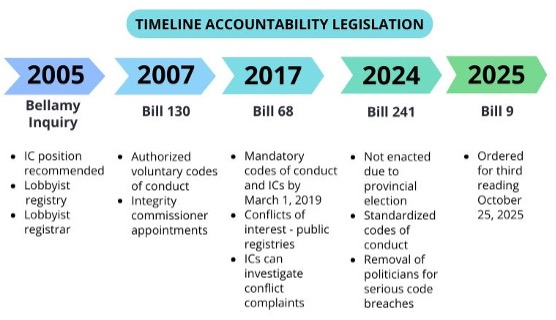
Bill 9, the Municipal Accountability Act, passed 110 to 1 on May 26, 2026.

Bill 68 amended the Municipal Act 2001 in 2017 to mandate municipalities create codes of conduct by March 1, 2019 and hire integrity commissioners.

The legislation prescribed codes were to include rules about gifts, respectful conduct, confidential information and use of municipal property.

Councils were to decide the remaining content of the code of conduct.

The Ministry of Municipal Affairs introduced Bill 9, Municipal Accountability Act, 2025 in May 2025.

The Standing Committee on Heritage, Infrastructure and Cultural Policy held public hearings to obtain feedback on Bill 9 in July 2025.

The bill, ordered for Third Reading on October 25, 2025, was expected to become law prior to the October 26, 2026 municipal election.

Now that it passed final reading, it needs Royal Assent to become law.

The new bill proposes standardized codes of conduct, training, and integrity commissioner processes.

An integrity commissioner may make a recommendation to the Integrity Commissioner of Ontario that a politician’s seat be declared vacant if the commissioner concludes all of the following criteria are met:

  1. The member has contravened the code of conduct. 
  2. The contravention is of a serious nature.
  3. The member’s conduct that is the subject of the inquiry has resulted in harm to the health, safety or well-being of any person.
  4. The penalties set out I subsection 160 (5) are insufficient to address the contravention or to ensure that the contravention is not repeated.

The commissioner may consider, among other matters, whether the contravention is a repeated contravention.

A new function of the Integrity Commissioner of Ontario will be to advise municipalities, on request, about the independence of a person being considered for appointment as a Commissioner, including whether the person has a conflict of interest.

Twenty one years ago, the Honourable Madam Justice Denise E. Bellamy’s Report 2005 recommended the City of Toronto hire a full time integrity commissioner.

The Bellamy inquiry followed allegations of conflict of interest, bribery and misappropriation of funds around computer leasing contracts at the City of Toronto in 1998.

RECAP Council Meeting May 11, 2026

I knew they couldn’t do it. They couldn’t get through the meeting without personal anecdotes, posturing, and not so subtle campaign plugs: I coached baseball (Courtney), when I first got elected, I advocated for baseball (Courtney), I heard when I was knocking on doors last election (Crain), and I played ball as a kid (McArthur). Campaign points deducted for Prue’s mansplaining to Pouget and Allaire’s offhand comments about Kingsbridge traffic – just distracted, there’s accidents everywhere. The hot topic was the concerted effort to avoid public disclosure of the number of lawsuits pending against the town and the associated legal fees.

These are council meetings to discuss council business, but they appear to be meetings between council and admin, who are welcome to participate. Admin whispers into the mayor’s ear and he announces they have something to say.

The perception in the community is that admin directs council – not the other way around.

Shawn Wilkie certainly gave the impression that admin deserves to be recognized, even before members of council. Delegates are there to address council, but Wilkie, a Royal Canadian Legion Fort Malden Branch 157 delegate, greeted, “honourable mayor, deputy mayor, CAO, town of Amherstburg administration and esteemed councillors for the residents of Amherstburg.” (Only serving MPPs are honourable).

Admin are not elected officials – they can’t ask delegates questions, they can’t grant or deny a delegate’s request. Civil servants serve the public by implementing council’s decisions.

Wilkie requested perpetuity for the annual Legion Week parade event permit requirement and all fees associated with the annual event.

Councillor Pouget did not ask if waiving the fees in perpetuity meant forever, as was erroneously written elsewhere.

VERBATIM TRANSCRIPT:

Councillor Pouget: just one question – the Legion is requesting it to be waived in perpetuity, forever; is that correct?

Prue: I believe that’s what’s been requested, yes.

Pouget: okay, thank you.

Prue waited almost five seconds and then mansplained: What that means is it never has to come back again. It doesn’t mean that council, 30 years from now might say, no, we don’t want to do this anymore. That’s still within that realm of possibility, but up until then, it just keeps going. Okay, all right.

Listen to the audio.

I don’t recall Prue doing this to his male colleagues. Same for when he tells Pouget, “I don’t know if that was a question or simply a statement.”

Borrowing By-law and Delegation of Authority By-law

Prue invited Deputy CAO Melissa Osborne to make a presentation that might’ve been meant to reassure everyone that all is well with town finances. Confusion followed.

Councillor Crain was the first to raise his hand. Of course he offered kudos to “Deputy CAO Melissa: very helpful report, very positive report. I think online, we see a lot of misinformation. I have lately a lot of AI driven, and it’s very helpful to see the stats on screen. I think this council, past councils, have been making great strides,” said Crain.

There will always be misinformation; I’ve seen it from admin too. For example, when the town erroneously advertised for appointments to the accessibility committee, which I repeatedly pointed out to admin and council, including Crain; he never responded.

Artificial Turf Fields, Premier Baseball Diamond issue. As he usually does, Prue asks if there are any questions of staff before members of council debate the issue. (I’ve watched other municipal council meetings and they are so much more efficient and professional).

  • Councillor Crain questions the impact of not approving the project on baseball Canada standards and public use.
  • Admin (didn’t say his name) confirms the field would still be usable for general play but not for hosting tournaments or official leagues. The field is used by the University of Windsor, Windsor Select, North Star High School, and local minor baseball teams.

Crain said I’m not sure I can make a decision, which seems inconsistent given that Crain, along with the majority of council, approved almost $500,000.00 for pickleball. In fact, council waived rules of order to hear the plea for pickleball in June 2023 when it wasn’t on the radar. Prue even asked the audience what their preferred location was. And then, “the motion has passed; now the thorny issue of how do we pay for it?” said Prue.

Almost a half hour later, after all the ‘what if’ questions, the motion to approve staff recommendation carried.

Kingsbridge Traffic Calming Review

Prue once again asks if there are any questions of staff before members of council debate the issue.

Councillor Allaire said she had a follow up, although there was no initial question.

“It was an old report, so we didn’t have new numbers. We did look at the numbers and asked how many new accidents have happened near and around this intersection? And it was quite high. We have received nine since like 2025 however, I want to back that up with eight of the nine were people just either distracted driving or just hitting cars, parked cars, one backed into a boat; I mean a parked boat, I might add. So I think when you look at things as a whole and as an intersection, it didn’t meet any of these policy standards. …great now that we have a policy, we can see where we should increase the speed and decrease it. So now that we have a baseline, this is great to see, but there’s accidents everywhere, and people are distracted everywhere. So I think enforcement is a huge thing that we could step up on and hopefully work on. But I’m going to move the staff recommendation,” said Allaire.

Just distracted driving. Just hitting cars.” Sounds dismissive.

A pedestrian was hit; several people were taken to hospital.

According to data from Transport Canada’s National Collision Database, distracted driving contributed to an estimated 22.5% of fatal collisions and 25.5% of serious injury collisions in 2021. These statistics are part of an upward trend of distracted driving-related collisions, up from 21.3% of fatal collisions and 23.8% of serious injury collisions a decade earlier(2011).

There’s accidents everywhere. People are distracted everywhere.

Exactly. Reason enough to take action. Distracted driving is a leading cause of traffic collisions in Ontario, with one person injured in a related collision every 30 minutes. In 2022, 105 deaths were recorded in the province due to distracted driving, and about 25% of all fatal collisions in Canada involve distracted drivers.

But Allaire moved admin’s recommendation to receive the report from the Director of Infrastructure Services regarding the 2025 Kingsbridge Traffic Calming Review.

Of course, Crain offered kudos to staff. “Appreciate staff sharing the report. We definitely face traffic issues across town, not just in Kingsbridge. And I understand that the based on the study Kingsbridge Drive, McClellan, Lavers, Whalen did not meet the 35 point threshold. However, what I am hearing from residents, and I know there’s no recommendations to come out of this inside of Kingsbridge, but what I’ve heard when I was knocking on doors last election, I’m hearing it now is a three way stop at Texas, and I believe it’s not maybe Knobb Hill if I’m not mistaken; that intersection is, is there, is it possible on the south end for a three way stop to be there? Is it warranted?”

Admin’s answer was that three or four way stops fall under provincial regulations and a different warrant system, but it’s council’s prerogative.

Crain asked about a third exit out of Kingsbridge and admin said they’ve looked at that a few times with previous councils. It is a very costly endeavor. I don’t recall the number, but it was in the millions of dollars. And those traffic studies did not warrant a third exit. And so when that was presented to previous councils, it was determined that we would not move forward with that expenditure. Once again, council’s prerogative to take a look at it again, but I know that in my time here, we’ve looked at it at least twice, and just the cost and the warrants that didn’t dictate that we required it. Councils decided not to go forward with it.

Pouget responded. I believe one of the objections, or when we did try to get another exit from Kingsbridge was an objection from the Canada Railway Company, because they said it was either we were going to have to have them cross over to exit out of the second concession, or when we are trying to have another exit off Texas. I believe the railway interfered with that also, so I think that was why we couldn’t get the second exit on that. My other concern is that Amherstburg Police is well aware of all the problems within this community and the speeding and the distracted driving, there is nothing here that stops us from requesting them to do more surveillance in those areas, to try and get people to be more knowledgeable about how they should be driving and more aware of the safety factors in that community.

“I don’t know if that was a question or simply a statement,” said Prue. (It would be so refreshing, and fair, if he would do that to McArthur, Gibb and Courtney).

Pouget asked if a letter could be sent to Amherstburg Police, asking them to be more aware of the situation and to periodically send out more patrol cars. Appropriate action taken, as opposed to the usual ‘support the recommendation of administration.’ Motion amended and carried.

Unfinished Business

Pouget wondered when the illegal driveway on Dalhousie Street was going to come before council. She said they dealt with that in planning, it’s got to be a couple months ago,

Osborne very concisely said, it’s coming back on May 25.

Pouget then asked about the 208 St. Arnaud Street issue (the warehouse turned arena).

Osborne very briefly said, as per the question at the last meeting, we advised Council in an email of what the status update is and that an application is to be received from the property owner for a minor variance.

(Council received an email, but the public is not privy to it).

Pouget asked but when will that be held? Because committee of adjustment just had their meeting.

Osborne said administration has to review the application to make sure it’s a complete application, and then they will schedule it for the meeting. Once they do, the proper notices will go out.

Allaire said she “received like three or four emails this past week with regards to the closing of Murray Street. Is there an update coming back on that anytime soon?”

Osborne’s answer was a little bit more forthcoming than her answer to Pouget:

“No, there is not. This matter came up at the Economic Development Committee meeting as well, and what we clarified is with the new unexpected project associated with closing Richmond, that’s going to be a substantial one. We’re focusing first on the businesses associated with that required closure. It will also help to inform how we approach the businesses on Murray at some point in the future when we have that discussion,” said Osborne.

Prue asked if there were any notices of motion but then realized he skipped new business.

New Business

Crain mentioned an email to all Council and staff but wanted to ask publicly for feedback. With regards to incentives for ADUs, permit fee rebates, development charge exemptions, reductions, forgivable loan programs, community improvement incentives and streamlined approvals for compliant units; have they considered any incentives for ADUs?

Osborne answered; again, a little more forthcoming than her very brief answers to Pouget:

“So if Council will recall, there was housing accelerator funding which had come to council in that particular incentive program, those funds were allotted to municipalities that were willing to make adjustments in their zoning by laws unilaterally to allow for buildings as of right and other provisions. So this council in advance of the official plan amendment that was going to happen, as well as the zoning elected to allow those to happen, rather than making a decision on those matters at that meeting in order to apply for those funding sources. So we’ve not put forward any new incentive programs. And the email you’re referring to, the municipalities that they’re talking about did make those changes in their communities. They’re not funded directly only from the municipality. They’re part of the housing accelerator funding.”

So, no.

Courtney gave a speech about supporting Amherstburg Minor Baseball Association and said he had a question, but he continued his speech. Then he said he had a question, continued speaking and finally asked, what does staff need to let them know, to put this back on the radar? And, more speech.

(Prue didn’t announce it was a statement like he did for Pouget).

Osborne answered: the current capital budget does have identified in future years funding under the parks master plan so that council can determine which next set of amenities as approved in the parks master plan should move forward. It is a place holder values, so I would suggest that there is opportunity in the next capital budget cycle for those directions to be provided.

Courtney asked for help in wording a motion, which Osborne supplied: if I may assist in that – that council direct administration to identify for the 2027-28 year capital budget, funding currently in the parks master plan, placeholder values which would address washroom and canteen facility at that park.

Pouget read a prepared motion: to direct administration to provide council with a full report at our next public council meeting, the status of a motion that was passed unanimously in May of 2016 for the town of Amherstburg to fund and erect a plaque in front of the former Senator Eugene Whelan and his wife Mrs. Elizabeth Whelan’s home on Front Road North for their role in hosting the former Soviet Ambassador Alexander Yakovlev and Mikhail Gorbachev while visiting our historic town, marking the location of the historic, historically known as ‘the walk that changed the world.’

Pouget mentioned this motion was passed in May of 2016 and it was unanimous. And somehow or other, this motion got lost. It was never reconsidered, and I’m asking for a full report to come back to council regarding the status of this motion, I do have all the documentation that was presented at that time, all the newspaper reports, the actual pictures of them with Senator Whelan, and what brought it to light is that Kirk Walstedt, who used to work for Senator Whelan and is Deputy Mayor of Lakeshore, asked county council to provide that information. I went back and received it all, contacted the Whelen family, and also Paul Hertel’s wife for her permission to forward it, because he did all the research, and I’m prepared to present it so that you, the clerk, may look it up and see why we haven’t acted on that thing from 10 years. It’s only been 10 years and it was passed; it was unanimous.

Also see: In 1983, Gorbachev took a stroll in small-town Ontario that helped shape the future of the Soviet Union – TVO.

Admin said they could bring back that information and mentioned there was a plaque installed in the Navy Yard Park.

Pouget said they only recognized Senator Whelan that day with a rock, and the rock remains in the park. But this was to be put up at the beginning of the driveway of his house, because he actually took the two Soviet Union leaders at a time that there were a lot of problems in that area, and that’s when they claimed that it was the ‘walk that changed the world.’ I think that’s really, really important, that we acknowledge that historical function in the town of Amherstburg.

Prue said it was a fairly simple request, just bring back something that’s 10 years old and find out what happened to it. Motion carried.

And then the mood changed.

Pouget said she had a motion to direct administration to provide council with a complete report of any pending lawsuits against the town of Amherstburg, the estimated cost to date to defend our town and how we will pay for these possible expenses.

Allaire seconded the motion.

Alarms sounded, security doors closed, and window bars were activated. No, not really, but that’s how the scene played out.

Pouget explained in the past few weeks, she’s been getting the same question over and over again – how many lawsuits do we have? And they are specifically referring to the lawsuit that is being brought before us in the Superior Court Toronto on May 15, filed October 2025. It currently says the town of Amherstburg is unrepresented, and I think it’s very unfair that the public knows about this, and yet I as a councillor, have to say I know nothing about it, and that’s why I’m asking for this report to come back to council. I think we are entitled to know when we have major lawsuits against us.

(Of course council is entitled to know; so is the public).

Prue’s dissuasion seemed obvious.

“I mean, I don’t know whether this, we live in the litigious society, and I’m not sure whether the staff can report on every person or group of persons who wants to sue us. Very often, they just end up being there for years, and there’s nothing to them, and they’re not defended, and they’re eventually thrown out…but I’ll let staff answer this question. I think Mr. Clerk has something to say, and I think Madam Deputy CEO also has something to say on this,” said Prue.

Clerk: “I have heard from a resident about, you know, claims that exist, that they say are before the courts, for which the town has no notice and no record previously, when we received that months ago, you know, we investigated that. We sent somebody down to the courts. We looked into it. There was no validity to the claims. So certainly, you know, happy to look into this again and pursue it, but sometimes, you know, there’s some mistakes that are made in terms of what people believe might be before the courts. We are required by law to receive formal notice that does come to me as the clerk. So if something were to be filed with the courts, they would have to duly serve notice and prove that they had served that notice upon me. So if that notice hasn’t been provided, then you know they wouldn’t have met the requirements in law.”

Pouget said she had the case in front of her and will send it to him, and it says it was filed the 29th day of October, 2025; the file is active. And it it goes on to say, well, who the parties are and it says the town of Amherstburg is currently not being represented at this time, and it’s before the courts on the 15th in Toronto, Superior Court.

Prue asked, is it just the one case?

Pouget said she only had the one case be in front of her.

Prue: “Well, I mean, the motion is asking for a staff report on all the cases, so it’s just one case. I think the clerk can clear it up whether we’ve actually been served, and sometimes in these court cases, if it’s a damage claim, they will sue everything from the King down to the school board and everybody in between, you know. And if that’s what it is, I don’t know. I just don’t know what this one is. But is it all right just for the clerk to answer your question?”

Pouget thought it should come back to the public, to council; “if it’s a public document and we have to pay fees for representation, I think public business is public business”, said Pouget.

Prue: “okay, but we wouldn’t pay a fee. I’m just trying to understand this. We would not pay a fee if we have not been served. So first of all, I need to find out from the clerk whether we’ve been served, and if we’ve been served, who our solicitor is and how much it’s going to cost. That would have to come back in camera as well.”

(Pouget asked for a report, so admin would’ve obtained all the information requested. In-camera would maintain confidentially; however, public disclosure of the number of lawsuits and associated legal fees would be allowed and would be transparent).

Pouget said no.

Prue asked, should that be the report?

Pouget said no.

Prue said, “I’m not trying to stop it. I’m just trying to tell you. But you have to finesse it a little bit. You ask the clerk to find out. You look at it if we have, if we have been served, he will, he will tell you. And so, and then, and then, then we’ll have to determine if we’re hiring a solicitor to defend us, and then Council will be informed in camera of the cost and the likelihood of success, as we do other in camera.”

Clerk: rather than the motion that’s before us tonight, you know, happy to provide a confidential email to council on the status of the particular one that is of concern. The motion before us is rather vast and would take a lot of time to gather all the potential lawsuits. As you know, anybody can sue anybody for anything. It doesn’t mean it has merit. And I think probably in this case, you have a more pointed answer, happy to provide those details to council.

(If anyone is to determine if a motion is appropriate, it’s the chair, in this case Prue – it’ s not admin’s role. If a duly moved and seconded motion is vast, then it is what it is and it gets voted on).

Prue asked, is that sufficient?

“I guess it has to be,” said Pouget.

“Well, it doesn’t have to be. I mean, if you and the seconder wanted to proceed to a vote, it can; you risk it not being passed, but, but you also risk, but you also have the potential of Council, all of Council, wanting this, or you can just get the information you want with no risk at all. So it’s your choice,” said Prue.

(Yes, Pouget, consider your options with an emphasis on the risk).

“No, I would like this to be made public,” said Pouget.

“All right, then we have a motion moved and seconded. Any other discussion? All those in favour? Opposed; the motion is lost,” said Prue.

(I can imagine the sigh of relief).

McArthur thought “it would it be in order to make a motion that the clerk respond to Councillor Pouget’s specific email about a specific case, because that’s something that can assuage concerns without wasting a significant amount of resources. If that’s proper, considering the vote just failed, I’ll make that motion. That’s what I offered.”

(I wonder what significant amount of resources would be required, given a computer search should return results within minutes).

(Pouget’s motion was in order; it just lacked the political will to commit to transparency).

Prue didn’t think he could do that again today on the same issue. (Why not? New motion).

Pouget appreciated McArthur’s effort but said if the clerk provides her with his legal opinion about this, she can’t share it with anybody.

McArthur told Pouget she could share the public document with anyone. (technically, copyright of court documents belongs to the Queen’s Printer so you need permission to publish).

Gibb chimed in with, “we could have talked about it tonight. It’s a public document. You know, I don’t know why there’s any secrecy to it. We could have just discussed what was in that document. So I’m not sure why it’s gone this far, but I guess we’ll wait to hear back from the clerk.”

(If Gibb doesn’t know why there’s any secrecy to it, why didn’t he vote in favour of Pouget’s motion to get a report back on ALL lawsuits against the town?)

Meeting adjourned at 7:52 pm.
Another Broken Promise?

Are residents being denied another opportunity to provide input on policing?

Council’s December 5, 2022 recommendation and subsequent council motion was to extend the Windsor Police contract deadline to renew to March 31, 2023 so public consultations could be held.

Mayor Prue made a point of ensuring the public understood the town requested an extension ‘so that we can hold public consultations’ on the police contract which would take place between December and March.

No public consultations were held.

Then, before the extended March 31 deadline, on February 8, 2023, council directed the CAO to renew with Windsor for a five year period commencing January 1, 2024 to end December 31, 2028. 

I requested members of council defer the February 8 decision pending promised public consultations, to no avail.

Councillor Linden Crain’s response was, the February 8 “open public meeting is the consultation as promised. The Windsor Police Service also completed a telephone survey in Amherstburg.”

I don’t believe public consultations are the same as a 5 minute delegation, if one is allowed to delegate or one might receive a random phone call.

Crain is the one who is quick to deny residents the opportunity to speak from the gallery.

Has Crain indicated an unwillingness to hear from residents on other occasions?

  • He was the sole opposition to a residents’ Open Air survey, stating they’ve done an Open Air survey for residents and businesses so he felt it would waste staff time. CAO Critchley confirmed there was no resident wide survey. 
  • Crain was part of the team that created the THRIVE Open Air white paper; from the THRIVE website, ‘We believe that it should be a permanent summer feature.’ 
  • During the 2022 campaign, Crain said yes to removing barriers during Open Air. If there are particular barriers in place, I am more than willing to investigate further and help find a solution. But he voted in favour of it.
  • Crain also said he didn’t even think Open Air should have been a topic of discussion, that they shouldn’t even be discussing this every year because eventually it’s going to be nothing.
  • During the November 21, 2024 Economic Development Advisory Committee Meeting Crain moved, McArthur seconded That: 
    1. The report on the Open Air including the Business Survey and Open House BE RECEIVED for information; and
    2. Council SUPPORT the continuation of Open Air, in the same format, same times, and same duration, for the remainder of the current term of Council.
  • During the November 25, 2024 council meeting, when residents would not have had an opportunity to delegate, Crain moved, and McArthur seconded That:
    1. The report on the Open Air including the Business Survey and Open House BE RECEIVED for information; and
    2. Council SUPPORT the continuation of Open Air, in the same format, same times, and same duration, for the remainder of the current term of Council.

During the February 8 meeting, council learned that the 5 year average cost for policing Amherstburg with Windsor Police was 5.4 million; LaSalle’s was 7.8 million; Amherstburg saved a 5 year average of $1,742,205.

Compared to savings of $1,742,205. over 5 years with Windsor, savings of around $10 million with the OPP would’ve been significant. 

With significant savings residents could’ve seen more investment in our crumbling infrastructure instead of half assed projects like partially paved parking lots and exclusive playgrounds. 

During an August 2025 council meeting, Prue said the town will continue to provide updates on policing as it becomes available.

But, now policing is back on the in camera agenda for March 9 – still no public consultations and no updates.

Municipal council members have a fiduciary duty to act in the best interests of the municipality and its inhabitants. They must act honestly, in good faith, and avoid conflicts of interest, a duty often reinforced by the Municipal Conflict of Interest Act and local codes of conduct. 

Inconsistencies: Councillor Allaire – Accountability

Accountability seemed to be the basis for Councillor Allaire’s motion to seek a draft policy requiring a report following attendance at conferences, conventions, or similar events during the February 9 meeting.

Why now?

Accountability always gets mentioned during an election campaign.

Allaire has already declared she will run again as a candidate in the upcoming election to be held October 26.

Any member could’ve voluntarily given a written or verbal report any time during the last three years and two months.

Any member could’ve posted a report on social media, a tool used extensively by some.

Council’s first Accountability and Transparency policy was passed on November 25, 2019, as mandated by the province.

The policy was updated and presented in an annual report to council on December 16, 2024 – two years into this council’s term.

Councillor Allaire was the first to move the policy BE AMENDED in accordance with the November 26 report titled Annual Policy Report 2024.

The report noted, “there were no alterations to the policy’s core content.”

“Council and Staff are committed to practicing open and proactive communications and involving the community, business sector, developers, public partners and other in the ongoing work of the Town,” states section 6.8 of the policy.

I attempted to hold Allaire accountable for her April 14, 2025 statements about the library.

I asked her if she would explain how this library is not accessible; if this was just her opinion, or if she obtaIned an expert opinion; if she could cite an authority for her statement or a basis, and who is the ‘we?’

I followed up several times, but Allaire did not respond.

During the April 29 council meeting, Allaire asked for a bit more transparency.

Allaire mentioned more transparency again at the May 12 meeting, “which is what I would love,” she said.

In June, I emailed her some of her statements about transparency at meetings: “I’m genuinely asking for a bit more transparency in adding it to our social media” and “I feel that the transparency was limited recently, and I think that that’s what the public really wants” and “I actually appreciate the fact that it keeps some sort of transparency.”

A policy requiring reporting back after conferences might be just another document that gives the appearance of accountability.

People will continue to wonder if a commitment to accountability and transparency is credible until accountability measures are consistently utilized.

Defamation And Disability Advocacy

My defamation lawsuit against the town clerk and town of Amherstburg is the result of my disability advocacy four years ago.

In January 2022, I critiqued the draft multi-year accessibility plan council approved in December 2021.

I submitted what I perceived to be deficiencies of the draft plan to council, as I had done for decades.

I conveyed my concerns about the plan, council’s approval of the traditional voting method for 2022 and highlighted some barriers. 

I provided input on the town’s accessibility plans since the Ontarians with Disabilities Act (ODA) 2001 required organizations to create them annually.

The ODA’s purpose was to “improve opportunities for persons with disabilities and to provide for their involvement in the identification, removal and prevention of barriers to their full participation in the life of the province.” 

The ODA mandated plan contents. 

Plans were to include a report on measures taken, measures in place, and the next year’s measures to take to identify, remove and prevent barriers. 

The town was also required to assess, review and list its by-laws, policies, programs, practices and services to identify barriers.

I delegated to council and the accessibility committee; I emailed and wrote letters to the editor to help raise awareness of some barriers.

I had already advocated for ten years for an accessible library, but the town remained silent.

Throughout the decade the town pursued funding for other projects like a marina and arena, despite the provincial government’s grant stipulation that accessibility was the number one priority.

Finally, my human rights complaint against the town was settled and an elevator was installed in the library along with accessible parking spaces.

The town installed a plaque in the library lobby crediting others with my accomplishment.

I reiterated some of the barriers that were either not included in the plans or were not removed when they could have been.

For example, an accessible town website was relegated to year 3 of the town’s first accessibility plan, then listed as a priority for 2005, and then 2006.

A 2007 report informed council that the website was compliant with W3C accessibility standards but it wasn’t, according to an external expert. 

In 2009, a newly designed website was unveiled and problems continued. 

In 2011, I mentioned difficulty navigating the website. 

In 2014, Amherstburg was invited to hire esolutions when Essex County redesigned its site to meet accessibility standards; Leamington and Essex had already hired the company, but Amherstburg declined. 

According to the town’s site, esolutions redesigned Amherstburg’s site in 2016, although it still had issues.

Thousands of dollars and redesigns later, in 2020 administration recommended, and council agreed, to request the province to extend the AODA January 1, 2021 website compliance deadline to at least January 1, 2022 due to COVID-19.

Following the January 1, 2022 deadline extension request, the province agreed the town’s work should be completed prior to December 31, 2024. 

The new website redesign and refresh was not to exceed $70,000, excluding HST.

The AODA 2005 now requires organizations to review their multi-year plans every five years but report annually on barrier removal progress.

Although the town’s plan review is due by December 2026, the town posted a 2026 Multi-Year Accessibility survey on January 26, 2026.

The survey introduction states, “The Town’s Multi-Year Accessibility Plan outlines the outcomes and initiatives that reaffirm the Town’s commitment to an accessible community and to building an equitable and inclusive society that values the contributions of people with disabilities.”

I do not feel like my contributions have been valued – my decades of input parallel decades of barriers.

Despite my repetitive requests for a strong commitment to accessibility, the town failed to meet the 2025 AODA compliance deadline.

In fact, Mayor Prue even declared, ‘this town has not been compliant.’

Commentary by Linda Saxon

RECAP Economic Development Advisory Committee Meeting January 15, 2026

Another contentious and confusing committee meeting with chair Pat Simone on zoom. Both she and Alan Buterbaugh were re-elected to their respective positions of chair and vice. 

Not much was accomplished. As usual, Crain offered kudos to staff and asked admin to explain the purpose of the work plan for the benefit of viewers. Not sure why he didn’t just explain it himself. 

Most of the time was wasted on admin’s longwinded speeches to Councillor Pouget explaining why five delegates were denied the opportunity to speak at this meeting and Kurt Reffle’s preferential delegate treatment at the November 26 meeting.

My understanding of explanations is:

The appropriate time for delegates to speak was then, in November, not now, but delegates can speak in the future – only when the item is on the agenda, accompanied by an admin report. Furthermore, both must be true: there would have to be a report or by-law before the body and there would have to be an action or recommendation. So why was Kurt Reffle allowed to speak when neither was true? There was no admin report or recommendation. The clerk’s clarification was that the initial working session in November was a brainstorming session and the appropriate time to provide new ideas was then, as Kurt Reffle did. Delegations for January 15 were in order, but they’re in order for a future date. But the clerk said the work plan is a “living document so it can be revised, amended, as you need to.” (But five delegates were denied speaking on it?)

Following Robert’s rules of order would result in more efficient meetings.

MINUTES

Instead of first asking if there were any corrections, per Robert’s rules of order, Simone asked for a motion to approve the October 16 minutes and got a mover and seconder. 

Councillor Pouget noted an omission of her declaration of a conflict regarding Belle Vue.

After the clerk noted the minutes would be amended, Simone asked for a motion to adopt the minutes with those changes noted.

“Seeking confirmation from the mover and seconder that that is a friendly amendment,” said the clerk. 

(Not in the rules. Corrections are made and the chair simply asks for a motion to approve the minutes as corrected).

Simone repeated her request for a motion of adoption before asking if there were any corrections for the October 16 special in camera and November 26 meetings.

Councillor Pouget mentioned complaints about five delegates’ denials and Kurt Reffle’s delegation lasting over 11 minutes and how he spoke about items not on the agenda, an ongoing theme throughout the meeting.

Simone didn’t offer an explanation at this meeting why she didn’t stop Reffle after five minutes, which is the procedural by-law limit (and usually strictly enforced), but CAO Critchley answered my inquiry. Critchley stated “…the chair was attending remotely and did not see the email from the Policy & Committee Co-ordinator alerting her that the delegate was “at time.”

Simone asked the clerk to speak, and he did at length. To summarize, he pointed out the discussion was about the minutes. As for the delegates, the initial working session was a brainstorming session and the appropriate time to provide new ideas for the work plan suggestion was during the November meeting for which Mr. Reffle did. 

Pouget said she would raise it at the appropriate time.

Proposed 2026 – 2030 Economic Development Advisory Committee Workplan

Simone first asked if administration would like to speak on any of those items. 

(This seems to be a bad habit – asking admin to speak before council/committee members).

Deputy CAO Osborne believed they captured what was said but noted a member identified a missed item. 

Michael Deneau noted one item discussed last week (it was November) was additional infrastructure investments be endorsed to provide for expanded events and short term accommodations, which includes, but not limited to festival stage and Marina and expanded KNYP. 

Councillor Crain said he had a question, not on that topic, just a question overall about the work plan.

Simone said go ahead. 

(she shouldn’t have allowed Crain’s question if it was unrelated to the topic. Why wasn’t he told this was not the appropriate time? There seems to be no hesitation to tell Councillor Pouget when it’s inappropriate.).

Crain asked Osborne, for the public’s knowledge, if she’d be able to reiterate the purpose of the work plan and next steps overall. 

(Shouldn’t he have just been able to inform the public himself? Some of us watched the November 26, 2025 meeting discussion re the purpose of the work plan so I’m not sure we needed a reminder of what it’s all about).

Osborne explained the work plan is a work plan for this committee to adopt. It then goes to council, not for approval, but for awareness and adoption only. It does not set direction to council. It is just really what will inform this group for the remainder of the term, as well as the next potential Economic Development Advisory Committee, presuming that the next council strikes said committee. So this would help inform the next council as well what this committee feels its purpose and reason is for the community as well is they consider that particular item as well. 

(got it?)

Pouget spoke about the potential closure of Murray Street and the relevant 2024 council motions. On this work plan, it says ‘near,’ which means close or at hand for the term for our goals, that administration be directed to bring the report back regarding the potential closure of Murray Street to the Economic Development Advisory Committee for the Committee’s review and comments to be provided to council. 

Pouget noted the item remained on the unfinished business list and wasn’t brought forward. She said they asked why not. 

Well, it was because it was a very controversial issue and council was aware most people were opposed, and there was a petition against it. Unfortunately, no one was allowed to present the petition to council because it was never on the agendaIt wasn’t on the agenda. At no time in one and a half years did administration check with business owners and people thought it was a dead issue, until Mr. Reffle and three members of the chamber appeared. It was not on the agenda

Under the work plan’s midterm goals, Pouget noted additional programming around Open Air weekends was also never on the agenda, but Reffle spoke about it and it became part of the work plan. Yet five delegations wanted to speak on the work plan, and they were all denied. So, what is the difference?

The clerk spoke again about the five delegates’ requests. He started off with certainly, which he uses quite frequently, they have not been denied; they’ve been held in abeyance.

(Not being allowed to exercise one’s right to freedom of expression when one requests to do so is a denial). 

He continued, there’s a structural difference in that meaning – that meaning is that those requests are held until that matter comes before the body. (But it was before the body January 15). So tonight, the merits of the items are not for discussion. Those would happen at the point when those reports come back. At this point, it’s merely the discussion on what pertains to what is in the work plan. At the last meeting, when that delegation was made, a delegation was to include that as a future work plan item and so it certainly was in order. These delegations while in order, they’re in order for a future date when that matter should come back to them. 

(got it?)

Pouget said Open Air was not addressed. No one was allowed to speak on it for two years, yet Reffle spoke on it and these people can’t. 

Pouget noted the other unaddressed item was why they didn’t proceed with direction from council to meet with all the businesses – they’re here tonight to tell you that no one met with them, no one in one and a half years; but that’s put on our plan.

Osborne provided a long winded response not just about why the conversations haven’t happened; she spoke about Kurt Reffle’s delegation last November and the delegates that were denied an opportunity to speak at this meeting. 

Osborne explained: Quite simply, there was a miscommunication internally, because the direction and the transportation master plan was brought forward by infrastructure services. Our understanding is that infrastructure services were given the direction by council to solicit the businesses. Infrastructure services felt that that is (inaudible) normally part of theirs and it would be economic development, and we have since (inaudible) that, and we will be working with the businesses in the area to bring a report back to council on the matter. 

More repetition about the delegates’ denial. Osborne reiterated the delegates’ requests are held in abeyance until the report comes back. Then they can either address this committee, or council. What he was trying, in earnest to do, (does she know his state of mind?) was to ensure that when the actual report comes forward, and these people are likely wanting to speak to council directly and/or this committee, that those rights are continued to be preserved, and that’s simply what we’re attempting to do. The meeting that happened in November was specific about the work plan and proper delegations were received. 

If delegates wish to delegate at that time to this committee, they’re welcome to, understanding if they delegate on that matter before this committee, they will not be able to delegate before Council on the same one. That is the way the procedural by law works. 

(I’ve asked the Critchley to provide me with the procedural by-law section of this rule). 

How many times does the work plan have to be explained?

The clerk explained to Pouget: a work plan in itself is future work to be undertaken. And so what you do when you create a work plan is you brainstorm what it is that you’d like to discuss in the future to provide recommendations. This body is a body that cannot make determinations. It can only provide recommendations to council. And so at the time at which they (not they, since Pouget is on the committee) were doing their brainstorming session, you guys were doing your brainstorming session. The idea behind that session was that the work plan was going to be discussed, which would entail what work the committee would like to undertake, as you can understand, presupposing what work the committee would want to undertake would prevent that committee members from doing the essential job of brainstorming those ideas. That session is intended to provide that those ideas would be generated for future discussion. And so the agenda itself references that they’re going to have a discussion, the body, about what future work they would undertake, and then the appropriate time to delegate on those matters would be when those matters come back. So I don’t want to confuse the issues at the time at which a work plan is being generated. It is, by its very nature, a brainstorming session where ideas are thrown at the wall to see whether or not the body as a whole wants to discuss them at a future point in time. 

(got it?)

Crain had two comments. I feel like we’re going in circles here (then blame admin). First comment is under new business any member of this committee or anyone at Council can bring up any item they want to discuss under new business. Opinions aside, that’s the purpose of new business. (Who needs an explanation of the purpose of new business?) And quite frankly, there’s many motions that are brought up under new business at every council meeting that I may not agree with or that the public is not able to speak on. (For example, when Crain votes against hearing people speak). So it was in order. The committee voted on it, council voted on it, and I imagine there’s going to be items under new business tonight that the public isn’t able to speak on with advance notice. Secondly, (here comes the cheerleading) the year and a half comment, I believe staff have a lot of competing priorities and a lot on their plate. And folks in the audience can make comments if they wish, (as is their right), but I think there’s a lot more pressing issues that the town is facing that staff are working on, and I think they’re doing a great job in balancing what they can so those are my thoughts.

(a year and a half of inaction is not something that should be cheered).

Buterbaugh asked if there is a document that the public has access to that defines the criteria for being a delegate. (he doesn’t know??) And if so, is it, is it described in the way you’ve described it tonight? 

The clerk answered: yes, so the procedural by law sets out what is a delegation and how that would work. Further to that, there is also, of course, the web page where it sets out if you want to speak at a council or committee meeting and how you do that, and it sets out the parameters for doing so. 

Buterbaugh then asks is that document clear about the fact that an item, an item needs to be on the agenda for a delegate to speak to it?

The clerks answers yes, there must be a report or a by law before the body. Further to that, the delegation in the definition of it, there has to be an action item associated with it, or a recommendation that’s being made to council. Both of those things would have to be true. There would have to be a report or a by law before the body, and there would have to be some sort of action or recommendation to come out of that.

(Reffle’s November 26, 2025 delegation request form stated the item he wished to speak to was not on the agenda, contrary to the town’s procedural by-law. 

Buterbaugh continued: then it appears to me that there has been a misunderstanding around the purpose of the work plan, because it’s in a work plan, it’s not necessarily an agenda item, and I think that’s where the confusion is.

The clerk confirmed he was correct.

Crain asked if they were seeking a motion on 8.1 or just to receive.

Simone should’ve been able to answer but the clerk advised what the appropriate action would be – adopt a work plan tonight; of course, it is a living document, so it can be revised, amended, as you need to, but it gives some guidance to council on what you’re working on and to administration, what further reports and items you’d like to see in the future.

Crain moved the work plan for adoption.

Pouget: further to what Alan just stated. We just heard it has to be on the agenda. It has to be on the agenda. Our previous speaker in November spoke on items that were not on the agenda. There was no motion, no direction, regarding Murray Street or Open Air, and he spoke on both of them, that’s what my point is, and no matter what we do, how good this committee is, that will be forever, that shadow will follow us no matter what we do.

Simone said, I believe the clerk has answered that question as well as administration, the delegate came forward knowing that the work plan was on the agenda, and he was providing his comments and suggestions to make Amherstburg a tourist destination, if I remember the presentation correctly. So he did speak on items that were on the agenda and the clerk or administration, if I’ve misinterpreted that, please let me know. But that is my understanding.

Osborne  You are correct, Madam Chair. So the work plan itself was the discussion on the November meeting for which he delegated, and all of the topics that he spoke to were things that were identified in the previous work plan that were being discussed at that time about whether or not they should proceed or be amended. Administration had provided identification of things that had already been completed. And he spoke to Murray Street, which was on the agenda, and I do believe Open Air was as well in this particular listing, as well. 

The clerk chimed in: just to build on that, I have loaded up the agenda and placed on the screen so that it’s clear that the previous work plan, which does include things like the closure of Murray was on the agenda, was there for public notice so that people could provide any comments they wished.

(I thought both must be true: there would have to be a report or by-law before the body and there would have to be an action or recommendation, which there wasn’t).

Simone, because she was on zoom, wasn’t sure if there were any other questions or comments. 

Comments about the establishment of ‘districts’ in the area. 

(Like the Anchor District?)

Economic Development Newsletter

Jack Edwards asked questions about the signs. 

Osborne answered: council directed administration to seek an advertising agency that would be able to advertise on those signs with guaranteed revenue to the community. So that has since happened. However, the town continues to secure rights on the digital signs for any advertisements that are required for town business and or nonprofits, and there’s a process for that. However, anything that’s business related goes through the third party, which is Patterson, and those revenues are directed to an economic development reserve fund for use as and when we request it to council and with their approval.

Unfinished Business – none.

New Business

Simone believed there were some items that wanted to be discussed on this section.

Osborne had a couple of ‘new business items that we wanted to bring forward.’

(Who is we?)

  1. Nominations will open in February for the chamber’s excellence awards.
  2. This week’s RTT River Bookshop ad about what makes Amherstburg great, a collection of businesses, stories, history, families, social heritage that they are looking to do. I believe it’s every week for the next 50 weeks to share those good news messages. And just wanted to relay that to this economic development committee. We’ve been given permission by them to use it as and when appropriate for any of our marketing and advertising for prospective investors.
  3. The only other item that I would want to add, and I guess this could have been under unfinished business. Just before the holidays, people are probably already aware, but the Diageo plant has been listed officially for sale. It’s our understanding that they’re not entertaining any walk throughs until the February timeframe, we have been in dialogue with various parties, and we have been in dialogue with Diageo as and when appropriate. However, at least, it is moved forward in that particular regard, and we are certainly actively pursuing as and when we have the opportunity to help reactivate or reimagine that site to additional jobs or new jobs. 

Jen Ibraham also wanted to bring to their attention the chamber’s annual general meeting on March 4 and they are looking for board members. 

Mr. Morrison asked about future meeting dates.

The clerk said he didn’t have it in front of him, but he’d send out the schedule. 

Pouget asked if there was an approximate timeline for meeting.

Alan said not a new item but regarding the work plan, will the updated work plan be sent out to this committee.

Osborne said the updated work plan, as amended based on motions today, will be sent to you, and then it will be also on the next council agenda, which might be February 9. 

The clerk advised the committee that during an election year committees usually don’t meet after June.

Pouget said Peggy Thompson requested to ask a question, but she wasn’t sure if she’d be allowed. Pouget asked if they could waive the rules of order.

Simone thought procedural by-laws for a committee do not allow for that like at Council. 

The clerk the chair is correct. The delegation of authority that exists only extends to council to waive Council’s by laws. There is no provision for a committee to do so, and so it is not possible for a committee to waive Council’s procedural by law.

Meeting adjourned.

Delegations Discouraged At This Time – Murray Street Closure Concept

This is what delegates requesting to appear before the January 15, 2026 Economic Development Committee meeting might receive from admin:

Thank you for your delegation request submission. Upon review, the item that has been identified for discussion purposes is drawn from the Committees future work plan, and not something that is before the body at this time to make any determinations. For background, Council last directed that Administration consult with businesses in the Downtown area regarding the concept of closing Murray Street and then report back to Council. This consultation will be done this year and the report will then be brought back for consideration. The action item associated with this issue in the Economic Development Advisory Committee (EDAC) work plan is simply to bring this future report to the Committee first before presenting it to Council so that the Committee can provide its comments. To be clear, there is no report or recommendation regarding the closure of Murray Street being presented to either the Committee or Council at this time.

For this reason, should you wish you delegate regarding the merits of closing Murray Street, the appropriate time would be when this report is completed and presented to the Economic Development Advisory Committee for discussion. At this time, the only thing on the agenda is a notation of that future work, not a discussion in relation to what recommendation may be made with regards to that future report. Furthermore, it should be noted that section 9.4. (d) states that, “Delegations appearing before Council, who have previously appeared before Council on the same subject matter, shall be limited to providing only new information in any subsequent delegation request.” What this means is that, should you choose to delegate to the Committee either now, or in the future when the report on closure is before the Committee, you will not be able to delegate on the same matter to Council, except to provide any additional information not provided to the Committee. For all of these reasons your delegation requested will be noted in relation to this matter and when the report moves forward to come to the committee, we will contact you to inquire if you continue to desire to speak to it, have any need to change your previous submission upon having the chance to have read the report, and, provide you the opportunity to delegate at that time.

Happy Election Year!

We get to exercise our democratic right to vote for candidates we feel will best represent us.

I haven’t felt represented, except for Councillor Pouget who isn’t even on the accessibility committee.

At the start of 2025, Prue referenced the AODA and said, ‘this town has not been compliant. And I have promised, as mayor, and the council has promised, that we will hence for, hence forward, going forward, always be AOD compliant. And I want people to know that the those who have disabilities have every right to use every one of the services in this town, the same as everyone else.’

Parks were touted as accessible but still pose barriers to some children with disabilities.

Councillor Allaire said she would like the library to have a new place ‘that’s accessible’ and our library service is small and ‘not as accessible as we want it to be,’ and ‘its challenges are inaccessibility.’ She has refused to answer questions about her statements.

Council decided to continue the time old tradition of in person voting, which will still create barriers for some disabled residents.

Councillor Crain led the momentum to shut down any further debate about the contentious Open Air, aka Closed Streets, which will continue to pose barriers to some residents with disabilities.

Council took no meaningful action in response to the number one Open Air survey complaint – accessibility.

Council hasn’t reviewed the controversial procedure by-law that reduced opportunities for residents’ participation in the decision making process.

Some residents were allowed to bypass the procedure by-law rules.

The town continued its swim arrangement with Movati, forcing some disabled residents to go to LaSalle if they wanted to swim – but they had to pay.

The town continued to unapologetically approve inaccessible businesses.

The town applied for, and received, a grant to promote the Aphasia Friendly initiative where some businesses might become Aphasia friendly yet they may remain inaccessible. I reached out to the group a few times but my questions remain unanswered.

The accessibility committee continued with its annual symbolic flag raising ceremony during National AccessAbility Week, requiring minimal effort.

The town hall still has some accessibility issues. Money spent on pickleball, trails and a dog park could’ve been prioritized for accessiblity.

When the first dog park opened Prue was quoted as saying, it ‘reflects our commitment to creating a vibrant and inclusive community for all residents, including our beloved canine companions.’

For as long as barriers exist, and they do, no one should claim we are an inclusive community. It takes strong leadership and a strong commitment to remove the barriers and keep promises.

The Burg Watch Is 14 years old

In 2011, right after the 2010 election, I became Amherstburg’s first local blogger. Having a record to review to make more informed decisions about future candidates was my goal.

I was also the first one to facilitate questions to the candidates, for which I endured threat of legal action and harassment.

Some candidates ignored me while others were happy to answer. Even though I allowed for generous deadlines, one claimed she couldn’t meet it. Funny how she posted about 45 tweets in the same time frame; I discovered just how nasty some people are.

Another candidate was nasty when I shared my observations of what appeared to be a slate. (I’m sure there will be more commonalities among candidates in 2026. The facts are not my opinion).

As a person with disabilities, and an advocate, I let candidates know about their inaccessible campaigns. Anyone excluding a marginalized community, while hypocritically campaigning to represent everyone, wouldn’t get my vote. Attitudinal barriers are obvious.

In 2014, the three candidates who created websites had accessibility issues. In 2022 more candidates used social media yet didn’t provide accessible information, even after I pointed it out to them and after they received information about conducting accessible campaigns. Lori Wightman’s website had accessibility issues in 2018 and 2022. 

Noteworthy about the 2022-2026 council:

  • the more restrictive procedural by-law limiting citizen participation; delegates can only speak to an issue that’s listed on the agenda and if it’s accompanied by an admin report or a by-law.
  • Councillor Crain and Deputy Mayor Gibb voted a couple of times against audience members speaking to council.
  • the amount of time some council members spend on self promotion while ignoring emails from residents.
  • failing to meet the January 1, 2025 AODA deadline.
  • no decision on an inaccessible town hall.
  • claims of inaccessibility at the library without accountability for statements (Councillors McArthur and Allaire).
  • pickleball – almost $500,000.00 June 2023: ‘The motion has passed now the thorny issue of how do we pay for it?’ said Mayor Prue. (yes, money is found for some things).
  • a future fire hall being slowly built

Unchanged Common Themes:

  • lack of decorum (I blame a lack of leadership for allowing the incivility)
  • council 4-3 divisions
  • excessive kudos to staff
  • staff participation in council meetings
  • demands for FOI requests
  • a high number of in-camera meetings
  • lack of public consultation
  • preferential treatment (some items get moved quickly)
  • over expenditures
  • police costs
  • ableism
  • lack of commitment to accessibility – a decades old issue.

Thank you to those who continue to follow, stay connected and share my vision of a more inclusive community.

Evaluating Amherstburg’s Commitment to Accessibility: A Community Call

The accessibility committee will discuss a report in favour of in-person voting that council already approved last month, review my 3 year old voting barriers submission to council that was to go to committee before council’s decision (as per council’s motion) and receive a communications plan for next May’s National AccessAbility Week with key messages. I have a few too, in blue below the town’s.

• Accessibility is a shared responsibility—together, residents, businesses, and community partners can help make Amherstburg more inclusive for everyone.

• Throughout the week, the Town will showcase local accessibility features in municipal parks, trails, and facilities, and share supports available to persons with disabilities.

Last but not least, the town used grant funding on this segregated accessible swing at Jack Purdie Park. Shameful.