People With Disabilities Are Not ‘Special’

During the October 12 Heritage Committee meeting, Frank DiPasquale made comments about Brittany Bolger that, to me, were offensive.

The heritage committee was discussing the street naming policy when the town’s heritage planner mentioned other municipalities implement an asset naming policy and Councillor Crain was working on a motion wording.

Listen to the audio.

DiPasquale mentioned generally they use those who served in our military and those who gave up their lives and he agrees with that. He mentioned when Mr. Bolger came and wanted to name his subdivision after his daughter, Brittany, and I believe Council followed through with that, the concern was that he had she is an individual with special needs and disabilities, she soldiers on every day with a positive attitude. He didn’t think there’s not anyone in uniform alive or not that would not tip their hat and be honoured to have their street named after this young lady. He suggested there’ll be other examples of that coming in the future where there’s people that may have special needs or special challenges and he thought they should keep that in mind too.

DiPasquale was a 2022 municipal candidate that, like all other candidates, should have received accessibility materials from the town.

Once again, I emailed council members that this clearly indicates the need for more training, although he should have received it by now. I also shared:

COMMON MYTHS ABOUT DISABILITIES:

Pity

People feel sorry for the person with a disability, which tends to lead to patronizing attitudes. Persons with disabilities generally don’t want pity and charity, just equal opportunity to make their own way and live independently.

Hero Worship

People consider someone with a disability who lives independently or pursues studies to be brave or “special” for overcoming a disability. Most persons with disabilities do not want accolades for performing day-to-day tasks.

Worth repeating: the late disability activist Stella Young says it all so well; one of my favourite videos.

Attitude Check – Hero Worshipping

Excessively praising a person with a disability can be insulting because it implies that you have low expectations of them. For example, calling someone a “hero” or an “inspiration,” though it may seem complimentary, can sound condescending to a person who is simply trying to live their life just like anybody else. 

HIE HELP CENTRE

As a person with disabilities, I regularly encounter physical barriers that provincial legislation mandates to be identified, prevented and removed. But attitudinal barriers offend me the most and there is a list; for example, people make generalized assumptions, behave awkwardly out of ignorance, or adopt an outdated model of disability like pity/charity which leads to patronizing.

During the September 25 council meeting, Councillor Crain spoke briefly and thought it was only right that they help the Bolger family recognize their daughter, Brittany, whereas Councillor McArthur, council’s representative on the accessibility advisory committee, spoke longer and repeated his message throughout that Bolger made a clear, convincing and compelling case.

McArthur weighed in that he was supportive of the motion, acknowledged the town has a policy and stated the developer wasn’t asking for a favour or trying to pull a fast one. He stated Mr. Bolger made a clear, convincing and compelling case to name this after his daughter, who has a remarkable story, and has overcome adversity and serves as a testament to that we are all able that we all have special abilities and that no matter what hand we’re dealt, we can make compelling contributions to our community and she can serve as a role model for youth going into the future. McArthur said he wasn’t going to read Bolger’s letter aloud but he has made a clear and compelling case that the street name will serve a greater good and allow his daughter Brittany to be remembered forever and to serve as a role model for Amherstburg youth and he was happy to support that.

Since I embrace any opportunity to challenge attitudes, I emailed members of council.

the burg watch: As a person with disabilities, and an activist, I encourage you to learn beyond what appears to be very basic training materials you received when elected regarding accessibility and inclusion. 

As you may recall, I pointed out examples of ableism during the election campaign and have since mentioned examples of inappropriate language. As a result of the Brittany’s Gate discussion, I am enclosing a portion of a UN document: 

‘Inclusive language is a key tool in combating ableism and its entrenched manifestations. Ableism is a misguided and biased understanding of disability that leads to the assumption that the lives of persons with disabilities are not worth living. Ableism can take many forms, including harmful language. 

AVOID LABELS AND STEREOTYPES 

Disability is a part of life and of human diversity, not something to be dramatized or sensationalized. Persons with disabilities should therefore not be portrayed as inspirational or “superhuman”. This language implies that it is unusual for persons with disabilities to be successful and productive and to live happy and fulfilling lives. Descriptions of persons with disabilities as “courageous” or “brave” or as having “overcome” their disability are patronizing and should be avoided. Persons with disabilities are the same as everyone else in terms of talents and abilities.’

Councillor Pouget, as usual, was the only one to respond and thanked me for sharing.

The late disability activist Stella Young says it all so well.

New Jack Purdie Park Swing

I posted that I’d have more to say about the Multigenerational Swing Installation Jack Purdie Park.

While the Amherstburg Accessibility Advisory Committee spent about half of the meeting discussing the proposed new LCBO, it took about two minutes for the clerk to provide a background and for the committee chair to note it looks amazing and should be standard.

The clerk advised that for a second time the Town of Amherstburg received funding through the Enabling Accessibility Fund – Youth Innovation Component and they may have to recognize the individual’s support for the community and for being such a forward thinking youth to continue to drive forward the town and its initiatives.

The agenda attachment notes, ‘We are excited to announce the ‘swing along’ installation in Jack Purdie Park, which is already getting lots of use! This multigenerational swing allows children ages 5 and under to sit face-to-face with and in close proximity to a sibling, parent or caregiver. This configuration promotes social, emotional, visual, vestibular, proprioceptive and language skill development and is a great way to teach little ones how to swing.’

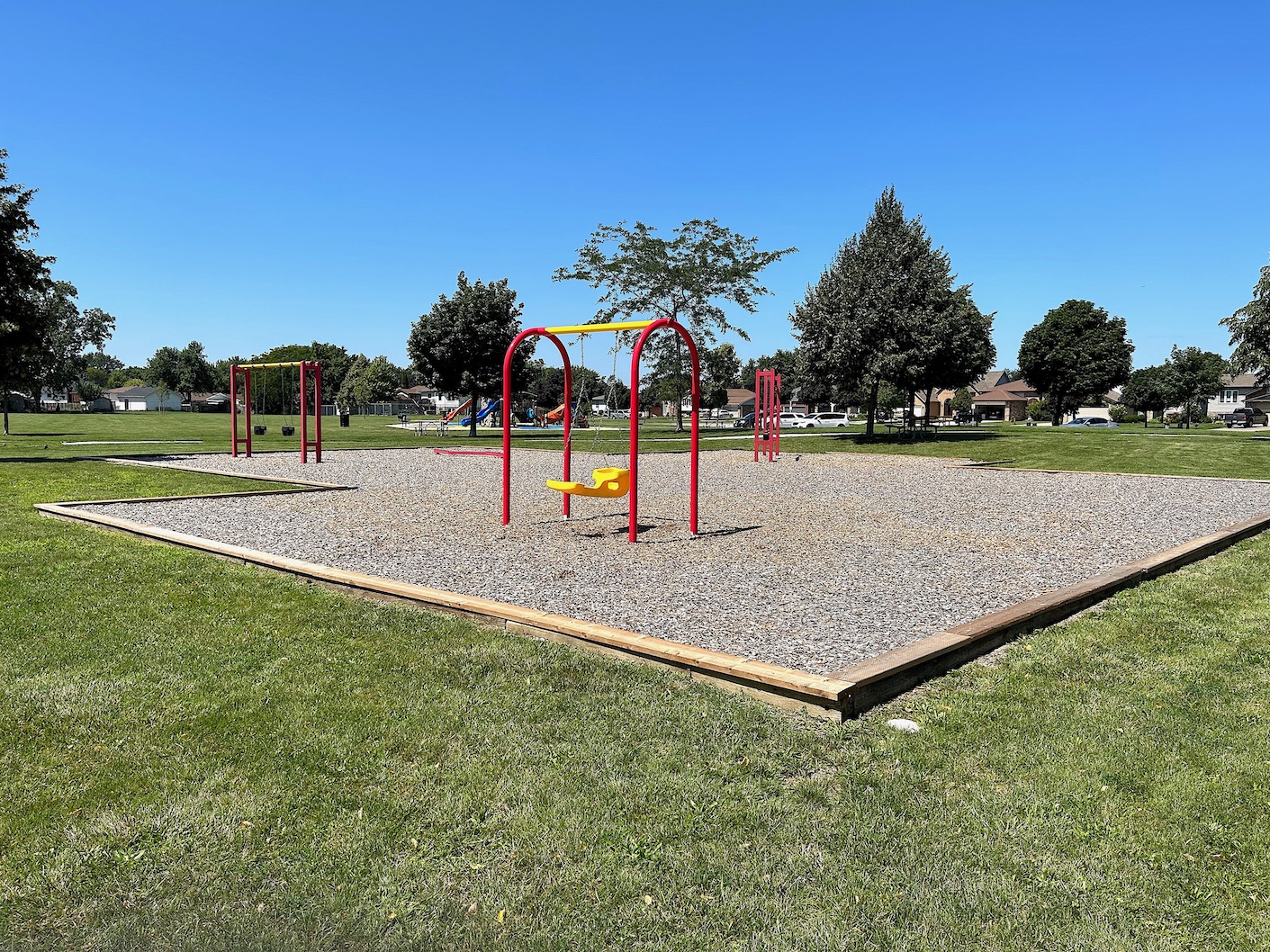
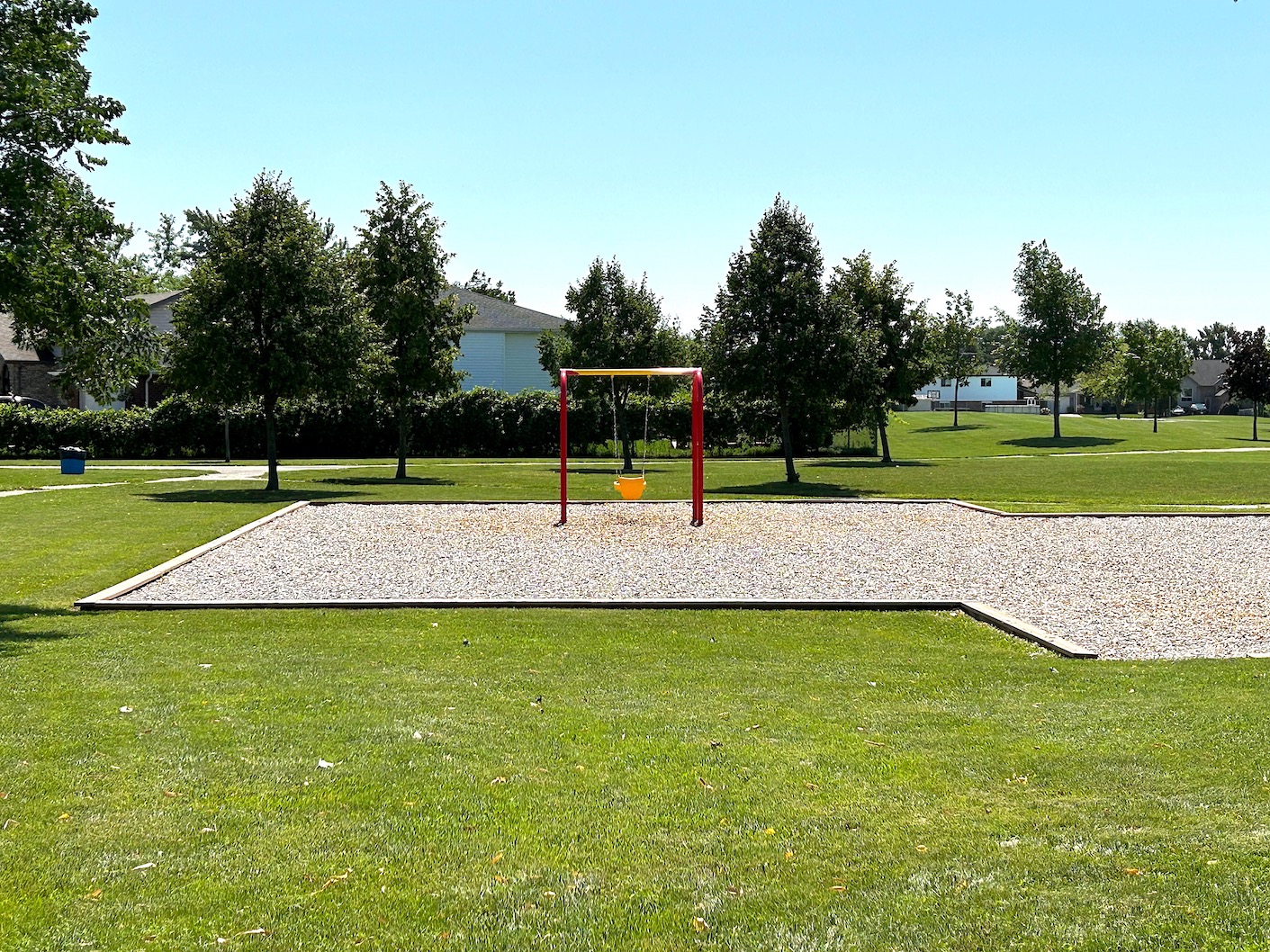
My critique? The swing limits use to under age 5. Stats Canada states in 2021 there were 745 children age 0 to 4; so what about the 1670 children ages 5 to 14 who want to swing? The swing is segregated; I question how that promotes social skill development. There is no sidewalk leading up to it. The surface is soft and uneven. There is no shade. And, as mentioned in this post,

‘When adapted or specialized equipment is made available, it is often limited in quantity and engaged with alone, thereby highlighting the functional limitations of that child and further segregating them from their peers.’

canadian public health association accessibility and usability of play spaces march 2019

Evidence-Informed Recommendations for Designing Inclusive Playgrounds to Enable Participation for Children with Disabilities By: Canadian Disability Participation Project, supported by Canadian Tire Jumpstart.

How does this playground compare?

photo 1: isolated new swing

photo 2: no sidewalk to it

photo 3: the rest of the playground in the distance

Accessibility And Usability Of Play Spaces

Continuing awareness of definitions, the Canadian Public Health Association article, Accessibility and Usability of Play Spaces is another resource that fully explains ‘accessible’ and ‘useable’ playgrounds.

‘When adapted or specialized equipment is made available, it is often limited in quantity and engaged with alone, thereby highlighting the functional limitations of that child and further segregating them from their peers.’

CANADIAN PUBLIC HEALTH ASSOCIATION ACCESSIBILITY AND USABILITY OF PLAY SPACES MARCH 2019

Offensive Terminology

copy of email sent to members of council and CAO Critchley today:

i was appalled to hear one Amherstburg Accessibility Advisory Committee member use “wheelchair bound” and another use “bound” during the June 22 committee meeting; this language is outdated and offensive.

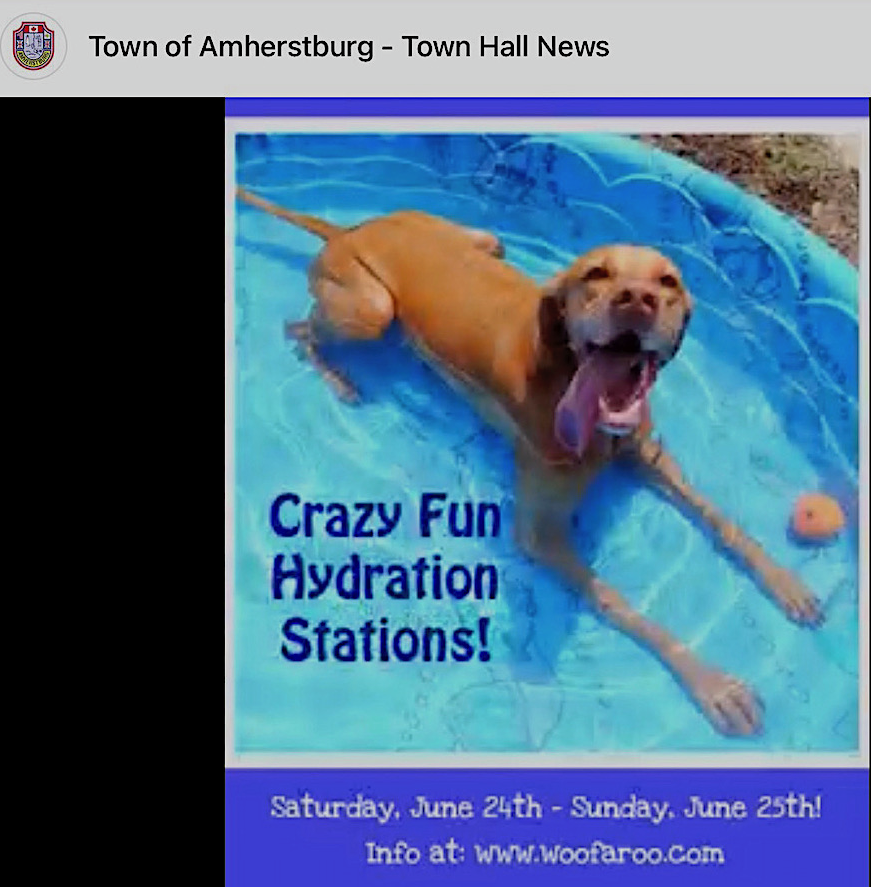
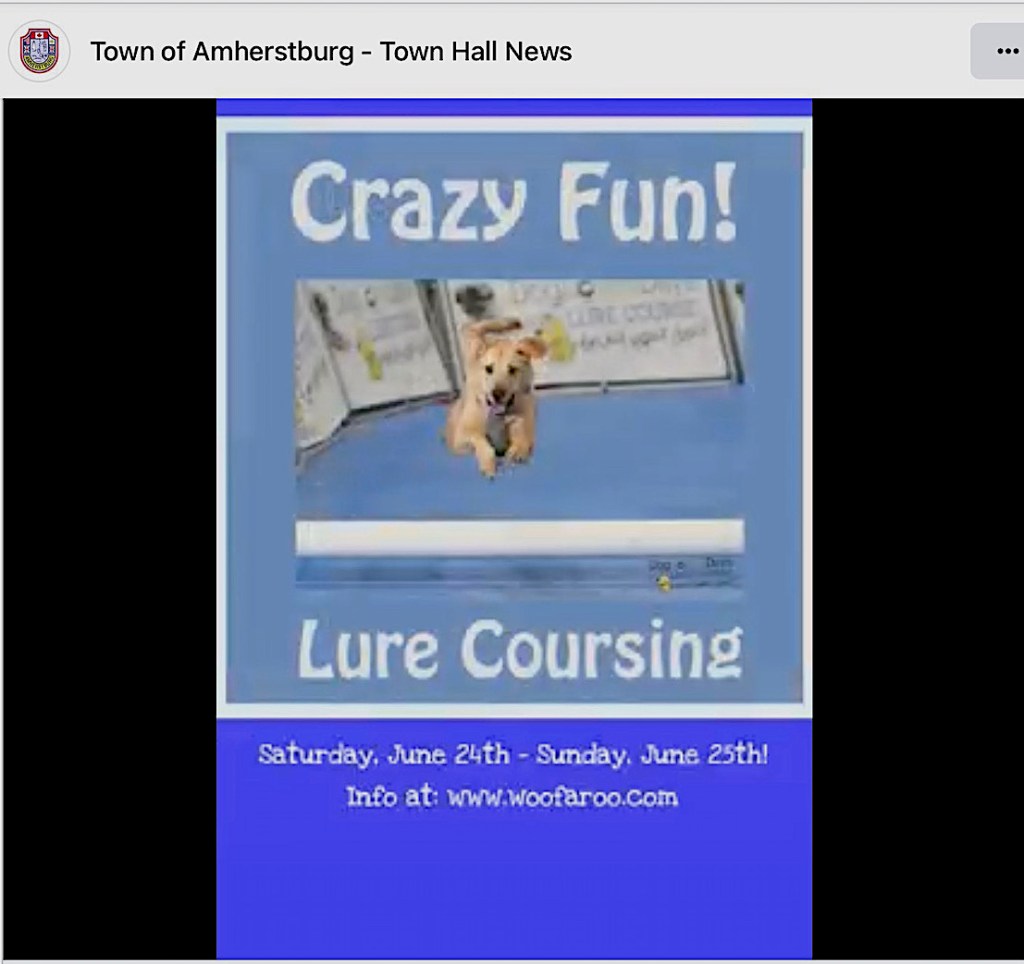
i was equally shocked to see the term “crazy” used in three images on the town’s facebook page in reference to woofaroo. i’ve attached screenshots for your information.

i’m also including a link to an article, Are You Still Using The Word Crazy in 2022, even though it’s 2023.

i suggest there is a need for more training given the language used by a member of a committee that should be more aware of preferred terminology and the number of times i’ve encountered ableist attitudes.

Interested In Accessibility?

Watch the Amherstburg Accessibility Advisory Committee in action. Today’s 5 pm meeting agenda has a few items but the meetings seem to take longer than necessary for the same reasons as the council meetings. Can’t people refrain from providing unnecessary speeches, sharing personal anecdotes, and straying off topic?

ORDER OF BUSINESS includes:
2023 Public Consultation Objectives
Multiyear Accessibility Plan
Survey Responses Report – Public Consultation 2022

Site Plan Review – 580 Middle Side Road
580 Middle Sdrd – Site Plan
That the Site Plan for 580 Middle Side Rd. BE ENDORSED by the Amherstburg Accessibility Advisory Committee.

Site Plan Review – 527 Sandwich Street South
01 May 09 2022 Amherstburg SP Metric SP 2.1 Rev
That the Site Plan for 527 Sandwich Street South BE ENDORSED by the Amherstburg Accessibility Advisory Committee.

Watch online.

Amherstburg An Inclusive Community? Says Who?

I think different people have different definitions of what an ‘inclusive community’ is. How does a crosswalk, sponsored by a family, reinforce what an inclusive community is all about any more than raising a flag? Might these gestures be seen as minimal efforts?

Mayor Prue broke the tie vote in favour of Open Air, despite objections that it created barriers that excluded people with disabilities. Councillor Crain stated yes, he would remove Open Air barriers and then voted in favour of it. How does that make #Amherstburg an inclusive community?

CTV News Windsor reports Amherstburg reveals first-ever rainbow crosswalk representing inclusivity and included the following quotes:

‘WE ARE AN INCLUSIVE COMMUNITY. GET USED TO IT’

“It helps to reinforce what an inclusive community is all about,” said Amherstburg Mayor Michael Prue. “I’m very proud of this town and foresight and the inclusivity that people have shown.”

‘INCLUSIVITY AND ACCEPTANCE’

On Twitter, Amherstburg Coun. Linden Crain also voiced his support for the new crosswalk.

“Amherstburg has taken a colourful step forward towards inclusivity & acceptance. We are thrilled to announce the installation of the town’s first-ever rainbow crosswalk! A huge thank you to the Goggin Family for making this happen. Happy #PrideMonth!”

Strong Leadership Needed

As published in the RTT in response to May 31 Flag Raising article.

The week that initially was National Access Awareness Week in 1988 became National AccessAbility Week in 2017, not Accessibility as stated in the article.

Deputy Mayor Gibb is quoted as saying, “it is also an opportunity to reflect on ongoing efforts to become a better, more accessible and more inclusive Canada.”

I reflected and concluded that a flag raising might be seen as tokenism. 

The J. S. HELD 2021 facilities condition assessment of the town hall noted, “The building is non AODA compliant” and “the cost to convert the town hall to AODA compliant is $291,117.78.” If, as Deputy Mayor Gibb stated, “we strive to improve our infrastructure and services,” why has an AODA compliant town hall not been a priority? The $165,000 dog park and the $170,000 Libro Trail over expenditure would have paid for an AODA compliant town hall.

Mayor Prue noted the Gordon House was not accessible and campaigned to ensure all town buildings are accessible to facilitate an open and inclusive municipality. Last month, Mayor Prue referenced the AODA and said in this town, we have not brought it into force. Why not?

What about the narrow, uneven sidewalks with trees growing out of them and all kinds of obstacles Deputy Mayor Gibb mentioned during budget deliberations? 

As this week ends it’s ironic that Open Air and its barriers begin, despite any denial. People with disabilities may be excluded, physically and socially, from equally participating in the community, a preventable barrier. While there will be those who claim the 16 weekends of closed streets increase accessibility for people using wheelchairs, such positive attributes overshadow the need to commit to fixing sidewalks for year-round use and eliminating barriers.

Inclusive communities welcome ALL marginalized communities, not just some and only during festivals.

We need strong leaders to commit to the identification, prevention, and removal of barriers. When that is accomplished, and all barriers in Amherstburg are removed then there will be cause for celebration, but not until then. 

An FOI Request For This?!

Absurd. Why did this information require an FOI request? Especially when two of the three documents are publicly available policies on the town’s website? And other municipalities live stream their workshop meetings?

CAO Critchley advised council members received training in accessibility on November 29, 2022; the Council Workshop Agenda did not mention Accessibility training.

Following this post, What Accessibility Training Did Council Receive? File An FOI Request, I submitted an FOI request and today received full disclosure of the following three documents: