RECAP October 15 Council Meeting

It was another dumpster fire. An abundance of kudos to staff, who are well compensated to do their jobs so I’m not sure why all the kudos, comments/speeches instead of questions, jabs at provincial politicians, some ignoring accessibility barriers while citing the AODA, and some more grandstanding.

Mayor Prue noted an error in the minutes – it was not the Legion but a different group; another inconsistency since two errors involving his wife were noted in minutes pertaining to my delegations that I asked to be corrected but they never were.

The first delegate, Bryerswood Youth Camp Optimist Club, wanted Texas Road tarred and chipped. After council passed a revised and more restrictive procedural by-law last year, delegates would only be allowed if there was an admin report or a by-law for an agenda item. The delegate request form did not list an agenda item that would be addressed.

So, Bryerswood submitted the petition and request, then the admin report was created, and then the agenda was published. Notification of the council meeting agenda was delivered on October 4 at 3:55 pm. The October 2 admin report mentions ‘a petition was circulated and has been submitted to the Town of Amherstburg requesting consideration of the conversion of a stretch of gravel road on Texas Road, from Howard Avenue to the 6th Concession North. The estimated cost is $250,000.’

Following the delegation, the admin report, item 15.1, was brought forward and Councillor McArthur wanted to move a motion to consider the request at budget because he thought they made a great case for them to at least consider this at budget time among other competing priorities. At the March 11, 2019 council meeting, McArthur declared a conflict of interest because he had a child who was a Girl Guide and was previously hired to do web design for the presenters. The motion carried.

As an aside, it’s shameful that McArthur hasn’t been more of an accessibility champion. After all, he volunteered to be council’s rep to the accessibility advisory committee and I think residents with disabilities have ‘made a great case’ for barrier removal and inclusion.

The second delegate, Bill Petruniak, spoke in opposition of an application for the Community Sport and Recreation Infrastructure Fund that would allow for the provincial government to match funding of $500,000. Petruniak opposes spending money on parks, citing financial constraints and the need for fiscal restraint. He said the time is now to become a council that Amherstburg taxpayers can be proud of, instead of one we are ashamed of. He mentioned that 14 years ago, McLean’s magazine wrote an article about the 10 worst mayors and councils in Canada; Amherstburg made that list. He continued, If this council does not change course, Amherstburg is going to make that list again. He emphasized the importance of managing tax dollars wisely and avoiding frivolous expenditures. He suggested using the fire hall and town hall for additional space and stopping unnecessary spending. Prue asked the usual, if there were any questions of staff and Councillor Courtney offered kudos to staff not a question. Prue did not object to Mr. Petruniak responding to Courtney for almost a minute and a half like he has done in the past to other delegates; another inconsistency that creates the perception of preferential treatment for some.

When 11.1 was brought forward, community sport and recreation infrastructure fund, there were more kudos for staff from Courtney and McArthur and Gibb, who applauded staff. Prue had two comments and said he didn’t have a question. McArthur said they couldn’t get blinded by dollar signs and we need to invest in recreational amenities; his speech lasted about 4 minutes. His enthusiasm for recreation, including cycling, running, and trails is obvious. Councillor Allaire said she’s obsessed with parks; likewise, her enthusiasm for parks is obvious. I already wrote about Prue’s jabs at MPP Leardi and Premier Ford in this post. Eventually, a motion carried after making some changes.

National Disability Employment Month proclamation is passed with a motion by Allaire and seconded by Deputy Mayor Gibb. More on that to follow.

The contentious issues came up during new business. Councillor Pouget mentioned that she believed it was in June that council passed a notice of motion, unanimously, to go before the county. They thought it was a county road and council would ask them to investigate the feasibility of a crosswalk at Sandwich and Lowes Side Road and to move the 70 kilometer sign from the corner of that intersection, just past the five driveways. The motion went to county council; both the mayor and the deputy mayor acted on their behalf. She further believed it was approved August 14, and now she understands that there’s a problem and they wanted it to come back to this council because they believe that it’s our responsibility, because that section belongs to our town, and the county road doesn’t exactly start until a few meters away from that; they need this council to decide what they’re going to do with that area before the county can proceed with the moving of the 70 kilometre sign.

Pouget suggested that Deputy Mayor Gibb could probably speak more to it since she was just acting on his behalf of what he was told. Gibb’s response was: so when we originally approached the county, I think we were all under the assumption that that intersection was shared with the county, and it’s come to light that no, that intersection of Lowes and Sandwich belongs entirely to the town of Amherstburg. So from discussions I’ve had with county staff, they’re reluctant to make changes to the speed limit until they know what direction Amherstburg is going to go with the intersection. Again, the way I understand it is, you know, if we were to put in crosswalks, they may move. They may have to move the speed limit a certain distance. If we have flashing lights, it might be another distance. If we do a full signaled intersection, it might be something different. So they’re the way I understand it, and I’m I would defer to the clerk, but the way I understand it is the county needs some direction from this council as to what we’re doing before they can take the appropriate action on the speed limit.

Prue asked if it would it be advisable to have staff, and then asked which one? More whispering in his ear, and he agrees to whatever was said, for staff to bring back a report outlining exactly who owns that intersection and what options there are and what costs there are, and bring it back to council so that they would be able to either act on it themselves or go back to county council for their support and assistance. Then Prue asked, is that okay? You can do that? Okay? All right, that’s sufficient. (Why would anyone ask if that was okay? Admin is expected to provide reports, they get kudos for doing so, and it is council’s job to direct them, not ask if it’s ok).

Then Pouget confirmed if she was to make a motion to direct administration but Prue said no no, he thinks they’ve already indicated, (more whispering) yeah, they’re going to bring back the report. (A motion should always be made after there has been a decision to take action. The minutes are the official record where resolutions are stated).

Prue then introduced the matter of some people upset in the George and Seymour area, and staff went out and did what staff is supposed to do. He said they have to dig up the entire two roads and put in new sewers, probably have to put in new sidewalks, and try to keep all the trees. There is some encroachment, and the staff has gone out and talked to people and have sent out a letter talking about the end of the month, and he has tried to advise people that they will not be acting on that, and the staff have agreed they will not act on that until after council has had an opportunity to weigh in. So he asked that a report comes back to the next council meeting. It is not his wish as the mayor, he doesn’t know what council thinks, to force people to take out their porches or their houses or anything else. Some of these houses are 100 years old, and it’s a difficult circumstance, but he wants this to come back to council so they can have a good discussion at the next council meeting and determine how best to proceed. He said it’s gone too far. People are talking about hiring lawyers. Some have actually gone to lawyers to spend money (as is their right). And he thinks they can, with goodwill, accommodate all the concerns around this council table. He just wanted to say that publicly so that the newspaper and others can get it out.

Pouget asked if administration can bring back a report whether or not those five foot sidewalks are required in the older section. She said she fully accepts five foot sidewalks in new sections, but she believed there’s an exception under the Act that when it’s in a very old section, and it would affect some properties like that. She wondered if they can keep the sidewalks at four feet the way they are right now, with this exemption, then they wouldn’t have these worries. While Pouget was speaking, CAO Critchley whispered to Prue; he said the CAO has just indicated to him it will be in the report. Prue added, in case people wonder, (it sounded like he said AOD instead of AODA) compliance to make sure that it’s compliant would be five feet. But if it has to be four in that section so people won’t have to take down portions of their house he thinks they can all recognize that may have to be done but they’ll see the report and have a good discussion at the next meeting.

Allaire read her notice of motion to reconsider council resolution 20240527–008 regarding temporary patio extensions. Councillor Crain said it’s a bad idea to reconsider and McArthur was also opposed. Pouget supported it but Prue cut her off while she was speaking to say she was getting into the merits. Courtney supported. McArthur said he personally loves patios, it gives our residents something to do. Prue said the province allows patios to be on streets in Ontario. Staff needs to ensure AOD (the second time he left off the last A as in AODA). He mentioned emails and the arguments people made: 1. it takes away two parking spots; 2. it was ugly; 3. no money to town in return. He didn’t mention that I pointed out my argument regarding inaccessibility.

The motion to reconsider was carried and then there was more back and forth posturing. Gibb said he just didn’t understand what the issue is; two parking spots out of 500 you know what? He doesn’t think there’s that big of a problem parking in downtown Amherstburg. (The number one complaint in the residents’ survey about Open Air was accessibility, followed by parking. And again I wonder when there will be a strong commitment to accessibility and inclusion).

Crain echoed Gibb: It’s two parking spots, or maybe a little bit more, in the downtown, there’s definitely not a parking issue downtown. We received that in the study that came back, there’s a parking perception issue, but I don’t believe there’s a parking problem, and for me, it’s not something that I think we need to look at again.

More inefficient windbaggery and the motion to remove temporary patios on public properties failed. A recorded vote was held. In favour: Allaire, Pouget, Courtney. Opposed: Crain, Gibb, McArthur and Prue.

Mayor Prue’s Stance On Provincial Grant Funding

During the October 15 council meeting discussion of a provincial grant, Mayor Prue passed the gavel to speak. Following comments he made about MPP Leardi and Premier Ford which, in my opinion, were unprofessional I reached out to MPP Leardi, who responded.

Unofficial transcript of Prue’s speech: (listen to the audio).

I’m going to pass the gavel because I want to speak to this. I’m going to support this. And I know that some people say, oh, he just wants to spend the money. No, I also want to save the money. If we put in this application now, we are eligible for 50% funding from the province. If we don’t put it in now and we wait, which was suggested, we’re going to get zero. So am I going to say to the people of Amherstburg I said I’m going to, you know, we should just wait and maybe next year or the year after, we can see whether we have enough money at that point and forego the $500,000 from the province of Ontario, absolutely not. It is very difficult and anyone who sat around this table over many years will know it’s very difficult at budget time to try to do all the competing interests. But never once did I ever, in all of my years see a politician refuse provincial or federal money when it was there, and I don’t think we should be just saying cavalierly, no, we’re not going to even apply, because if we don’t do this tonight, we can’t, we can’t even apply. Might as well kiss it goodbye, and I am not going to kiss that money goodbye. It’s difficult enough waiting for Provincial funds. And every year our funding from the province goes down. Every year it gets less and less and less. And somebody sent me something from Facebook, and I was rather appalled so many people in Amherstburg commenting how wonderful Mr. Leardi was making sure we were getting 200 or $2 million from OCIF. That’s the least amount we’ve got in the last 10 years. Every year it goes down. Every year it goes down. And yet there are people who congratulate him for pushing it down. When I went to the to the AMO conference, there’s the Premier up there, big and bold as could possibly be, bragging that in his four years as Premier, he’s never had to raise taxes once, no, because he doesn’t fund things like municipalities anymore. And then we have to turn around and do the best we can. So when this rare opportunity comes for $500,000 I’m going to take it and I’m going to support this tonight so that we can get that 500,000. If we don’t get it, I know what we’re going to have to do instead. I don’t like it, but I want to see that place built right out if it can be done, I’ll take the gavel back.

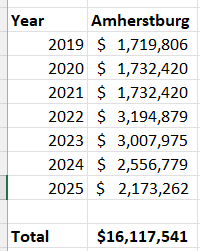
MPP Leardi’s response was: Thank you for letting me know about Mr. Prue’s comments. I don’t think he has a full understanding of the millions of dollars that Amherstbug gets in infrastructure grants. Below is a breakdown. The infrastructure grants effectively doubled in 2022. In infrastructure grants alone, Amherstburg has received over $16 million from the Ford government. 

RECAP: September 23 Council Meeting

It was another dumpster fire. The usual time wasters: passing the gavel, long-winded speeches, raising a question, which was really just a comment, confusion about motions, both reconsideration and notices of motion, staff interjecting, and kudos after kudos to staff for a job well done – jobs that they are compensated for. One new twist; Councillor McArthur asked Councillor Pouget to retract a comment that he felt was an attack on the clerk.

First up, a decision had to be made; should the agenda order be changed to allow presenters to go first ahead of delegations? Deputy Mayor Chris Gibb felt that since they were paying people to be there he preferred they deal with those first and that carried.

First presentation, Valente, took about 20 minutes to talk about future plans for incorporating a new town hall into the former General Amherst high school.

Second presentation, the space needs study, lasted for about 12 minutes and appeared to tie in with Valente’s presentation since the preferred location of a new town hall would be Bill Wigle Park area.

Following the space needs study presentation, Councillor Pouget had a question about the presenters’ page 57, which stated:

AODA stands for the Accessibility for Ontarians with Disabilities Act 2005. It’s a law that sets out accessibility standards for organizations in Ontario. The aim of AODA is to make Ontario more accessible and inclusive for people with disabilities. The Act requires organizations to identify, remove and prevent barriers for people with disabilities. The Government of Ontario was targeting making the province accessible by 2025. However, this has been extended to 2030.

Pouget said she checked all the documents, and couldn’t find that they extended it by five years; the last she was aware was that AODA had to be completed by 2025. She asked if they could guide her to find that document.

The presenter did not answer and Mayor Michael Prue acknowledged the clerk. He explained that he thinks the reference to the 2030 is from the Ministry of Seniors and Accessibility, and the recent findings that they have found that the province of Ontario will not meet the sort of objective of achieving compliance across the board by 2025 in the province of Ontario, and so they have stressed the need to not extend it beyond 2030 and have set that as the goal and benchmark. Certainly that’s the province of Ontario’s goal.

Pouget’s follow up question was, so has it actually been extended? Or are they just speaking on the issue? The clerk continued: So the requirements to comply with accessibility take effect when you build or significantly renovate any structure. And so those exist today and will continue to exist. You know, something like this town hall was required to meet accessible requirements when it was built, and should it be significantly renovated or rebuilt, it would be required to meet those standards. You know, as a town that provides goods and services to members of the public and employees personnel, you want to ensure that you’re putting your best foot forward. So it’s not necessarily about whether the town is in compliance or not, because it might legally be compliant, but it’s about setting yourself to achieve the goal of the province in making it equitable and fair to all by making accessibility the target in every public space.

Pouget then asked about the recommendation to demolish Toddy Jones Park and Bill Wagle Park washrooms and where would washrooms be located? Answer: within a new town hall. Pouget then asked if the presenters were aware of the Bill Wigle Park’s 1949 deed’s stipulation that if it’s not used as a park the deed would revert back to the federal government.

Gibb thanked the presenters for taking a 133 page report and putting it down to a 16 page presentation. He was curious if the town owned 36 buildings were more than average for a town this size? about average? Less than average? Answer: it’s more than average. As is his style, Councillor McArthur editorialized before he inquired about the Libro not being selected. It was noted that the Gordon House, owned by the town, was excluded from the space needs study.

Prue passed the gavel to ask a question, which was really just a comment. He didn’t want people to be horrified and frightened. You mentioned a $64 million cost, but I see that almost a huge portion of that was in 2074, 50 years from now. Okay, so I just want people who are watching there on television, you know, to remember that the only upfront cost that you’re actually talking about in the next five or so years would be the town hall and even the Libro is 10 years from now.

Prue then apologized that it had taken a long time but now they would get to the delegates. (Another argument in favour of revisiting the restrictive procedural by-law would be to initiate time limits for presentations, which aren’t defined in the by-law. While they’re looking at that, they should also implement time limits for their own speeches like other municipalities do.)

Following John Menna’s delegation, there was confusion about whether a motion could be reconsidered. Prue asked if anybody had any comment on that and said, The clerk’s advice, I generally find his advice, although not always welcome, is always right. Pouget said not always and then Prue acknowledged Pouget, who said she had questions for administration.
 
McArthur should get a cheerleading for staff award; he actually asked Pouget to retract her comment, that it was an attack on their clerk. (Last year Mcarthur mentioned they were acting like delegates were urinating on the rug.  Listen to the audio. Weren’t members of council just asking the delegates questions? No one admonished him for that comment.)
 
Pouget said it was not an attack on the clerk and Prue said he didn’t hear it. Pouget asked if she could proceed asking administration questions and Prue said they couldn’t reconsider and then Prue referenced the rules. Pouget reminded Prue that he said the clerk is always right and she said not always; none of us are always right so she didn’t know what the problem was.

Prue advised McArthur that he wouldn’t allow it because he didn’t know that that is serious enough to be offensive. He said he admires the clerk’s expertise, and he’s not ever sent him wrong in the six years he’s been here and he wasn’t the clerk the whole time, but he was the deputy clerk, and he’s never sent him wrong, and he has to unless there’s information the contrary take his advice. And is he always right? No, you’re right. He’s a human being. We are all wrong once in a while, but I don’t know whether he is on this issue. Okay, so I’m not going to ask you to retract that, but your point of order was well taken Councillor McArthur.

Prue’s wife had submitted a delegation request and although she was present, she did not speak after all. Two other Belle Vue Conservancy members spoke instead. Marc Pillon also delegated about Belle Vue.

Financials, more reports, more kudos to staff, more speeches, (is it campaign time already?), more confusion about a motion, more excuses about a lack of accessibility at the Gordon House: due to the age of the building and how it was constructed, to keep the historical integrity, you would not be able to make the building totally accessible without doing major modifications, which would then go against the historical preservation of the building. So we could do things to try to modify access ways, but again, that would be modifying the building, and again, you would have to apply, probably, to the government, for permission to do so.

A no from Gibb and Crain to allow someone in the gallery to speak. Gibb maintains it’s an equity issue and repeated what he said before: I do not think it is equitable to allow people to just raise their hand and speak when others have registered as delegations and people are watching online who may have physical limitations that don’t allow them to be here in person. I’m sorry, but I just think it’s an equity issue that I cannot support.

That should’ve been the end of it but Crain chimed in with if there’s any residents that are looking to speak with us on matters of the agenda, please register in advance or approach us directly offline. (good luck with that; he so rarely answers my emails. Besides, you can’t just delegate on agenda matters; they voted on a restrictive procedural by-law that requires delegates to only speak to admin reports or by-laws listed on the agendas). Then Prue said he wasn’t going to allow a debate. (because rules are rules).

Two notices of motion were dealt with.

I could probably create a template for meetings since so many of them are so similar and predictable.

Mayor Prue’s Response to Open Air Complaints and Lawsuit Inquiry

I requested Mayor Prue’s comments about Open Air complaints and former CAO Peter Simmons’ lawsuit, which he answered below.

  • how many complaints about open air have you received?
    Prue: I have received less than 10 complaints including your own, since becoming Mayor.
  • how many complaints about open air has the town received?
    Prue: I do not have that statistic. We have a seven member Council and many paid staff.
  • what are your comments regarding peter simmons’ lawsuit against the town?
    Prue: I have no comment as this is a personnel matter.  This was clearly enunciated by the Town’s CAO to you, in the past few weeks.

Follow-up question:

Regarding answer 2: if you don’t have the statistics of complaints the town has received, do you feel you’d be making a well-informed decision about what is in the best interest of the town?

Regarding answer 3: I did not ask the CAO for a comment; I asked if she could confirm the claim against the town by former CAO Peter Simmons. I only asked you for comments about it since you’re the official spokesperson.

Comparing Affordable Transit Passes

Amherstburg does not offer an affordable bus pass program like neighbouring municipalities. However, on September 9, council will consider Administration’s recommendation to waive transit fares for the Uncommon Festival from 6pm on September 20, 2024, through the end of the service day on September 22, 2024.

If the taxpayers can absorb the cost for Festival attendees, who no doubt can afford costumes and restaurants, why not offer affordable bus passes for people in need?

The Affordable Pass Program (APP) allows eligible Windsor-Essex residents to purchase a discounted 30-day bus pass from Transit Windsor. The APP covers 49% of the cost for a full-price 30-day Smart Pass, and registrants pay the remaining 51% at the time of purchase. 

The APP is funded by Pathway to Potential. Full details and how to apply are found on Pathway to Potential’s web page.

Available Affordable Pass Program (APP) Subsidies

Bus Pass TypeDiscountService ProviderEligible Residents
30-Day49%Transit WindsorWindsor
30-Day49%LaSalle TransitLaSalle
30-Day Leamington to Windsor (LTW)50%Leamington TransitLeamington, Kingsville, Essex
10-Ride (LTW)50%Leamington TransitLeamington, Kingsville, Essex

Tecumseh Transit offers free fares for children under 5, Veterans, blind persons and persons accompanying disabled riders.

Lakeshore was looking at a transit feasibility study.

Amherstburg Previous Agendas: Access and Transparency

August 15, I emailed CAO Critchley and council members: there appears to be changes made to the town’s website regarding previous years’ agendas. would you please provide me with a link to previous agendas?

No answer.

August 19, I emailed CAO Critchley and council: there are no agendas in records repository as you can see from the screenshot. Where are they located?

No answer.

August 29, I emailed CAO Critchley and council, summarizing my previous emails and stated,
I am emailing again to request the link to all previous agendas. Pursuant to Section 270 of the Municipal Act, 2001, the town created an Accountability and Transparency Policy that states: The Corporation of the Town of Amherstburg is committed to ensuring that it is accountable to the public for its actions and that its actions are conducted in an open and transparent manner by: Section 1.4 Providing access and disclosure of public information in compliance with current legislation.

Screenshot that clearly indicates 5 folders exist:

CAO Peter Simmons Lawsuit Against Town of Amherstburg

Former CAO Peter Simmons was a plaintiff in a statement of claim, naming the Corporation of the Town of Amherstburg as the Defendant on July 5, 2022.

According to the statement of claim, Mr. Simmons commenced his employment with the town on or about February 22, 2022 as CAO. On June 9, 2022, without reasonable notice or pay in lieu thereof, the town terminated Mr. Simmons’ employment, allegedly with cause due to alleged wilful misconduct, disobedience and wilful neglect of duty. Mr. Simmons pleads that the town had no cause to terminate his employment and, consequently, the town is in breach of the express and/or implied terms of his contract of employment.

A Notice of Discontinuance, and consent to same by both parties’ lawyers, was filed on July 3, 2024.

Restrictive Procedural By-law: Impacts on Civic Participation and Engagement

In his August 7 letter, Frank Cerasa highlighted this council’s passing of a more restrictive procedural by-law.

For months I requested council update its procedural by-law; ‘the by-law that most directly affects democracy should reflect current accessibility and human rights legislation and it is within your authority as representatives of the public you serve to address the issue and implement a best practice. There should be no administrative burdens or barriers to democracy.’ 

In July 2023, to assist council, I shared the Director of the Centre for Free Expression’s response: he never heard of a municipality requiring the delegation speaker’s notes, much less the text of the speech, to be submitted ahead of the event. And he never heard of a requirement for a copy of the notes or speech text to be submitted with the application to appear.

In August, without direction from council, Administration presented its report to council, titled, Procedural By-law Renewal for Greater Civic Participation and Engagement and Revised Procedural By-law. While the revised by-law ended the bad practice of requiring notes/speeches in advance, it became more restrictive than its previous version and more so than neighbouring municipalities.

Although it was meant, in part, to provide council the tools to have efficient and effective meetings and provide all members of the public the same equity in terms of participation and engagement, I don’t think either was achieved.

There are no limits on the number of questions members of council can raise, no limits on the number of times a member can speak and there are no time limits for either item. When administration is invited to participate, there are no time limits on their input either, all of which may result in inefficient meetings.

As for equity, treating all members of the public the same may result in inequities and disregard for individual accommodations which should have been learned during mandatory AODA and human rights training.

Since neither the public nor council members provided any input, the new procedural by-law reflects administrations’ vision. But, since council unanimously approved it, and Councillor Pouget’s November 2023 reconsideration motion failed, this council will be remembered for shamefully curtailing civic participation. 

Commentary by Linda Saxon

Salmoni Residents’ Appeal Dismissed: Ontario Land Tribunal Decision

An August 12 Decision by the Ontario Land Tribunal hotel at 256 Dalhousie has ordered that the Salmoni residents’ appeal is dismissed.

[107] In order to address the possibility of noise and disturbance from a rooftop
restaurant/bar the Tribunal includes, that the approval of the draft Zoning By-law
Amendment shall accommodate the addition of text which will require that the rooftop of
the building be an enclosed space as depicted in the architectural drawings submitted in
evidence and that the use shall not be a restaurant/bar within that space. Further, that
any commercial/restaurant space use on the ground level shall be an enclosed space.

[108] On the weight of the evidence heard by the Tribunal, its assessment of same as
detailed in the reasons above and the submissions of counsel, and having weighed
submissions of residents, the Tribunal finds that the proposed ZBA which will allow the
relief sought by the Applicant is consistent with the PPS as well as the County OP and
the Town OP, and applicable guidelines, and thus represents good planning in the public interest.