The Candidate Platforms 2026 page has been updated, including 2022 information, whether they showed favouritism towards bloggers’ questions to the candidates (they did), and Open Air position if known (it’s obvious).
Tag Archives: Michael Prue
RECAP Council Meeting May 11, 2026
I knew they couldn’t do it. They couldn’t get through the meeting without personal anecdotes, posturing, and not so subtle campaign plugs: I coached baseball (Courtney), when I first got elected, I advocated for baseball (Courtney), I heard when I was knocking on doors last election (Crain), and I played ball as a kid (McArthur). Campaign points deducted for Prue’s mansplaining to Pouget and Allaire’s offhand comments about Kingsbridge traffic – just distracted, there’s accidents everywhere. The hot topic was the concerted effort to avoid public disclosure of the number of lawsuits pending against the town and the associated legal fees.
These are council meetings to discuss council business, but they appear to be meetings between council and admin, who are welcome to participate. Admin whispers into the mayor’s ear and he announces they have something to say.
The perception in the community is that admin directs council – not the other way around.
Shawn Wilkie certainly gave the impression that admin deserves to be recognized, even before members of council. Delegates are there to address council, but Wilkie, a Royal Canadian Legion Fort Malden Branch 157 delegate, greeted, “honourable mayor, deputy mayor, CAO, town of Amherstburg administration and esteemed councillors for the residents of Amherstburg.” (Only serving MPPs are honourable).
Admin are not elected officials – they can’t ask delegates questions, they can’t grant or deny a delegate’s request. Civil servants serve the public by implementing council’s decisions.
Wilkie requested perpetuity for the annual Legion Week parade event permit requirement and all fees associated with the annual event.
Councillor Pouget did not ask if waiving the fees in perpetuity meant forever, as was erroneously written elsewhere.
VERBATIM TRANSCRIPT:
Councillor Pouget: just one question – the Legion is requesting it to be waived in perpetuity, forever; is that correct?
Prue: I believe that’s what’s been requested, yes.
Pouget: okay, thank you.
Prue waited almost five seconds and then mansplained: What that means is it never has to come back again. It doesn’t mean that council, 30 years from now might say, no, we don’t want to do this anymore. That’s still within that realm of possibility, but up until then, it just keeps going. Okay, all right.
Listen to the audio.
I don’t recall Prue doing this to his male colleagues. Same for when he tells Pouget, “I don’t know if that was a question or simply a statement.”
Borrowing By-law and Delegation of Authority By-law
Prue invited Deputy CAO Melissa Osborne to make a presentation that might’ve been meant to reassure everyone that all is well with town finances. Confusion followed.
Councillor Crain was the first to raise his hand. Of course he offered kudos to “Deputy CAO Melissa: very helpful report, very positive report. I think online, we see a lot of misinformation. I have lately a lot of AI driven, and it’s very helpful to see the stats on screen. I think this council, past councils, have been making great strides,” said Crain.
There will always be misinformation; I’ve seen it from admin too. For example, when the town erroneously advertised for appointments to the accessibility committee, which I repeatedly pointed out to admin and council, including Crain; he never responded.
Artificial Turf Fields, Premier Baseball Diamond issue. As he usually does, Prue asks if there are any questions of staff before members of council debate the issue. (I’ve watched other municipal council meetings and they are so much more efficient and professional).
- Councillor Crain questions the impact of not approving the project on baseball Canada standards and public use.
- Admin (didn’t say his name) confirms the field would still be usable for general play but not for hosting tournaments or official leagues. The field is used by the University of Windsor, Windsor Select, North Star High School, and local minor baseball teams.
Crain said I’m not sure I can make a decision, which seems inconsistent given that Crain, along with the majority of council, approved almost $500,000.00 for pickleball. In fact, council waived rules of order to hear the plea for pickleball in June 2023 when it wasn’t on the radar. Prue even asked the audience what their preferred location was. And then, “the motion has passed; now the thorny issue of how do we pay for it?” said Prue.
Almost a half hour later, after all the ‘what if’ questions, the motion to approve staff recommendation carried.
Kingsbridge Traffic Calming Review
Prue once again asks if there are any questions of staff before members of council debate the issue.
Councillor Allaire said she had a follow up, although there was no initial question.
“It was an old report, so we didn’t have new numbers. We did look at the numbers and asked how many new accidents have happened near and around this intersection? And it was quite high. We have received nine since like 2025 however, I want to back that up with eight of the nine were people just either distracted driving or just hitting cars, parked cars, one backed into a boat; I mean a parked boat, I might add. So I think when you look at things as a whole and as an intersection, it didn’t meet any of these policy standards. …great now that we have a policy, we can see where we should increase the speed and decrease it. So now that we have a baseline, this is great to see, but there’s accidents everywhere, and people are distracted everywhere. So I think enforcement is a huge thing that we could step up on and hopefully work on. But I’m going to move the staff recommendation,” said Allaire.
“Just distracted driving. Just hitting cars.” Sounds dismissive.
A pedestrian was hit; several people were taken to hospital.
According to data from Transport Canada’s National Collision Database, distracted driving contributed to an estimated 22.5% of fatal collisions and 25.5% of serious injury collisions in 2021. These statistics are part of an upward trend of distracted driving-related collisions, up from 21.3% of fatal collisions and 23.8% of serious injury collisions a decade earlier(2011).
“There’s accidents everywhere. People are distracted everywhere.“
Exactly. Reason enough to take action. Distracted driving is a leading cause of traffic collisions in Ontario, with one person injured in a related collision every 30 minutes. In 2022, 105 deaths were recorded in the province due to distracted driving, and about 25% of all fatal collisions in Canada involve distracted drivers.
But Allaire moved admin’s recommendation to receive the report from the Director of Infrastructure Services regarding the 2025 Kingsbridge Traffic Calming Review.
Of course, Crain offered kudos to staff. “Appreciate staff sharing the report. We definitely face traffic issues across town, not just in Kingsbridge. And I understand that the based on the study Kingsbridge Drive, McClellan, Lavers, Whalen did not meet the 35 point threshold. However, what I am hearing from residents, and I know there’s no recommendations to come out of this inside of Kingsbridge, but what I’ve heard when I was knocking on doors last election, I’m hearing it now is a three way stop at Texas, and I believe it’s not maybe Knobb Hill if I’m not mistaken; that intersection is, is there, is it possible on the south end for a three way stop to be there? Is it warranted?”
Admin’s answer was that three or four way stops fall under provincial regulations and a different warrant system, but it’s council’s prerogative.
Crain asked about a third exit out of Kingsbridge and admin said they’ve looked at that a few times with previous councils. It is a very costly endeavor. I don’t recall the number, but it was in the millions of dollars. And those traffic studies did not warrant a third exit. And so when that was presented to previous councils, it was determined that we would not move forward with that expenditure. Once again, council’s prerogative to take a look at it again, but I know that in my time here, we’ve looked at it at least twice, and just the cost and the warrants that didn’t dictate that we required it. Councils decided not to go forward with it.
Pouget responded. I believe one of the objections, or when we did try to get another exit from Kingsbridge was an objection from the Canada Railway Company, because they said it was either we were going to have to have them cross over to exit out of the second concession, or when we are trying to have another exit off Texas. I believe the railway interfered with that also, so I think that was why we couldn’t get the second exit on that. My other concern is that Amherstburg Police is well aware of all the problems within this community and the speeding and the distracted driving, there is nothing here that stops us from requesting them to do more surveillance in those areas, to try and get people to be more knowledgeable about how they should be driving and more aware of the safety factors in that community.
“I don’t know if that was a question or simply a statement,” said Prue. (It would be so refreshing, and fair, if he would do that to McArthur, Gibb and Courtney).
Pouget asked if a letter could be sent to Amherstburg Police, asking them to be more aware of the situation and to periodically send out more patrol cars. Appropriate action taken, as opposed to the usual ‘support the recommendation of administration.’ Motion amended and carried.
Unfinished Business
Pouget wondered when the illegal driveway on Dalhousie Street was going to come before council. She said they dealt with that in planning, it’s got to be a couple months ago,
Osborne very concisely said, it’s coming back on May 25.
Pouget then asked about the 208 St. Arnaud Street issue (the warehouse turned arena).
Osborne very briefly said, as per the question at the last meeting, we advised Council in an email of what the status update is and that an application is to be received from the property owner for a minor variance.
(Council received an email, but the public is not privy to it).
Pouget asked but when will that be held? Because committee of adjustment just had their meeting.
Osborne said administration has to review the application to make sure it’s a complete application, and then they will schedule it for the meeting. Once they do, the proper notices will go out.
Allaire said she “received like three or four emails this past week with regards to the closing of Murray Street. Is there an update coming back on that anytime soon?”
Osborne’s answer was a little bit more forthcoming than her answer to Pouget:
“No, there is not. This matter came up at the Economic Development Committee meeting as well, and what we clarified is with the new unexpected project associated with closing Richmond, that’s going to be a substantial one. We’re focusing first on the businesses associated with that required closure. It will also help to inform how we approach the businesses on Murray at some point in the future when we have that discussion,” said Osborne.
Prue asked if there were any notices of motion but then realized he skipped new business.
New Business
Crain mentioned an email to all Council and staff but wanted to ask publicly for feedback. With regards to incentives for ADUs, permit fee rebates, development charge exemptions, reductions, forgivable loan programs, community improvement incentives and streamlined approvals for compliant units; have they considered any incentives for ADUs?
Osborne answered; again, a little more forthcoming than her very brief answers to Pouget:
“So if Council will recall, there was housing accelerator funding which had come to council in that particular incentive program, those funds were allotted to municipalities that were willing to make adjustments in their zoning by laws unilaterally to allow for buildings as of right and other provisions. So this council in advance of the official plan amendment that was going to happen, as well as the zoning elected to allow those to happen, rather than making a decision on those matters at that meeting in order to apply for those funding sources. So we’ve not put forward any new incentive programs. And the email you’re referring to, the municipalities that they’re talking about did make those changes in their communities. They’re not funded directly only from the municipality. They’re part of the housing accelerator funding.”
So, no.
Courtney gave a speech about supporting Amherstburg Minor Baseball Association and said he had a question, but he continued his speech. Then he said he had a question, continued speaking and finally asked, what does staff need to let them know, to put this back on the radar? And, more speech.
(Prue didn’t announce it was a statement like he did for Pouget).
Osborne answered: the current capital budget does have identified in future years funding under the parks master plan so that council can determine which next set of amenities as approved in the parks master plan should move forward. It is a place holder values, so I would suggest that there is opportunity in the next capital budget cycle for those directions to be provided.
Courtney asked for help in wording a motion, which Osborne supplied: if I may assist in that – that council direct administration to identify for the 2027-28 year capital budget, funding currently in the parks master plan, placeholder values which would address washroom and canteen facility at that park.
Pouget read a prepared motion: to direct administration to provide council with a full report at our next public council meeting, the status of a motion that was passed unanimously in May of 2016 for the town of Amherstburg to fund and erect a plaque in front of the former Senator Eugene Whelan and his wife Mrs. Elizabeth Whelan’s home on Front Road North for their role in hosting the former Soviet Ambassador Alexander Yakovlev and Mikhail Gorbachev while visiting our historic town, marking the location of the historic, historically known as ‘the walk that changed the world.’
Pouget mentioned this motion was passed in May of 2016 and it was unanimous. And somehow or other, this motion got lost. It was never reconsidered, and I’m asking for a full report to come back to council regarding the status of this motion, I do have all the documentation that was presented at that time, all the newspaper reports, the actual pictures of them with Senator Whelan, and what brought it to light is that Kirk Walstedt, who used to work for Senator Whelan and is Deputy Mayor of Lakeshore, asked county council to provide that information. I went back and received it all, contacted the Whelen family, and also Paul Hertel’s wife for her permission to forward it, because he did all the research, and I’m prepared to present it so that you, the clerk, may look it up and see why we haven’t acted on that thing from 10 years. It’s only been 10 years and it was passed; it was unanimous.
Also see: In 1983, Gorbachev took a stroll in small-town Ontario that helped shape the future of the Soviet Union – TVO.
Admin said they could bring back that information and mentioned there was a plaque installed in the Navy Yard Park.
Pouget said they only recognized Senator Whelan that day with a rock, and the rock remains in the park. But this was to be put up at the beginning of the driveway of his house, because he actually took the two Soviet Union leaders at a time that there were a lot of problems in that area, and that’s when they claimed that it was the ‘walk that changed the world.’ I think that’s really, really important, that we acknowledge that historical function in the town of Amherstburg.
Prue said it was a fairly simple request, just bring back something that’s 10 years old and find out what happened to it. Motion carried.
And then the mood changed.
Pouget said she had a motion to direct administration to provide council with a complete report of any pending lawsuits against the town of Amherstburg, the estimated cost to date to defend our town and how we will pay for these possible expenses.
Allaire seconded the motion.
Alarms sounded, security doors closed, and window bars were activated. No, not really, but that’s how the scene played out.
Pouget explained in the past few weeks, she’s been getting the same question over and over again – how many lawsuits do we have? And they are specifically referring to the lawsuit that is being brought before us in the Superior Court Toronto on May 15, filed October 2025. It currently says the town of Amherstburg is unrepresented, and I think it’s very unfair that the public knows about this, and yet I as a councillor, have to say I know nothing about it, and that’s why I’m asking for this report to come back to council. I think we are entitled to know when we have major lawsuits against us.
(Of course council is entitled to know; so is the public).
Prue’s dissuasion seemed obvious.
“I mean, I don’t know whether this, we live in the litigious society, and I’m not sure whether the staff can report on every person or group of persons who wants to sue us. Very often, they just end up being there for years, and there’s nothing to them, and they’re not defended, and they’re eventually thrown out…but I’ll let staff answer this question. I think Mr. Clerk has something to say, and I think Madam Deputy CEO also has something to say on this,” said Prue.
Clerk: “I have heard from a resident about, you know, claims that exist, that they say are before the courts, for which the town has no notice and no record previously, when we received that months ago, you know, we investigated that. We sent somebody down to the courts. We looked into it. There was no validity to the claims. So certainly, you know, happy to look into this again and pursue it, but sometimes, you know, there’s some mistakes that are made in terms of what people believe might be before the courts. We are required by law to receive formal notice that does come to me as the clerk. So if something were to be filed with the courts, they would have to duly serve notice and prove that they had served that notice upon me. So if that notice hasn’t been provided, then you know they wouldn’t have met the requirements in law.”
Pouget said she had the case in front of her and will send it to him, and it says it was filed the 29th day of October, 2025; the file is active. And it it goes on to say, well, who the parties are and it says the town of Amherstburg is currently not being represented at this time, and it’s before the courts on the 15th in Toronto, Superior Court.
Prue asked, is it just the one case?
Pouget said she only had the one case be in front of her.
Prue: “Well, I mean, the motion is asking for a staff report on all the cases, so it’s just one case. I think the clerk can clear it up whether we’ve actually been served, and sometimes in these court cases, if it’s a damage claim, they will sue everything from the King down to the school board and everybody in between, you know. And if that’s what it is, I don’t know. I just don’t know what this one is. But is it all right just for the clerk to answer your question?”
Pouget thought it should come back to the public, to council; “if it’s a public document and we have to pay fees for representation, I think public business is public business”, said Pouget.
Prue: “okay, but we wouldn’t pay a fee. I’m just trying to understand this. We would not pay a fee if we have not been served. So first of all, I need to find out from the clerk whether we’ve been served, and if we’ve been served, who our solicitor is and how much it’s going to cost. That would have to come back in camera as well.”
(Pouget asked for a report, so admin would’ve obtained all the information requested. In-camera would maintain confidentially; however, public disclosure of the number of lawsuits and associated legal fees would be allowed and would be transparent).
Pouget said no.
Prue asked, should that be the report?
Pouget said no.
Prue said, “I’m not trying to stop it. I’m just trying to tell you. But you have to finesse it a little bit. You ask the clerk to find out. You look at it if we have, if we have been served, he will, he will tell you. And so, and then, and then, then we’ll have to determine if we’re hiring a solicitor to defend us, and then Council will be informed in camera of the cost and the likelihood of success, as we do other in camera.”
Clerk: rather than the motion that’s before us tonight, you know, happy to provide a confidential email to council on the status of the particular one that is of concern. The motion before us is rather vast and would take a lot of time to gather all the potential lawsuits. As you know, anybody can sue anybody for anything. It doesn’t mean it has merit. And I think probably in this case, you have a more pointed answer, happy to provide those details to council.
(If anyone is to determine if a motion is appropriate, it’s the chair, in this case Prue – it’ s not admin’s role. If a duly moved and seconded motion is vast, then it is what it is and it gets voted on).
Prue asked, is that sufficient?
“I guess it has to be,” said Pouget.
“Well, it doesn’t have to be. I mean, if you and the seconder wanted to proceed to a vote, it can; you risk it not being passed, but, but you also risk, but you also have the potential of Council, all of Council, wanting this, or you can just get the information you want with no risk at all. So it’s your choice,” said Prue.
(Yes, Pouget, consider your options with an emphasis on the risk).
“No, I would like this to be made public,” said Pouget.
“All right, then we have a motion moved and seconded. Any other discussion? All those in favour? Opposed; the motion is lost,” said Prue.
(I can imagine the sigh of relief).
McArthur thought “it would it be in order to make a motion that the clerk respond to Councillor Pouget’s specific email about a specific case, because that’s something that can assuage concerns without wasting a significant amount of resources. If that’s proper, considering the vote just failed, I’ll make that motion. That’s what I offered.”
(I wonder what significant amount of resources would be required, given a computer search should return results within minutes).
(Pouget’s motion was in order; it just lacked the political will to commit to transparency).
Prue didn’t think he could do that again today on the same issue. (Why not? New motion).
Pouget appreciated McArthur’s effort but said if the clerk provides her with his legal opinion about this, she can’t share it with anybody.
McArthur told Pouget she could share the public document with anyone. (technically, copyright of court documents belongs to the Queen’s Printer so you need permission to publish).
Gibb chimed in with, “we could have talked about it tonight. It’s a public document. You know, I don’t know why there’s any secrecy to it. We could have just discussed what was in that document. So I’m not sure why it’s gone this far, but I guess we’ll wait to hear back from the clerk.”
(If Gibb doesn’t know why there’s any secrecy to it, why didn’t he vote in favour of Pouget’s motion to get a report back on ALL lawsuits against the town?)
Meeting adjourned at 7:52 pm.
Ultimate Ironies In Amherstburg
The Town of Amherstburg denied my request to delegate. Again. This is the second time the procedural by-law was cited to deny my public engagement, even though my requests were in compliance with the very restrictive procedural by-law, as acknowledged by Deputy Clerk Sarah Sabihuddin.
Other municipalities welcome residents to speak to items on the agenda. But no, Amherstburg orders that a delegate can speak to an agenda item if it requires a council decision and the item stems from an admin report or by-law.
I completed the online delegation form, identified agenda item 15.2 Amherstburg Accessibility Advisory Committee Achievements in 2025 and 2026 Multi-Year Accessibility Plan; I wish to delegate as a form of civic participation. I will request council to create and enact a Community Engagement Policy.

But, admin set a precedent this time – “demonstrate how the requested action is connected to the matter under consideration.”
I insisted I complied with the procedural by-law but the deputy clerk countered with, in part, “At this time, your request identifies a proposed action (the creation and enactment of a community engagement policy); however, a clear connection to Item 15.2 – Multi-Year Accessibility Plan has not been established. As a result, the request does not meet the requirements set out in Section 9.4(c) of the Town’s Procedural By-law, which requires delegations to clearly identify the agenda item and the action requested in relation to that matter.
Accordingly, your delegation request has been deemed non-compliant with the Procedural By-law and is denied for the upcoming meeting. You remain welcome to speak to this matter should you wish to resubmit a delegation that clearly demonstrates how your comments relate to an item that is before Council prior to 3:00pm today.”
- Irony 1: “The Town of Amherstburg actively encourages public engagement by inviting members of the community to participate in Council and Committee meetings, fostering a sense of inclusivity and transparency in local governance.” 9.1 of the Procedural By-law.
But delegates must follow very strict rules to participate.
- Irony 2: A delegation is a person intending to address the Council or Committee on a matter listed on the agenda where a decision of the Council may be required. 9.2
But Mayor Prue, in his 2022 inauguration speech stated, “I hope Council will agree to allow more public deputations without having to all put our hands up and waive the rules every single time. I think people should have the right to make a deputation before Council when the item is on the agenda.”
“When the item is on the agenda.” That’s what he said. So why agree to the very strict rules?
- Irony 3: (The very strict rules). Delegations during other proceedings of Council or Committees are permitted in relation to matters listed on the agenda stemming from all Administrative reports and by-laws; in accordance with the following:
a) Persons wishing to delegate at any Council or Committee meetings, shall advise the Clerk, no later than the Thursday before the meeting. Delegations shall provide their name, contact information, association with any organization (if applicable) and the agenda item to be addressed;
b) Delegation requests will first be reviewed to determine if it is merely seeking information, and if so, will be directed to the appropriate member of Administration for a response;
c) All delegations shall indicate the item on the agenda they wish to speak to, what action they wish the Assembly to take and shall provide a copy of any material intended for public distribution (this is the very strict rule cited for my denial this time);
d) Delegations appearing before Council, who have previously appeared before Council on the same subject matter, shall be limited to providing only new information in any subsequent delegation request. 9.4 (This section is the one Deputy CAO Melissa Osborne relied on to deny my request to speak at the Economic Development Committee Meeting. Note: it states council, not committee).
- Irony 4: The Clerk may, from time to time, establish or amend procedures related to the Delegation Process, provided that such procedures do not conflict with the provisions of By-law 2023-085. 9.5
Council’s legal role is to create policy so admin should not be allowed to use discretion to establish or amend procedures that conflict with the intent of section 9.1 of the procedural by-law: “The Town of Amherstburg actively encourages public engagement by inviting members of the community to participate in Council and Committee meetings, fostering a sense of inclusivity and transparency in local governance.”
RECAP Accessibility Advisory Committee Meeting April 14, 2026
This recap reflects the audible portions of the meeting. Members of the committee spoke without their microphones activated several times during the meeting, including Chair Shirley Prue who frequently speaks away from the microphone. I have raised the issue several times with council and administration.
The committee could still benefit from training on procedures, as I suggested during my June 2022 delegation. There seems to be confusion about the necessity of motions.
Also notable is member Emily Rutherford’s repetitive requests she made in January to address three concerns adversely affecting people with disabilities in the community.
There were only two scheduled agenda items:
- The multi-year accessibility plan
- National AccessAbility Week
Chair Shirley Prue asks the clerk to take the roll call and read the land acknowledgement.
2026 Multi-Year Accessibility Plan
- Prue asks the clerk to read her message to be included in the plan.
- Prue asks if any comments from them, other than editorial was received.
- Clerk mentions receiving comments from various stakeholder groups, including service providers and employment agencies, all very supportive of the plan.
No one asked how many comments or what they were. - All the comments echoed this seems a very progressive plan that puts accessibility in the forefront.
- Some feedback was specific. For example, TWEPI sent information on hosting accessible events.
- Once this is adopted, the final adopted version will come back to the next committee meeting to discuss next steps and the implementation; look at 2026 and 2027 goals.
Implementation and Ongoing Efforts
- The clerk discusses the committee’s efforts to incorporate stakeholder engagement in various activities and the importance of ongoing feedback.
- The plan is described as a living document with projects that will be reviewed annually to ensure they remain priorities.
- Marc Renaud praises the committee’s active role in identifying and addressing accessibility issues, emphasizing the need for continuous improvement.
- Prue encourages members to stay informed and communicate issues to ensure the highest common denominator of accessibility is met.
National AccessAbility Week Update
- The clerk outlines the schedule for National AccessAbility Week, May 31 to June 6, including a multimedia campaign, flag raising ceremonies, and speaking engagements.
- Mayor Michael Prue and Chair Shirley Prue will speak about the importance of accessibility at the June 3 flag raising at the Libro. (Someone previously encountered barriers at the town hall flag raising).
I’m looking forward to the speeches. Mayor Prue has acknowledged the town has not brought it (AODA) into force; has said if people won’t get out of the way on sidewalks, they won’t get out of the way; and stated, “This town has not been compliant. And I have promised, as mayor, and the council has promised, that we will hence for, hence forward, going forward, always be AOD compliant. And I want people to know that the those who have disabilities have every right to use every one of the services in this town, the same as everyone else,” at the start of 2025 – the AODA deadline.
But the town continues with Open Air and an agreement with Movati.
- The town will feature an accessibility-focused book display at the Amherstburg branch of the Essex County Library.
- Invitations will be sent to various local organizations to participate in events and activities during the week.
- Easter Seals pledge forms will be available at the flag raising ceremony to encourage community commitment to accessibility.
- Anyone can make that pledge there, hold it up, wearing their red shirt, publicly reaffirm their position, and hopefully that encourages a sense of advocacy and support and community activism that will really sort of drive forward change in communities and different places.
I have advocated for a strong commitment to accessibility for 35 years. And I know other residents are committed to change, but we need a strong political commitment, not another piece of paper.
Communication and Outreach
- The clerk details the communication plan for National Accessibility Week, including social media posts, Rivertown Times articles, and gateway sign messaging.
- The purpose behind this proposal will be to really celebrate National AccessAbility Week by raising awareness about accessibility and promoting the initiatives to be more inclusive
- Key messages will be that:
- National AccessAbility Week celebrates the leadership, achievements and contributions of persons with disabilities in building stronger and more inclusive communities
- Accessibility is a shared responsibility, that together residents, businesses and community partners can help make Amherstburg more inclusive for everyone.
- Throughout the week, the town will showcase local accessibility features and municipal parks, trails and facilities and share supports that are available to support persons with disabilities.
- The flag raising ceremony will serve as a symbol of our continued commitment to accessibility, inclusion and community collaboration.
- Our communication channels will be using the website to feature these announcements, social media posts, which will be featuring local champions and accessible spaces and tips.
- The hashtag #NAAWeek2026 will be used to promote the week and encourage community engagement.
- Emily raises a concern about the inclusion of assisted living facilities in the outreach; the clerk promises to reach out to them.
- Tony Pietrangelo suggests reaching out to grade schools, emphasizing the importance of involving students in accessibility initiatives.
Unfinished Business
- Tony Pietrangelo requests an update on the committee’s finances, including the status of the reserve fund.
- The clerk explains that the reserve fund is built up annually with a base contribution of $55,000, with additional funds from specific projects.
- The committee discusses the need for regular financial updates and the importance of identifying barriers before allocating funds.
- Emily brings up the issue of a hazardous pylon near the beer store, which the clerk acknowledges and promises to address.
She brought this up in January; see list of her January concerns below. - Emily mentioned she wasn’t at the last meeting, but she was at the previous one and believed something they discussed was meeting up about the blind sign over at Blue Haven and what we were going to do at the crosswalk that they’re trying to implement near blue Haven. She wondered if that was still something that they were going to discuss. The clerk said when her availability is open, they’ll have that call.
She brought this up in January; see list of her January concerns below.
Emily brought up three concerns at the January meeting:
- She pointed out the pylon in the middle of the sidewalk near the Beer Store that’s been there for about a year and a half. At that meeting the clerk said we hope to affect the repair as quickly as we possibly can, following that and remove that notification of the hazard as we remove the hazard itself; he can follow up to find out.
- She raised concerns about the safety of crossing Front Road near the Blue Haven facility. The clerk advised in January the budget deliberations addressed those concerns in terms of council hearing the concerns of the residents and moving a motion to include the funds necessary to construct the crosswalk in close proximity to Blue Haven.
- She raised concern about signage indicating a blind resident lives in the area. The clerk said at that time certainly I can take that and follow that up offline. Generally, those requests, we receive them often in terms of areas where you know there may be needs and then signage is erected to reflect that need. So that’s not a problem. We can follow up on that. Let’s chat after the meeting and we’ll pursue that for you.
New Business
- Emily raises concerns about the placement of barriers during Open Air weekends; the clerk agrees to review and address.
- The committee discusses the importance of ensuring accessibility for all, including the use of sidewalks and proper placement of barriers.
- Prue emphasizes the need for continuous improvement and community involvement in accessibility initiatives.
- The meeting concludes with a motion to adjourn, which is seconded and approved.
The committee would receive emails. I requested copies of those emails but have not received a response. I have repeatedly requested that documents be attached to agendas to create efficiencies.
Meeting adjourned.
Amherstburg Is An ‘Age-friendly’ Community?
Commentary by Linda Saxon
People have been asking – how did Amherstburg become certified as an ‘Age-Friendly Community?’
I tried to find out.
MPP Anthony Leardi told council he had the pleasure of being at the March 9 council meeting on behalf of Raymond Cho, Minister of Seniors and Accessibility.
“We have a special award to present to the town of Amherstburg tonight. It is an award that does not go to every municipality. In fact, very few municipalities have received this award. Fewer than 15% of the municipalities in Ontario have achieved this recognition. It is a recognition given to municipalities who achieve age friendly communities. And I am pleased to present this to you, mayor and council, on behalf of Minister Raymond Cho the Minister of Seniors and Accessibility, in recognizing Amherstburg’s attainment of the Age Friendly Community award. Congratulations,” said Leardi.
The photo op:
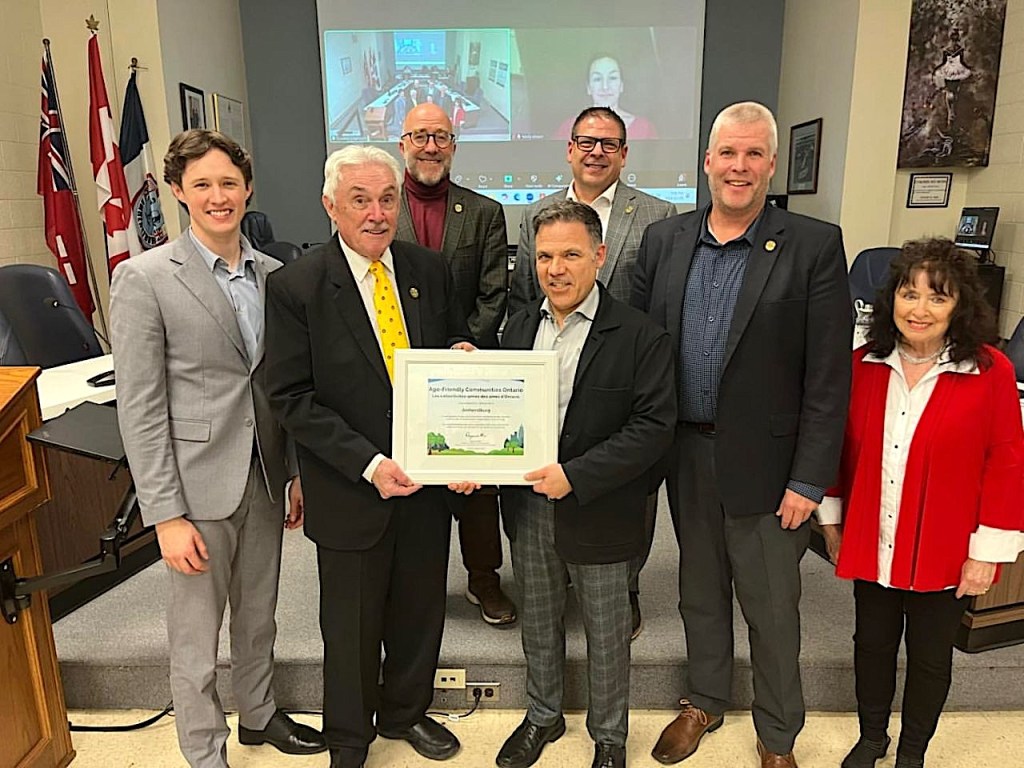
Councillor Linden Crain posted the above photo and mentioned initiatives in his March 10 social media posts.
“Proud to see Amherstburg recognized as an Age-Friendly Community by Ontario’s Minister for Seniors and Accessibility, Raymond Cho. Thank you to MPP Anthony Leardi for his continued support of initiatives that help make our community more welcoming and accessible for seniors,” wrote Crain.
On March 12, I asked council for the “initiatives that help make our community more welcoming and accessible for seniors.”
No answer.
I also shared my opinion; given how some seniors and people with disabilities are disgracefully treated in this community, council should be ashamed, not proud.
On March 13, I left a lengthy comment on the town of Amherstburg’s Facebook page when it shared the above photo.
Good optics, but Amherstburg is not an age-friendly or inclusive community given its historical treatment of some seniors and persons with disabilities. Concerns about some barriers in the community have been ignored. For example, accessibility is the number one concern in the first residents’ survey but council took no meaningful action regarding the feedback. Thanks to a very restrictive procedural by-law, and Crain’s motion, residents are prohibited from delegating regarding Open Air barriers for two years. In 2025 Prue referenced the AODA and said, ‘this town has not been compliant. And I have promised, as mayor, and the council has promised, that we will hence for, hence forward, going forward, always be AOD compliant. And I want people to know that the those who have disabilities have every right to use every one of the services in this town, the same as everyone else.’ We know we have the right to equal participation but we can’t exercise it. The town continues with an agreement with Movati for swims despite knowing the pool is inaccessible to some residents. The town continues to approve businesses that are inaccessible to some residents despite knowing the AODA customer service standard was enacted in 2008. The town hall still has barriers. Playgrounds are minimally accessible but not inclusive. The senior centre parking lot is a disgrace but money has been prioritized on unnecessary items like walking trails. Some feedback on the multi-year accessibility plan has not been included in reports. When people complained about patio barriers on sidewalks, Prue said if they won’t get out of the way on the sidewalk, they won’t get out of the way. He thought a business case had been made, and he believed that is in the best interest of the town to be a welcoming and friendly place for people to sit out and have a meal in the sun. Clearly, barrier removal is not being prioritized.
No answer.
On March 15, I visited Crain’s Facebook page and asked, “what initiatives?”
I reminded Crain that I asked on Facebook and by email but no one answered. I also reiterated my opinion that Amherstburg is not an inclusive or age friendly community given how some seniors and people with disabilities are treated.
No answer.
I also reached out to the ministry on March 12.
Officially, the honourable Raymond Cho, Minister for Seniors and Accessibility, recognized 69 communities, including Amhersturg, at the Age‑Friendly Communities Recognition Ceremony at the Rural Ontario Municipal Association (ROMA) conference in Toronto on January 18.
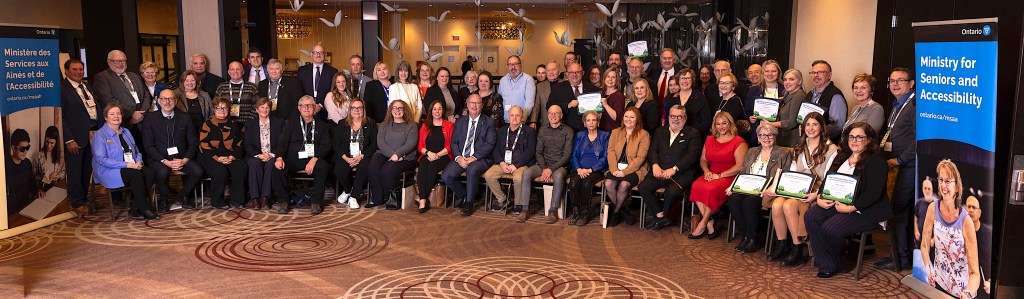
Photo courtesy of Ministry of Seniors and Accessibility
“The Ministry for Seniors and Accessibility (MSAA) Age-Friendly Communities (AFC) Recognition Program recognizes municipalities and organizations that create more accessible environments for people of all ages and abilities. This includes safe and accessible public parks and community centres, as well as recreation programming to help local seniors stay active in more walkable communities, with access to transportation and services that make it easier for people to get around,” emailed Wallace Pidgeon, Director of Communications, Office of Minister Raymond Cho.
“MSAA has an evaluation process and criteria that are used to determine which communities receive recognition based on demonstrated progress and initiatives that support age‑friendly, inclusive environments,” stated Pidgeon.
Pidgeon provided two contacts for Amherstburg for more information: Valerie Critchley vcritchley@amherstburg.ca and Councillor Donald McArthur dmcarthur@amherstburg.ca
I asked both Critchley and McArthur, “what was the criteria and what did the nomination process entail?”
No answer.
I followed up with the Ministry at the end of March, “Can you advise where I would find the specific criteria for the awarding of the certificate, assuming it’s the same for every municipality?”
“All communities are assessed against the same criteria. The criteria for the Age-Friendly Communities is outlined here at: Ontario’s Creating a More Inclusive Ontario Age-Friendly Community Planning Guide for Municipalities and Community Organizations (AFC Guide),” said a ministry spokesperson.
“In AFCs, community leaders and residents work together to ensure that local policies, programs and services are inclusive and support the social and physical environments that enable Ontarians to live safe, active and meaningful lives,” notes the Guide.
Four steps in the 2021 Guide’s Age-Friendly process are:
- Step 1: define local principles
- Step 2: assess need
- Step 3: develop action plan
- Step 4: implement and evaluate
Amherstburg received a $60,000 Inclusive Communities Grant to ‘foster inclusive community involvement‘ in 2020-2021.
The $60,000 was used to hire a consultant to complete a Needs Assessment and Action Plan Report, obtaining direct input from those most affected, seniors 55+, older adults 65+ and persons with disabilities.
The town appointed some members of each of the accessibility and seniors committees to form the new Inclusive Community Advisory Committee on April 27, 2021.
Amherstburg’s needs assessment aligned with the World Health Organization’s (WHO) eight domains of quality community life that overlap and intersect to affect an individual’s personal well-being, their independence and active living.
The 8 Domains:
- Respect and Social Inclusion
- Outdoor Spaces and Buildings
- Transportation
- Housing
- Communication and Information
- Social Participation
- Civic Participation and Employment
- Community Support and Health Services
The WHO website contains a detailed explanation and a history of AFCs.
So, what the town of Amherstburg did to become an AFC seems vague.
I know what an AFC is, in theory, but the reality doesn’t seem to fit.
Some of the town’s strengths listed in the report:
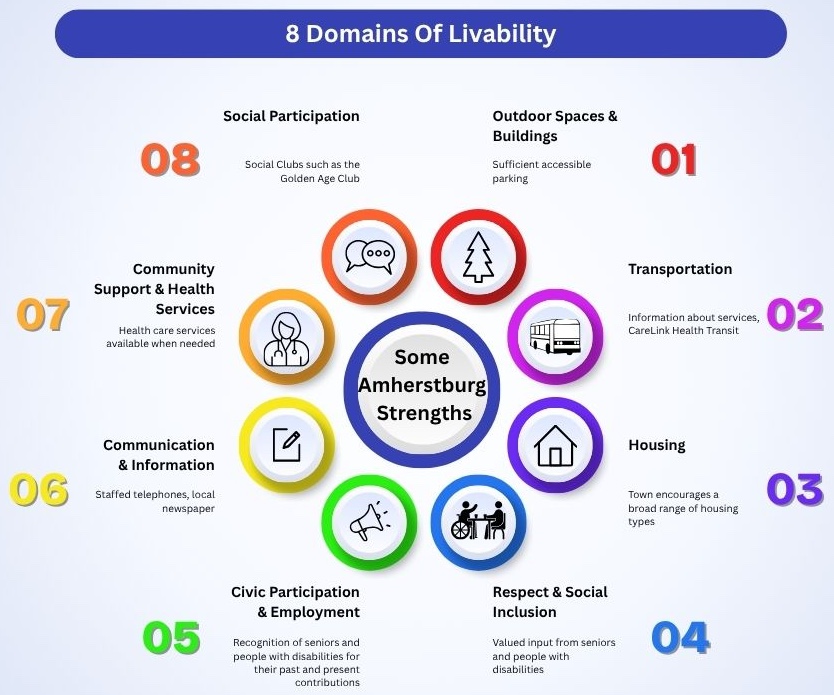
These five pages of the report list all identified existing strengths and suggested improvements.
Strengths like sufficient accessible parking, information about transportation services, and valued input from seniors and people with disabilities are noted.
Residents have complained about a lack of parking spaces; information about transportation is pointless if transportation is limited and/or unavailable.
My input as a person with a disability has not been valued. I’ve advocated for a strong commitment to equality without success for decades.
The number one complaint in the first residents’ Open Air survey is accessibility, but council took no meaningful action after learning about the survey results.
The parking lot at the seniors centre has needed repairs and paving for years but it hasn’t been prioritized.
Social media posts about seniors at the centre having to supply their own mop and bucket to clean the building, also used by others, circulated recently.
Seniors Advisory Committee meetings were last held February 8, 2022 when recorded votes were taken for approval of minutes and adjournment with minimal or no substance to discussions.
Perhaps the most convincing evidence of the lack of a commitment to inclusivity is Mayor Prue’s 2023 declaration that in this town we have not brought it (AODA) into force.
“2025 we’re going to have to make everything accessible in this town, that’s the law. I was in the legislature 20 something years ago, and I spoke to this issue when the bill was presented in the legislature, and I scoffed at them. I scoffed at the liberals who were standing up waving this piece of paper around, saying we’re going to be accessible, because it could take 25 years to bring it into force. Well, in this town, we have not brought it into force.”
“This town has not been compliant. And I have promised, as mayor, and the council has promised, that we will hence for, hence forward, going forward, always be AOD compliant. And I want people to know that the those who have disabilities have every right to use every one of the services in this town, the same as everyone else,” said Prue at the start of 2025 – the AODA deadline.
Ontario launched the Age-Friendly Program in 2017 ‘to recognize municipalities and organizations across the province that have made outstanding progress in creating inclusive and accessible communities for people of all ages and abilities,’ states a provincial press release.
Ontario’s first Age-Friendly Community Recognition Awards were given to 40 communities for Being Inclusive and Accessible for Seniors.
“We hope to make this an annual event,” emailed Pidgeon.
Provincial recognition of an age-friendly community will trigger eligibility for pan-Canadian recognition and international endorsement through the World Health Organization.
Related: Comparing Amherstburg To Other Municipalities: Inclusive Communities Grants.
Same Old In Person Voting For 2026
If I could give out awards for last night’s council dumpster fire, Deputy Mayor Gibb would be the recipient but there would be some runner ups. It would be so refreshing to listen to council members who would demonstrate they’ve conducted independent research. Instead, ableism was on full display, along with the race to ‘support the recommendation of administration.’
Gibb said he wanted to stick with in-person voting, “you can’t get more accessible than that.” Because two dozen people used in home voting? He said accessibility options have been addressed. And I have strongly encouraged him to take more training in accessibility and human rights.
Councillor Crain mentioned cybersecurity and believed the in-person method should be continued. Okay, then stop being on social media and meet all the constituents in person. Oh, and get rid of the town’s Talk the Burg online surveys.
Councillor Allaire said in-person voting gave residents at Seasons a sense of independence. She doesn’t get it and has a lot to learn. Her statement that online voters could be influenced if others are looking over their shoulders was what convinced me.
Councillor Courtney said it was a hybrid option already with the in-home option for people with accessibility needs. I don’t think he gets it either.
Councillor Pouget thought the decision could be deferred pending more consultation. The clerk said a bylaw needs to be passed prior to May 1, 2026, but resources need to be secured as quickly as possible. But admin is to blame for not bringing the report back by mid-term as the CAO mentioned. (Shhh; no kudos for admin). Like the policing renewal contract that was delayed until there was no choice but to stay with Windsor, oh, time ran out to consult the public so stick with the same old and stay comfortable with that.
Councillor Don McArthur agreed with Pouget. He said voting at the polls is “democracy in action” but acknowledged it is harder for some to get to the polling stations than others. I think democracy in action is the voting process, not the voting method.
Mayor Prue said “I’m a little nervous about going with the computer system until I get a little more safeguards than I saw in the report.” But I mentioned the accredited standard that wasn’t mentioned in the report. Did he not catch that when I spoke?
A post-election survey was mentioned, along with the 73% in favour of in person voting. I support taxes being put toward calculators for members of council. A man was asking voters at the Libro how they liked to vote and used tally marks. When I asked him when the survey was decided he said that day he was given pen and paper.
As I advised council, the 73% represents only about 16% of eligible voters in town. Using 2022 eligible voters’ data, about 9000 residents have a disability or have a family member with a disability. Remember how council members voted before you vote in 2026.
Amherstburg Resident On Windsor Police Service Board
David Hammond, of Amherstburg, is a provincial appointee to the Windsor Police Service Board as of January 16, 2025 and will serve until January 15, 2027.
Mayor Prue might not be happy that his role is to be an Advisor on the Windsor Police Service Board, without a vote, but the terms of the contract were known when town council renewed the contract on February 8, 2023.
I reached out to Mayor Dilkens, who responded by email:
The City of Windsor has a contract to provide policing to the Town of Amherstburg. Windsor City Council was agreeable to providing their one seat to the Mayor of Amherstburg for the first term of the agreement. After the first term, the contract specifically allows City Council to choose any other member of the public. The contract also provides that if the mayor of Amherstburg is not selected, then the mayor can sit as a non-voting advisor to the Board, which Mayor Prue has done since assuming his office. The City of Windsor is simply a service provider to Amherstburg. We aren’t jointly governing the Windsor Police Service. David Hammond is a provincial appointee to the Windsor Police Service Board. The City has no control over who the Province of Ontario appoints as their representatives. The City of Windsor can only appoint a single public member to the Board. The remaining appointments controlled by City Council must be members of Windsor city council.
The initial Agreement between the Town of Amherstburg and the City of Windsor, signed on October 12, 2018 stipulated:
The following shall determine the role of the Town with respect to the Board:
14. l (a) The City shall appoint the Mayor or his or her designate to the Board for the remaining term of Council until November 14, 2022, starting with the commencement of this Agreement on January 1, 2019.
(b) The City may consider the appointment of the Mayor or his or her designate for subsequent terms of Council provided that the City is providing police services to the Town.
(c) If at any time during the Initial Term or any Renewal Term, the Mayor or his or her designate is not appointed to the Board, the City agrees to allow the Mayor or his or her designate to become an advisor to the Board, as contemplated by the Act with the full ability to attend all meetings of the Board.
For further clarification regarding 14.1 (c), ‘all meetings of the Board’ shall include in-camera meetings and the advisor shall also receive all reports and correspondence as a full member of the Board would receive, subject to the advisor signing a confidentiality and non-disclosure agreement.
Essex County’s Fest-for-All: A Call for Action on Accessibility
We need action, not more rhetoric.
From the Essex County News update about the Essex County Accessibility Advisory Committee’s ‘Fest-for-all’.
“Amherstburg is honoured to host this event and there’s no better place to host it than the Libro Centre – an accessible facility and the home of Canada’s first ever Miracle League,” said Amherstburg Mayor Michael Prue. “There will be something for everyone at this amazing festival and it is my hope people come to Amherstburg from far and wide to learn more about accessibility issues and the importance of building inclusive, barrier-free communities.”
Mayor Michael Prue
Well I have been advocating for over 3 decades for accessibility by delegating, emailing, blogging, and writing letters to the editor. I resorted to a human rights complaint against the town to gain equal access to the library following my 10-year campaign.
Both staff and members of council, other than Councillor Pouget, have dismissed the existence of Open Air barriers. The number one complaint in the residents’ Open Air survey is accessibility but council did not take any meaningful action about it.
Councillor Crain
- was the sole opposition to a residents’ Open Air survey, stating they’ve done an Open Air survey for residents and businesses so he felt it would waste staff time. CAO Critchley confirmed there was no resident wide survey.
- Crain was part of the team that created the THRIVE Open Air white paper; from the THRIVE website, ‘We believe that it should be a permanent summer feature.’
- During the 2022 campaign, Crain said yes to removing barriers during Open Air; it is important that all members of the community can experience Open Air. If there are particular barriers in place, I am more than willing to investigate further and help find a solution.
- Crain also said he didn’t even think Open Air should have been a topic of discussion, that they shouldn’t even be discussing this every year because eventually it’s going to be nothing.
- During the November 21, 2024 Economic Development Advisory Committee Meeting Crain moved, McArthur seconded That:
1. The report on the Open Air including the Business Survey and Open House BE RECEIVED for information; and
2. Council SUPPORT the continuation of Open Air, in the same format, same times, and same duration, for the remainder of the current term of Council. - During the November 25, 2024 council meeting, Crain moved, and McArthur seconded That:
1. The report on the Open Air including the Business Survey and Open House BE - RECEIVED for information; and
2. Council SUPPORT the continuation of Open Air, in the same format, same times, and same duration, for the remainder of the current term of Council.
- During the November 21, 2024 Economic Development Advisory Committee Meeting Crain moved, McArthur seconded That:
Councillor McArthur
- volunteered to be on the Amherstburg accessibility committee
- has championed Open Air.
- McArthur said everybody he talked to loves Open Air the way it is.
- McArthur stated how families come together, and he didn’t want to take that away from people. (Yet children with disabilities that can’t equally access play areas can’t come together with families, so they have that opportunity taken from them).
- During the 2022 campaign, McArthur said if there are persisting issues with accessibility, let’s work collaboratively to address them in consultation with the Town’s Accessibility Advisory Committee.
Deputy Mayor Gibb
- publicly admitted he’s a huge fan of Open Air.
- Gibb stated he was ‘proud to say that I did complete the ADOA training that was offered to all members of council and I hope to put what I learned into practice not only in my “municipal life” but also in my personal life.
- And then he said, “to me, Open Air makes the downtown more accessible for people with in at least in wheelchairs because I’ll tell you right now, try and push a wheelchair down one of those downtown sidewalks and you’ll see exactly what I mean.”
- am800 2024, Gibb said, “”It’s family friendly, it’s free, it’s pet friendly, it’s accessible so we just want to invite all of Windsor and Essex County to come out to Amherstburg and get together and have a great time.”
Mayor Prue
- broke the tie vote in favour of 14 weekends for 2023.
- in 2023 Prue said, I have been to every single one of these events and probably most of the Open Air weekends; not all of them, but most of them. I have never seen any problem with access. My wife is the chair of the accessibility committee. I have discussed it with her she has never once said that there was any accessibility problem brought to that committee or anyone on the committee. I know there was one complainant, but I don’t necessarily agree with what’s being said. (aside from my complaint, council was advised that there was a member of the community who felt that there were barriers).
- On the rainbow crosswalk, Prue said, ‘WE ARE AN INCLUSIVE COMMUNITY. GET USED TO IT’. “It helps to reinforce what an inclusive community is all about.” “I’m very proud of this town and foresight and the inclusivity that people have shown.”
- On the dog park, Prue said it ‘reflects our commitment to creating a vibrant and inclusive community for all residents, including our beloved canine companions.’
- On the Salty Dog patio, Prue said I am sorry that some people are not getting out of the way when someone comes by with a cane or a walker or a wheelchair, but what difference would it make if there was two cars there instead of the patio? If they won’t get out of the way on the sidewalk, they won’t get out of the way. And so I think a business case has been made, and I do believe that is in the best interest of the town to be a welcoming and friendly place for people to sit out and have a meal in the sun.
- During the 2022 campaign, one of Prue’s priorities was, ‘Ensure all town buildings are accessible to facilitate an open and inclusive municipality.’
- Prue referenced the AODA in 2023 and said in this town, we have not brought it into force.
- In 2025 Prue referenced the AODA and said, ‘this town has not been compliant. And I have promised, as mayor, and the council has promised, that we will hence for, hence forward, going forward, always be AOD compliant. And I want people to know that the those who have disabilities have every right to use every one of the services in this town, the same as everyone else.’
- On the sign by-law in 2025, Prue said I don’t mind the signs. I don’t mind them, provided they are AOD compliant. I will never, never support a sign that is blocking someone who is blind, in a wheelchair, a mother in a carriage, with a carriage. I will never, ever support that sign on the street, because those people have rights, same as all of us. They’re not different. They have rights, and their rights, I think, supersede the rights to be safe, supersede the rights to make money.
Anne Rota - was ordered to take human rights training following a human rights tribunal hearing
- on Open Air, said, ‘there are no barriers in open air. There are not. Please come down and have a look. I know that for a fact. It’s not just the golf cart. We’ve actually opened up our arms if someone needs to get through. We’ve never had one complaint. That’s the honest truth in three years, and I’m sure we would have.’
RECAP Council Meeting June 24, 2025 Part 1 Sign By-law Delegates and Discussion
Objectionable. Mayor Prue’s offensive terminology, a good indicator that council needs more intensive accessibility training, Deputy Mayor Gibb’s ridiculous rant about human rights complaint and speaking as a business owner, the usual kudos to staff, maybe a bit more than usual, typical confusion about motions, unnecessary clarifications sought, time wasting passing the gavel, and five passionate delegates pleading to keep signs to offset lost revenue.
Delegate 1: Paul Peltier, representing the K of C hall, mentioned having a sign there for at least 30 years with no complaints and no problems; it doesn’t interfere with any pedestrian traffic, and are at least a meter and a half away from the parking blocks. Peltier noted how important the sign is to advertise bingo, fish fries and making donations to community groups of over $40,000. annually, and donating almost half a million dollars since the beginning. He said it really hurt to have somebody come in and say, you got to move it.
Questions to Peltier:
Councillor Pouget thanked Peltier, acknowledged the hard work of the K of C and for confirmation that the sign has been there for 30 years, and is not on the sidewalk. Councillor Courtney asked him what he didn’t agree with regarding the proposed sign by-law. Councillor Allaire asked if he was okay with a fee if he had to pay a fee for it, like an annual fee of $150. Prue reminded Allaire that fee was for A frames and this is not an A frame. Allaire wanted to ask Bill Tetler a question and Prue said ok but then he said questions were to be directed to the deputants. Peltier focused on how they say it has to be so far from the lot line and then it says you can only do it for a certain period of time and then you can’t leave the sign there, and it’s got to go back in; he was ok with a fee.
Questions to Staff
Pouget asked Tetler why his sign had to be removed when it does not; before she finished her sentence, Bill Tetler explained that the sign is, under the sign by-law definition, a mobile sign, that requires a permit under the current sign by-law; it required a permit under the previous sign by-law as well.
Pouget said they never had a permit for all these years and Tetler said he was not aware of them ever having a permit for a mobile sign. Allaire asked which type of sign he would consider the Knights of Columbus’ sign to be under the sign by-law; permanent or mobile. (Tetler just told Pouget that it’s a mobile sign under the sign by-law).
Allaire then asked about the cost to keep it there permanently and Tetler said they weren’t allowed under the current by-law; it could be there for 200 days, for $1 per day, and the business can choose the duration at any given time. He explained the maximum is 60 days at a time, there has to be a 14 day break in between the maximum days of permits. But someone could apply for a 15 day permit and then a 23 day permit, like they can utilize their 200 days to the best to their business. Tetler said they could contact the building department and work with them about erecting a permanent sign on that property, potentially with a manual change in letters, rather than having a mobile sign. Tetler continued, a mobile sign is not a permanent sign; it cannot be used as a permanent sign but by definition, if a mobile sign is never leaving the location, it could be looked at as a permanent sign.
Prue passed the gavel just to ask, if they move it somewhere else on the lot will they be in any violation at all? Tetler said they could apply for a mobile sign permit and have it located elsewhere on the property
Delegate 2: Lynn Durfy, owner of Lynn’s Variety for the last 31 years expressed concerns about the current by-law that prohibits sandwich signs and A frame signs on the boulevard where she’s had her sign for the last 24 years. Durfy said her sign has never caused a problem, no one ever complained until the by-law officer stood in front of her threatening a fine if it wasn’t moved in 24 hours. She said she moved the sign into her parking lot three metres as she was told she needed to be from the sidewalk and then she got a phone call saying that she still was going to be fined because it needed to be three metres from the lot line, which is technically the front of her building, so the sign then needs to be right up against the side of my building to meet the by-law.
There were no questions of the delegate.
Questions to Staff
Courtney spoke at length and mentioned AODA compliance and limiting the number of signs, the size of the sign and how secure it is and said he had a general question. Prue asked him to ask a question specifically about Lynn’s Variety like, why is that sign not appropriate? Why is it illegal? Prue then asked why it was illegal. Tetler said the setback requirement of the sign by-law is two meters; any business owner that has enough property to have the sign on their property is allowed to have it. He suggested that most businesses will be allowed to have the sign, just maybe not in the current location.
Delegate 3: Peter Leardi, business owner for 40 years now, 21 years at their current location. He’s had a portable sign in front of my current location for 21 years for multiple reasons:
- To announce new seasonal arrivals.
- To advertise promotional items, advertise end of season sales.
- The ability to advertise and take advantage of all the traffic on Sandwich Street was one of the reasons he moved his business and spent $600,000. 21 years ago. That portable sign would help draw traffic into his store and hopefully keep business here in our community.
- The sign was four feet wide and five feet tall; it sat three feet on his property and one foot on town property. There existed 12 feet of remaining sidewalk from the edge of his sign to the road curb. In absolutely no way was his sign an impediment to pedestrian traffic, vehicle traffic, and it was also AODA compliant.
- In the 21 years that that sign sat out in front of his store, the only complaint that he ever received was from the town of Amherstburg. On April 25 of this year, he received an order to comply that said he didn’t have a permit and it was too close to the lot line.
Leardi wanted to address some conditions of the new by-law and his order to comply:
- The order to comply stated he didn’t have a permit. However, he wanted everyone to know that he has always paid his permit fee through his sign supplier.
- The order to comply states that his sign is too close to the lot line. That is absolutely true. It sits on 12 inches of town property, but there’s 12 feet of sidewalk to the road, curbside on the other side of that sign, it was bothering no one, by the way, for the last 21 years, that 12 feet of sidewalk and patio on the other side of that sign; he’s swept it, cleaned it, shoveled the snow off of it, salted it, and never once sent the town a bill for that.
- The new by-law puts a limit of 200 days on the use of a portable sign. It goes on to say that this time allowance is generous compared to other municipalities in Essex County; who says the other municipalities are correct? Why limit the use of signs? And can someone please tell him which 200 days of the year are the best years to advertise? There should be no limits on the usage of a sign. If you’ve paid for the permit for the year, let the individual or business use it for the year. He doesn’t understand why the town of Amherstburg would do anything to impede the success of any small business in its community, unless the business was doing something illegal or posing a harm to its citizens, he was doing neither. Just in the month of May this year, and in June, my prom and grad suit sales were down 54% and 45% respectively. He had to take his sign down on May 2. Aside from affecting his business, his two tailors here in town had less work. He shared a supportive email from a parent that was grateful to be able to shop locally, while other parents were unaware of a sale because the sign was not out. He said he’d lost enough revenue the last seven weeks to pay for a sign permit for the next 75 years.
There were no questions of the delegate.
Questions to Staff
Pouget asked Tetler why they would make Mr. Leardi remove his sign if it was less than a foot away from town property and wondered if they couldn’t have worked with him to make sure that he was able to advertise until this report came back to council. CAO Critchley answered that she didn’t believe that council suspended the operation of the by-law so they did not have the authority to do that; that’s up to council to make that motion to suspend that.
Delegate 4: Sarah Brush, proud owner/operator of Speck’s Restaurant in Amherstburg for nearly 55 years, more than half a century. Speck’s isn’t just a restaurant, it’s a gathering place, a part of the fabric of this town, people come for the food, but they return for the connection. For decades, they’ve supported this community, quietly, consistently through local causes, kindness and hard work, but she will always stand up for what’s right, to protect what they’ve built, and to ensure that small businesses like hers are treated with fairness and respect. She said she’s appeared before council more than once, and while it takes time and energy, she will not back down. When she is suddenly told she can’t display a simple open flag she’s had for 55 years, she has no choice but to speak up. That flag never blocked a sidewalk, and it is on her own property; it’s never posed a safety hazard, and it complies fully with AODA standards. She mentioned that customers are confused, foot traffic is down, and their business has suffered because of a by-law that was drafted without real consultation with the people it affects most.
She said she has never paid a cent to the town to display this flag, and she doesn’t intend to now, this kind of nickel and diming of small businesses isn’t just unnecessary, it’s damaging. It sends the wrong message about who we are as a town. Brush wanted to make it clear that this just isn’t about Speck’s, it’s about every small business in Amherstburg. Small businesses are the heart and soul of this community; they create jobs, attract visitors, and bring life into our streets. When their visibility is restricted, so is their ability to survive. These signs and yes, even flags aren’t clutter. These signs are our connection. They’re how they let people know they’re here and they’re open. When they’re signs come down, so does the energy and life of this town. We want a council that understands us, respects us, and lets us run our businesses the way we always have, with pride, honesty and care.
Brush continued: frankly, this by-law doesn’t make sense. We’re being told to take our signs down, but then told it’s fine if we pay $150 a year. What kind of business logic is that if a sign is truly unsafe or inappropriate, charging a fee doesn’t make it any less so, and if it’s safe and has never been a problem, then why are we being punished for something that has worked for decades? Get rid of this ridiculous by-law. It’s hurting the very people who helped build this town. I still believe in Amherstburg. I believe in working together, and I hope that moving forward, we can have more conversation and not more enforcement, so that Amherstburg stays a place where small businesses feel valued and not punished. Let’s keep this town open, thriving and welcoming, just like it always has been.
Questions to Brush:
Pouget wanted to clarify that her sign was AODA compatible, not in the way and on her property. Brush said it’s in her garden and 2.5 meters away from the sidewalk.
Questions to Staff
Allaire asked how her sign was illegal if it’s 2.5 meters from the sidewalk. Following some confusion about which sign was being referred to, Tetler said the flag signs referred to in the by-law are prohibited in the HCD, the heritage conservation district, which is why the sign was asked to be removed.
McArthur asked for clarity because they haven’t passed the heritage conservation district. Tetler explained that the by-law states that that type of sign is not allowed in that area. Therefore, they did that enforcement, but A frame signs are allowed to be at the property line in that area. The explanation was that although the district hasn’t been adopted, the area was identified in the sign by-law.
Pouget agreed with Brush’s question – how is it okay for businesses to put up signs if they pay, but it isn’t if they don’t pay? Pouget asked, aren’t we more worried about keeping our residents safe and to follow the rules of AODA? If we’re making them move their signs because we’re saying they’re not in the correct area, then why would it be okay for them to put their signs there if they pay?
Critchley said if there’s a sign in the HCD, HCD overlay area, that wouldn’t be allowed at all so there would be no payment for sign. She thought that council had to make decisions on whether to allow a mobile sign in the HCD, because the by-law says no to that; A frame signs are permitted if there is enough width on the sidewalk. The fee is because it’s in the public right of way and is an encroachment on town property; and council had to decide whether to keep the 180 day time frame limit for mobile signs.
Pouget noted how they waived fees for residents on George Street, whose homes were on town property and asked if they could do the same thing tonight. Critchley said council can decide whatever council deems is appropriate in circumstances.
More discussion about what would and would not be allowed in heritage districts. A frame signs would still be allowed in the HCD, mobile signs would not be. McArthur sought clarity again because the report says that mobile signs are not permitted within a heritage conservation district and wondered if that was a provincial rule, or should this read they’re not allowed in ours because it says it’s not allowed in any Heritage Conservation District.
Delegate 5: Jen DeLuca, from Waterfront Ice Cream, understood that a complaint was made about A frame signs blocking the sidewalk and not being AODA complaint. What she didn’t understand is why an entire by-law had to be rewritten to address this. There was no consultation with the businesses, no meetings, no open houses, just a sign blitz. So they sent emails; they then tried to speak at a previous meeting but were denied the opportunity. They have no recourse to share their concerns when this happens, and here they are, two months later speaking at a meeting. Why is there no other more productive and more expedient way to work with the businesses? The businesses there have had signs out for 50 years, 46 years, 25 years and more, all of which are AODA compliant; they were greeted with citations and pending fines during business hours for not removing their signs. In this two month period, the absence of signs caused a drastic decrease in customers and sales for many, and here they are with a report only to tell them that after having to remove our signs and incur loss of business, they now get to continue to have this prior privilege reinstated, but for a yearly application and fee. This is clearly not about AODA compliance, since their our signs actually meet this criteria. (I strongly agree). It is about greed and taking more money from small businesses. DeLuca mentioned local businesses that would endure burdens: Armando Pizza, Wigle Meats, 67 Richmond Street, noting ‘some of you’ show your public support for Freed’s, Gumballs and Overalls, Ure’s Country Kitchen; their signs impede no one and they are essential to the success of their small businesses. DeLuca said they adopt bylaws that you do not fully read or understand, and there’s no communication with the actual people they affect. (Again, I strongly agree).Then they get five minutes to state their plea publicly. As business owners, they must leave their businesses to do this every time and she pleaded with all of them to do better. She thanked Councillor Pouget because she’s the only one who continues to ask questions for them, and she advocates for them, especially when she admits that her decision was bad for businesses. Asking them to wait for a report and sit tight while losing customers is not an appropriate answer; please erase the fine print in this by-law and don’t charge the business community to advertise for their businesses and livelihood. DeLuca asked, when did we stop taking care of each other? She mentioned how her husband, like Mr. Leardi, maintains the town property beyond their property line. For 46 years, Waterfront has been doing that and now she has to pay to put her sign there. It just doesn’t make sense. If there are other businesses who don’t have that AODA compliance, deal with that in a different light, but to rewrite a whole new by-law and pop in people’s businesses during business hours with a citation and a threat to be fined just doesn’t seem right. It’s not.
There were no questions of the delegate.
Questions to Staff
Pouget said she had no questions, but I do have a motion when it’s time.
Prue said he would allow the motion later since they were discussing general questions, not individual properties, but just about a by-law that is an old, old, old by-law, not new; this is going back 25 years, it just wasn’t enforced. (Didn’t we pay for by-laws to be enforced?)
Pouget asked Critchley if they enact this by-law, would it mean extra work for administration to go out and collect fees. Critchley said if you enacted the amendment to the by-law that the report suggests i.e. allowing A frame signs, if they’re permitted, people would have to make their application, so yes, it is additional work to have the A frame signs on public property. Critchley said they put the fee in there because they were following Council, what they thought was Council’s direction in terms of usage of public property. With the temporary patios it was certainly made clear that people should have to pay to use town property so they wanted to make sure that they were collecting back the money that would be used in staff time to take permits and do inspections. Critchley said the fee that’s being charged is not cost recovery.
McArthur asked if Mr. Leardi would be allowed to have a mobile sign and if Speck’s restaurant would be allowed to have the flag if they were within the HCD. Tetler said neither would be allowed.
Prue passed the gavel to ask a couple of questions; he mentioned a sign by-law that comes up every four years during elections and how some members had signs removed because they were on town property. He said he doesn’t mind the signs, provided they are AOD compliant. Prue said, “I will never, never support a sign that is blocking someone who is blind, in a wheelchair, a mother in a carriage, with a carriage. I will never, ever support that sign on the street, because those people have rights, same as all of us. They’re not different. They have rights, and their rights, I think, supersede the rights to be safe, supersede the rights to make money.”
Pure said what he wants to see is a sign by-law which is permissive, which will allow businesses to flourish, but will also be safe, and if they have to charge a few dollars, Ms. Brush says she’s not going to pay, well, he guessed what happens with all by-laws when people don’t pay, you end up in court. Not that that’s a threat, but that’s what happens. That’s what happens with every by-law that’s broken. Prue said Mr. Leardi made a very strong point; he said he would gladly pay because he lost more money. He lost 75 years’ worth of payments for the lack of that sign. I’m sure he would gladly pay for it and Lynn’s Variety, she said she just wanted some kind of compromise and I think that makes perfect sense. The K of C wants to compromise, and one is available to them so as a town they have to try to do something to compromise. He said he was waiting for the motions, but please, whatever they are, make them AOD compliant. Make them enforceable without being onerous. And let’s, as some of the delegates said, bring people back together. He thought it could be done; it’s up to council. He took the gavel back to hear motions.
Courtney said the gist of what he gathered was AODA compliance and there should be a one sign limit.
Pouget moved a motion to direct administration to allow businesses to advertise with sandwich boards, flags and mobile signs that fall within the guidelines of the AODA and do not obstruct mobility devices without payment to the town of Amherstburg in order to allow these businesses to thrive and to promote economic development. Further to that, this section of bylaw 2025-001 be removed.
Prue made a point of telling people in the audience that just because Councillor Allaire seconded it doesn’t mean she’s necessarily going to support it but she wants to hear it. Allaire asked which section would be removed since she didn’t have the by-law in front of her.
Critchley’s interpretation was that mobile signs and A frame signs would be allowed anywhere in the town if it was AODA compliant.
Allaire said she had it written a little bit differently, and she would love it if Pouget would just take on her amendments. Allaire was okay with not having mobile signs in our historic district, she didn’t think it would flow nicely with what they’re trying to create in our sweet town. She was okay with the overlay in the historic district, okay with this entire sign by-law to begin with and she was listening and understanding. She had written down that all signs must be compliant with accessibility for Ontario’s with Disability Act, (the proper title is Accessibility for Ontarians with Disabilities Act), signs must be placed entirely on the property of the individual for entirety displaying of the sign, so it must be on their property. In cases where the signs are not placed on the owner’s property, a fee shall be charged to offset the cost of the application processing, inspections and potential enforcement actions, that is just to cover the cost the by-law has to come out to make sure that it is safe to be on our property. It is only for signs that are not on entirety of their property and remove the time restriction so signs could be on display year round.
Prue said Pouget’s motion had to be dealt with first. (He should’ve said that as soon as he heard Allaire speak about the motion she had written differently).
Gibb’s speech: They never tell you when you run for council that you’re going to have to sit and look at your friends out there and disappoint some and make other ones happy. So that’s always the hardest part. The other thing is, I have to say, I wholeheartedly agree with Councilor Allaire; we’re not doing this to be mean, we’re not doing this to make people’s lives difficult, but this town is also a business, and if we don’t follow the law, especially with accessibility, we’re going to be fined. We’re going to be brought in front of the Human Rights Tribunal. It’s going to happen so we have to act. There’s going to be a cost to review these signs that are going to be on town property, there’s going to be a cost because we’re going to have to document it. We’re going to have to make sure we can defend ourselves when the inevitable human rights complaint or lawsuit comes, and I can’t ask the taxpayers to pay that cost. I have to put that like Councillor Allaire said, that has to be paid by the business owner. I’m sorry. It’s just not something that I can put on the taxpayers. We’ve charged other businesses to use town property. I don’t see what the difference is here. You know, the heritage district, as far as mobile signs and flags, I again, I agree with Councillor Allaire. That’s just not what we’re trying to do. I get it. I’m sorry that I’m going to disappoint some of you, but I agree with her that if we’re going to have a heritage district, it has to stay heritage. If your A frame sign is entirely on your property, that’s great that you’ve got the room to do it. If you have to be on town easement, then there’s going to have to be some kind of fee to cover the cost of ensuring it’s there properly. In the sake of what does the mayor always say working together? I was going to say that I’m not entirely happy about having no limit on temporary signs. But again, in the sake of working together, I would support council. I think we have to balance protecting the municipality. We have to balance the fact that we have to document these signs that are on town property, and there’s going to be a cost to it. And if the sign is that important, I know myself as a business owner, I would pay that cost. So if Councillor Allaire has a chance to make that motion, I will second it.
Prue reminded everyone that they were only dealing with Councillor Pouget’s motion and to limit speaking to whether it would be supported or not. Prue recognized Crain and then McArthur to speak.
Pouget said excuse me, I thought I could speak on my motion first in and then Councillor Allaire interrupted and gave her motion; I’m supposed to be able to speak to it. (Pouget is correct. After Allaire read what she wanted her motion to state, Prue said Pouget’s motion had to be dealt with first. And, according to Robert’s Rules of Order, the mover does speak first).
Prue said he didn’t see her hand; he said he would recognize Crain and then he would come back to her and then McArthur.
Crain said he wouldn’t support Pouget’s motion. He believed it would be difficult if there is no cost or reporting to the municipality to confirm if signs are AODA compliant. He said he believes if it’s on town property they have to pay for staff time to conduct inspections.
Pouget said council has repeatedly heard how difficult it is for small businesses to be profitable and viable and how they pay for overhead, insurance, licenses, inspections, compete with online shopping and many more businesses locating in the town of Amherstburg. She referenced Sarah Brush’s statement that these businesses are the heart and soul of our community and have been for many years. They are not here for handouts; they are only asking for respect and a chance to operate their businesses as they have done by advertising with sandwich signs and mobile signs, flags, whatever, to keep their businesses viable in these hard economic times.
McArthur noted a lot of clarity was needed and asked that a friendly amendment be made to Pouget’s motion to allow for the duration of 365 days. McArthur asked for another clarification: would Speck’s be allowed her flag and Mr. Leardi his mobile sign? (Tetler already answered his same question earlier; he said neither would be allowed in the HCD).
Courtney repeated his thoughts about limiting the number of signs per business and the size. More confusion about whether those stipulations were amendments or were already in the by-law. Prue called the vote, which tied, which he broke in opposition because he liked Allaire’s motion ‘a lot better.’
Allaire then read her motion that Prue should’ve stopped her from stating previously. She moved that the sign by-law be amended to include the following provisions. All signs must be compliant with the Accessibility for Ontario’s and Disability Act. (The correct title is the Accessibility for Ontarians With Disabilities Act). Signs must be placed entirely on the property of the individual or entity of displaying the sign. In cases where the signs are not placed on the owner’s property, a fee shall be charged to offset the cost application processing, inspection and potential enforcement actions. The current restrictions on the duration of the time a sign may be displayed shall be removed.
McArthur asked yet another clarifying question: if everything else in the by-law stands. Critchley advised it should come back in August.
McArthur then said he liked Pouget’s motion, which is not always the case. (That’s an understatement, given the number of times he’s chastised her). He would oppose Allaire’s motion because it didn’t address the inequity of prohibiting signs in the HCD.
Gibb said he might as well get in there and share how he generally agrees with McArthur. (again, the number of times they echo each other’s views is obvious). In this situation, he disagreed and, as in prior discussions, it’s about equity – one rule for all.
Another tie vote for Prue to break and he said he thought this motion was better, so it carried.
20 Year AODA Anniversary – Barriers In The Burg
Then-MPP Michael Prue stood in the Ontario Legislature twenty years ago today, on May 10, 2005, where the historic Accessibility for Ontarians with Disabilities Act (AODA) unanimously passed. Watch the moment at about 4:26 into the video.
As Mayor, during a May 23, 2023 Amherstburg Council Meeting, Prue declared we have not brought it into force. Listen to the audio.
Unofficial transcript: 2025 we’re going to have to make everything accessible in this town, that’s the law. I was in the legislature 20 something years ago, and I spoke to this issue when the bill was presented in the legislature, and I scoffed at them. I scoffed at the liberals who were standing up waving this piece of paper around, saying we’re going to be accessible, because it could take 25 years to bring it into force. Well, in this town, we have not brought it into force.
When the first dog park opened in Amherstburg, Prue was quoted as saying, it ‘reflects our commitment to creating a vibrant and inclusive community for all residents, including our beloved canine companions.’
During a January 27, 2025 council meeting, Prue referenced the AODA and said, ‘this town has not been compliant. And I have promised, as mayor, and the council has promised, that we will hence for, hence forward, going forward, always be AOD compliant. And I want people to know that the those who have disabilities have every right to use every one of the services in this town, the same as everyone else.’
For as long as barriers exist, and they do, no one should claim we are an inclusive community. It takes strong leadership and a strong commitment to remove the barriers and keep promises.

