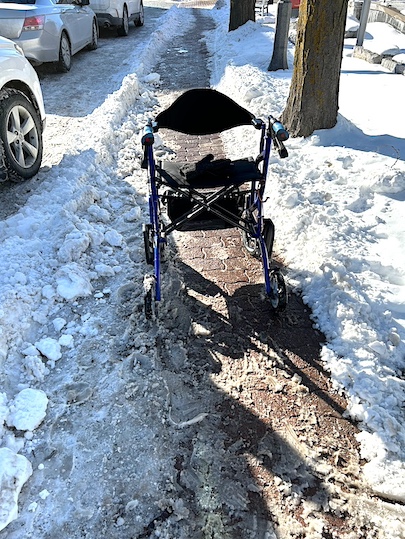
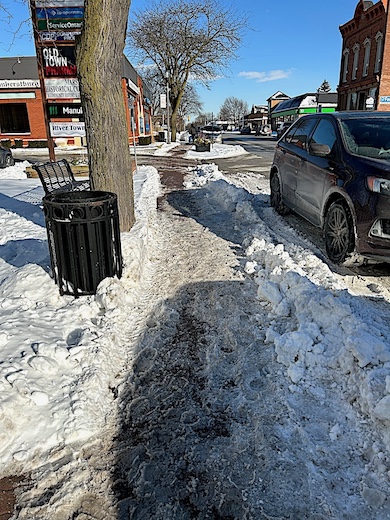
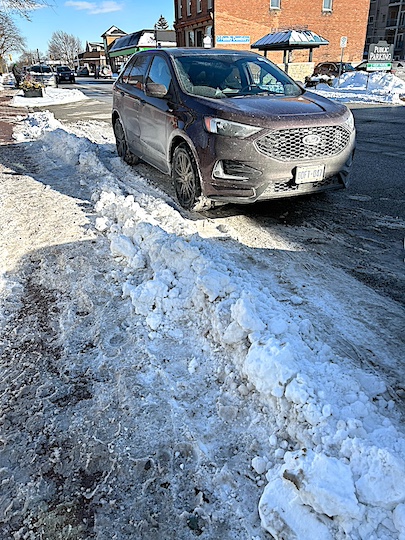
Sidewalks that have not been cleared thoroughly pose dangerous barriers to people with disabilities, as I discovered last Friday during a trip to the downtown post office.
in 2025 Prue referenced the AODA and said, ‘this town has not been compliant. And I have promised, as mayor, and the council has promised, that we will hence for, hence forward, going forward, always be AOD compliant. And I want people to know that the those who have disabilities have every right to use every one of the services in this town, the same as everyone else.’ So, we have the right – we just can’t exercise it, right?
The accessibility committee will discuss a report in favour of in-person voting that council already approved last month, review my 3 year old voting barriers submission to council that was to go to committee before council’s decision (as per council’s motion) and receive a communications plan for next May’s National AccessAbility Week with key messages. I have a few too, in blue below the town’s.
• Accessibility is a shared responsibility—together, residents, businesses, and community partners can help make Amherstburg more inclusive for everyone.
But some residents’ concerns have been dismissed and council took no meaningful action on the number one complaint of accessibility in the residents’ Open Air survey. My repeated requests for consultations with the disability community have also been dismissed. My emails to council members have been disregarded, except for Councillor Pouget and she’s not even an accessibility committee member. Councillor McArthur volunteered to be on the committee and he actively champions trails and Open Air, although I have encouraged him to equally champion accessibility. The town has approved, and welcomed, inaccessible businesses.
• Throughout the week, the Town will showcase local accessibility features in municipal parks, trails, and facilities, and share supports available to persons with disabilities.
The minimally accessible yet not inclusive parks that still exclude some children with disabilities? the trails that need more rest areas? lack shade? lack washrooms? lack drinking fountains? Facilities like the town hall that has accessibility barriers? the Gordon House that is inaccessible? Which supports? The Aphasia Friendly initiative where some businesses might become Aphasia friendly yet remain inaccessible?
• The flag raising ceremony will serve as a symbol of our continued commitment to accessibility, inclusion, and community collaboration.
A flag raising, or symbolic gesture, requires minimal effort. There can be no community collaboration if the disability community is ignored. Continued commitment? Dictionary meaning: existing firm decision. When barriers at Closed Streets are embraced, the least accessible voting method is endorsed, parks are not inclusive, and other barriers continue to exist or are created, the decision is that accessibility is not a priority. I have been requesting a stronger commitment to accessibility for over 3 decades.
Have you heard the term “performative allyship?” It’s used to describe when someone claims to be an ally to a marginalized group, but their actions don’t match their words. Performative allyship can be harmful because it can lead to tokenism, exploitation, and a false sense of progress. Read the full article.
Last but not least, the town used grant funding on this segregated accessible swing at Jack Purdie Park. Shameful.
Concerns that customers of the Salty Dog were impeding sidewalks, including people using assistive devices, were raised at the October 15 council meeting.
Following the meeting, I emailed council members: some of your comments during the October 15 meeting are concerning:
‘it’s good for the residents,’
it’s in the best interest of the town,’
‘it’s AODA compliant because there are no trip hazards’,
‘I am sorry that some people are not getting out of the way when someone comes by with a cane or a walker or a wheelchair, but what difference would it make if there was two cars there instead of the patio?’
‘It’s two parking spots, or maybe a little bit more, there’s definitely not a parking issue downtown.’
there are barriers at the Salty Dog patio and there are trip hazards so if barriers exclude people with disabilities then it’s not good for the residents and it’s not in the best interest of the town. i’ve asked council to create a patio policy to ensure all patios are AODA compliant and i still encourage you to create one.
also, as i’ve pointed out a few times, businesses with barriers may face human rights complaints. in fact, two downtown businesses are currently facing human rights complaints.
thank you Councillor Pouget for acknowledging the right of people with disabilities to equally participate in our community.
As usual, Councillor Pouget was the only one to respond; she thanked me for promoting all accessibility issues in our Town and said she’d do whatever she could to help.
November 4, I emailed a follow up to council and shared one resource: since you’ve not yet enacted a patio policy, like other municipalities, i still urge you to do so. there is an abundance of best practices in other municipalities, along with the AODA standards to address barriers that continue to exist. why are you not addressing them?
for example, at a minimum, the Ontario Traffic Council’s Restaurant Patio Guidelines within the Right of Way‘was created for the benefit of those road authorities who have not developed their own guidelines and as a supplementary resource to those road authorities who have developed their guidelines but are seeking additional guidance on the topics outlined herein.’
‘The intention of applying these guidelines is to ensure that universal accessibility, public safety and the streetscape experience are enhanced and not negatively impacted by the introduction of a patio within the road authorities’ right-of-way.’
7.1 Accessible Routes
Accessible routes must be provided through the patio area, as follows:
1) The pedestrian clearway requires 1.8 metres of space on most sidewalks, with wider sidewalks with higher pedestrian volumes requiring 2.5 metres. 2) To ensure the patio area does not impose a change in the direction of the pedestrian clearway of more than 20 degrees, the patio operator should use a tape measure and something to mark measurement points (pylons, chalk marks, etc.) to verify that this requirement is being adhered to 3) The patio operator must provide accessible access to the patio with a minimum width of 1.8 metres. 4) Accessible access can be achieved through two methods, installation of a temporary platform or a temporary accessibility ramp. It is the patio operator’s responsibility to comply with the Accessibility for Ontarians with Disabilities Act (AODA) at all times. 5) The patio operator: i) Must not place patio materials in the pedestrian clearway. ii) Must ensure the patio’s perimeter fencing has a solid base that is detectable for someone using a white cane. iii) Must not use the pedestrian clearway to queue patrons awaiting their reservation or table. iv) Must not place A-frame signs or other obstacles in the pedestrian clearway.
Several months later I found out why, despite my requests that public consultations be held in the spirt and letter of the AODA, there were no public consultations.
BACKGROUND
January 29, 2024 emailed council and urged members “to embrace the spirit of the AODA and consult the public regarding Richmond Street sidewalk repairs even though the report to council does not mention public consultation in accordance with the AODA’s Integrated Accessibility Standards Regulation regarding exterior paths of travel, rest areas:
‘Designated public sectors when constructing new or redeveloping existing exterior paths of travel that they intend to maintain, shall consult on the design and placement of rest areas along the exterior path of travel and shall do so in the following manner:
the public and persons with disabilities.
a municipal accessibility advisory committee if one exits.’
The report to council concludes with Financial Matters and admin’s recommendation to use Accessibility Compliance Reserve Funds that are ‘intended for repairs and improvements designed to reduce or remove barriers and promote greater access to public spaces, goods and services.’ Planters may create barriers for people with disabilities who rely on visual cues and space to travel along the sidewalks. Another concern is that there is no mention of what standards will be specified in the tender. Some of you voted to keep the loading/unloading zone on Dalhousie Street for accessibility reasons, so why not commit to accessibility and persons with disabilities in this instance and hold public consultations?”
January 29: Councillor Pouget asked questions at the council meeting and acknowledged receipt of my concerns and question regarding why they are not consulting with the public according to the AODA.
The clerk responded and stated, in part, if they were building a rest area, they would have an obligation to consult with the public of course and mentioned feedback mechanisms. When Councillor Pouget asked how they would reach out to the people in our community to ask them, the clerk’s answer was, in part, so in this case we’re not required to consult with the public. We’re looking at perhaps maybe 20 feet of brick sidewalk that we would lift and reset in the same place where it currently exists. So there’s no requirement in the act to deal with the sidewalk as an exterior route of travel. It’s with regards to rest areas that would be placed along the sidewalk and we’re not impacting a rest area. So this time, the consultations that exist in terms of the committees are all that that is recommended.
May 12 email to council members: I have some concerns about the Richmond Street sidewalk repairs. Shouldn’t rest areas be more important than more planters?
I repeated my January email, I urged council to embrace the spirit of the AODA and consult the public regarding Richmond Street sidewalk repairs even though the report to council did not mention public consultation in accordance with the AODA’s Integrated Accessibility Standards Regulation regarding exterior paths of travel, rest areas:
‘Designated public sectors when constructing new or redeveloping existing exterior paths of travel that they intend to maintain, shall consult on the design and placement of rest areas along the exterior path of travel and shall do so in the following manner:
the public and persons with disabilities.
a municipal accessibility advisory committee if one exits.’
May 27 Council Meeting: As a delegate regarding Murray Street: If you plan to redevelop the area, I urge you to hold public consultations for on and off street parking and rest areas. You might decide there’s no requirement to consult the public and people with disabilities. But nothing in the legislation prevents our municipality from exceeding the minimal AODA standards and why wouldn’t you? Last spring Mayor Prue referenced the AODA 2025 deadline and acknowledged in this town we have not brought it into force. Why not? You have an opportunity now to prevent barriers and increase inclusion.
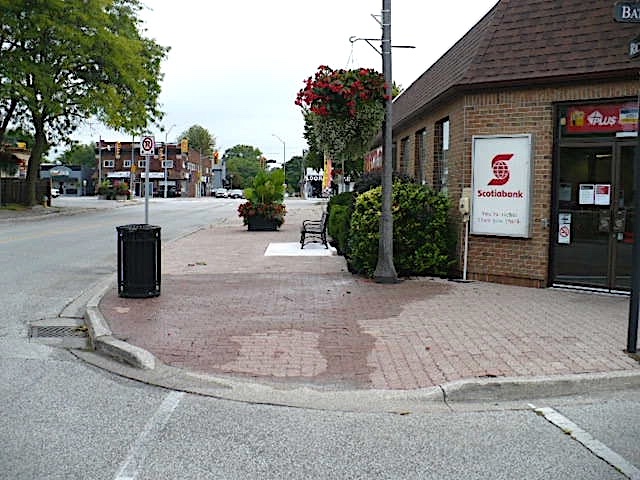
August 29: a reader sent me photos of the Richmond Street rest areas along with some comments: placing a bench on the “repair” by the Scotia bank totally blocks the normal flow of the sidewalk and we have no idea what the “curb” on the repair is for, unless it’s going to be for a bicycle rack. It also slopes downward toward Bathurst now. The repair farther down by the bank on Dalhousie is a bit better, as the bench sits closer to the building and doesn’t impede pedestrian traffic quite as much.
photo 1 by reader of Richmond St. sidewalk repairphoto 2 by reader of Richmond St. sidewalk repairphoto 3 by reader of Richmond St. sidewalk repairphoto 4 by reader of Richmond St. sidewalk repairphoto 5 by reader of Richmond St. sidewalk repair
August 30: emailed council to request an explanation for not consulting the public and people with disabilities regarding the design and placement of rest areas along Richmond Street.
August 30: Councillor Pouget responded that there was probably not any consultation at all. She said she raised the issue at a Council meeting and the clerk explained there was no rest area.
September 20: emailed council: I would still appreciate an answer to my August 30 question to council: what is the explanation for not consulting the public and persons with disabilities regarding the design and placement of rest area along Richmond Street?
September 27: emailed Critchley another week has passed and I would still appreciate answers.
October 2: CAO Critchley emailed, With respect to the rest areas along Richmond Street, these were created while doing a larger construction project that was subject to a timeline which unfortunately did not allow for consultation.
Someone started a rant to me with ‘you people just want to complain’ and included ‘wheelers’ in response to a Facebook conversation about inclusivity of an event.
‘You people,’ like ‘those people’ implies, to me, that people with disabilities are a separate segment of society. And, historically, people with disabilities have been disadvantaged, not by disabilities, but by a society where ableism prevailed and the identification, prevention and removal of barriers hasn’t been a priority.
As a person with disabilities, the barrier that I encounter the most is the attitudinal barrier; it’s usually based on stereotypical beliefs that people using wheelchairs make up the majority of the disability community or that people are demanding extra.
Do you know anyone that has or has had cancer? diabetes? arthritis? MS? lung disease? heart disease? dyslexia? low vision? hearing loss? ADHD? depression? anxiety? Then you know someone that has a disability.
While there are legislative definitions of ‘disability,’ there are also various models of disability that describe attitudes toward people with disabilities and I can usually quickly spot and categorize where people fit in.
There is a longer list, but briefly, the medical model where members of the medical community need to ‘fix’ an individual. The charity model; I see photo ops of politicians at charity events where people with disabilities are depicted as victims of tragedy and are pitied. What I sometimes hear are political comments related to costs and how things take time. The social model, and more recently the human rights model, emphasizes that it’s the environmental and attitudinal barriers that prevent people with disabilities from equally participating in communities, even though everyone has the right to equality.
There is also preferable and inclusive language but people still use the outdated ‘handicap’ and other euphemisms.
Ignorance is no excuse in 2024. It’s also unacceptable to personally attack people with disabilities on social media for ‘complaining’ about a lack of access or pointing out attitudinal barriers.




 the burg watch