About theburgwatch

Amherstburg's first local blogger since 2011, writing about town council and issues.

Majority Rules – Right Or Wrong?

Jack Edwards told Councillor Pouget that ‘the majority has to rule on this’ during the Open Air Report discussion at the November 21 Economic Development Advisory Committee Meeting.

And we frequently see the 4 votes at council meetings.

The following article is reprinted with permission of the author, Registered Parliamentarian Eli Mina.

Is the majority always right?

During a coffee break at a training session, a newly elected municipal official spoke to me
privately and said this: A wise person taught me that with a council of seven members, the most important number is four. With four votes you can change policy. With four votes you can
provide exceptional leadership. With four votes you are at liberty to govern however you wish.
After all, the majority is always right. What do you think about these words of wisdom?

On the surface, what he said sounded correct. After all, in parliamentary democracies, a basic
principle of decision making is that the majority rules. In order to adopt a proposal or enforce a
measure, a voting body requires that more members vote yes than vote no. If not, the motion is
defeated. With this in mind, the numbers are ultimately the only thing that matter. Right?

Not so fast. Something significant is missing with this logic.

Here is the problem: Have you ever observed an aggressive and impatient majority forcing its
will on a helpless minority by cutting off debate prematurely? Ever witnessed a majority being
stubbornly entrenched and unwilling to tolerate new data that might lead to enlightened and
thoughtful decisions? In such cases, there may very well be enough votes in the affirmative, but
this does not change the fact that the decision-making process is flawed; possibly leading to
flawed decisions that the majority, the minority, and the community, will regret.

Yes, the numbers are important. But if the group focuses exclusively on the number of votes, it
may be making its collective decisions on the basis of ignorance, self interest, and loud and
aggressive voices, instead of making them on the basis of objectivity, full knowledge, and a
careful analysis of the issues at hand.

With numbers-based democracies, the end—getting enough votes—justifies the means, which
may prompt some people to make pre-meeting deals on how they’ll vote. On the other hand,
with knowledge-based democracies, members refuse to commit their votes in advance of a
meeting. Instead, they arrive at meetings with fully open minds, listen to and learn from
everyone, and treat minorities as partners in decision making.

With numbers-based democracies, assertive and persuasive advocates tend to prevail. With
knowledge-based democracies, the individuals with the most relevant information and the most
astute and compelling analysis are listened to. The group has a culture that promotes learning,
inquiry and excellence in decision making.

Ultimately, numbers-based democracies are more likely to produce flawed and risk-prone
decisions. On the other hand, knowledge-based democracies are more likely to produce
informed decisions that increase opportunities and minimize risks for affected organizations.

The Impact of Open Air Events On Vulnerable Groups

Letter to the editor in response to the November 27 RTT articles.

Some of the comments during the delegation, committee and council meetings are appalling.

Carolyn Davies claimed that people can get out and enjoy the event and not be at home isolating from each other, something she said has positive mental health benefits. However, seniors and people with disabilities who can’t equally participate remain socially isolated, which can negatively impact their mental health and well-being. 

Although Ms. Davies mentioned that Open Air has been positive for her bed and breakfast, since she confirmed she has no accessible rooms, again, people with disabilities can’t equally participate. 

The suggestions that businesses should get creative or just adapt are dismissive and disrespectful; the negative impacts should not be minimalized.

Councillor McArthur stated how families come together, and he didn’t want to take that away from people. Yet children with disabilities that can’t equally access play areas can’t come together with families, so they have that opportunity taken from them.

Deputy Mayor Gibb said it is heartbreaking for him to see council unable to “get away from these entrenched positions” but it’s within his power to change his position. For me, it’s heartbreaking to see barriers in the community perpetuated and not removed so everyone in the community can equally participate in all aspects of community life.

As for the surveys, the number one complaint in the 2023 residents’ survey was accessibility, another concern that was overlooked and will continue every year for fourteen weekends until ingrained attitudes change. No one should claim we are an inclusive community if seniors and people with disabilities remain marginalized.

So much of the enthusiasm seems to be based on what are deemed to be positive impacts while disregarding the negative effects: it’s good for businesses, but not those that endure financial hardships; it’s good for people, but not if they are denied equal opportunities; and it’s good for the economy, but only for the businesses that profit.  

Instead of dismissing the so-called ‘naysayers’ that can’t share the hype, council should have drawn up an action plan to alleviate the hardships, exclusion and isolation that Open Air generates. 

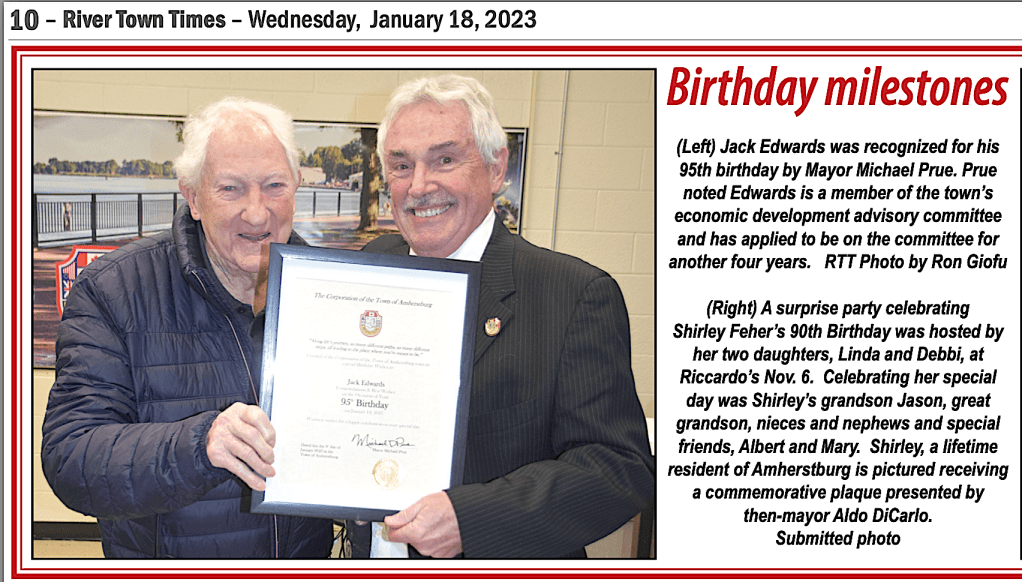
Jack Edwards On Open Air Naysayers

People have been asking who is Jack Edwards since I posted, RECAP November 21 Economic Development Advisory Committee Meeting – Open Air 2025 to 2026.

This is what he looks like:

This was his suggestion for anyone wanting to get elected in 2026: listen to the audio.

unofficial transcript:

okay, I just have one more suggestion that may allay all of the fears that anybody wants get elected next time. On Saturday, you’re going to have a big representative of the voting people in Amherstburg. Would it be possible to set up a table with a set with a sign says, are you in favour of open air? Yes or no. And you would know then what all the people of (???) Amherstburg really feel instead of a small group of people that have been naysayers since the get go. Is that possible?

At the October 28, 2024 council meeting, a resolution was passed:

Moved By Deputy Mayor Gibb
Seconded By Councillor Allaire
That: Jack Edwards and Ron Giofu BE NOMINATED by the Town of Amherstburg for
the King Charles III Coronation Medal and;
The Clerk BE DIRECTED to complete for nomination forms on behalf of Council
and submit them to Chris Lewis, MP before December 2, 2024.

RECAP November 21 Economic Development Advisory Committee Meeting – Open Air 2025 to 2026

Spoiler Alert: admin is already making plans for Open Air 2025 and the committee, thanks to cheerleader Councillor Crain, carried a motion that it continue as is into 2026. Crain did co-author the THRIVE White Paper on Open Air. Jack Edwards suggested hair stylists cut and style hair outdoors and dismissed complainers as a ‘small group of people that have been naysayers since the get go’ and vitriol. I was appalled that Edwards used the offensive and outdated ‘handicap’ and Alan Buterbaugh used ‘people that have handicapped needs. It appears there is a limited knowledge of barriers to accessibility: converted accessible parking will address the issue.

After deciding the next committee meeting would be held on January 16, 2025, the dumpster fire started. Cheerleaders Edwards and Crain gushed over the admin report, or as Edwards called it, ‘absolutely magnificent’ while Crain thanked staff and called it ‘exceptional.’ I’ll never understand why so many kudos are warranted for people doing their jobs.

Admin’s recommendation was for the committee to receive the Report Back on Open Air Business Open House for information but Edwards said this huge report, which he thought was excellent, also thought they were going to talk about it.

Deputy CAO Melissa Osborne answered, without going through the chair, that’s her understanding; if there are any questions of administration on it, or comments or recommendations for council, that this is the opportunity.

Edwards; unofficial transcript: I’m absolutely amazed that the amount of time and effort is being spent on this Open Air, and it’s gone to council a couple times, had been a divided vote, and the mayor had to split the vote. It seems such and from the report, and by the way, Jennifer, I assume that majority of this work is yours, and it’s just absolutely magnificent report and all the effort and the work has gone into this, and we will now have another vote of council whether we go ahead with it. I can’t fathom why anybody would be against open air. It has been so successful wherever it’s been tried around the world, and it’s successful for Amherstburg and the comments by all the people that answer the survey, all the percentages are so high, everybody’s in favour. And I know there’s a beautiful stylist down there, and I assume she’s the one that wrote three pages of comments in your report, and if she can’t figure a way to make her business viable during open house, and I was thinking of her as I said, all she has to do is do what everybody else move a chair outside, cut hair, style hair outside. Give a 25% coupon when you can’t park next door. The complaints in the report were so and you were at the meeting at the little cafe, you must have seen the vitriol list. Is that a word, the vitriol accent of the people that were there, but to me as the representatives on economic development and to me as our councillors and to me as the administration, it is a no brainer. It’s got to go forward. It’s good for this town. It’s good for the county. And thinking of this report, I thought, what an opportunity we have. The Valente, I knew Remo in Windsor a long time ago. They are a good family business, and now they own the high school. Look at that beautiful piece of property, that (unintelligible) onto open air. What you can do with all that green area to have something magnificent. It just doesn’t make any sense that we you have to go through 50, 60 pages of discussion in order to again bring it up at the Council where Councillor Crain, Councillor Pouget  and the other five will have to vote on this.

Osborne clarified that this report is merely the information back from the business survey as well as Open Air itself. At this particular time, the motion that has been put forward and approved by Council and is built in our base budget, is the 14 week, Friday to Sunday, Open Air, which, unless there is new direction from Council by way of a motion, at this point Open Air will proceed in 2025 as defined in the base budget and as defined as the last motion back in March so that doesn’t change unless Council makes a motion to make that change.

There was some back and forth about the motion and council’s direction between Osborne and Edwards.

Councillor Pouget commented; unofficial transcript: I can tell you without a doubt, with everything that’s going on in Council this is probably one of the most controversial issues there is because without a doubt, I get so many complaints about Open Air, numerous, numerous complaints, not only because we’re paying significant amount of money and tax dollars for it. But also many, many businesses, in fact, if you look at this, the survey, 70% of the businesses say they don’t want Open Air. And the motion that I think we’re referring to was the motion that was made March 25, 2024 that at the end of Open Air events in September, administration, business and council, if they so wish, participate in a meeting together to discuss the footprint, frequency, benefits and improvements for Open Air for all businesses within and outside the footprint up to 500 meters. But the motion of March 25 was supposed to be within and outside the 500 meter footprint. But the business survey actually says, and this is on page 2 of 13, the direction from council was to survey all businesses within the open air footprint. It doesn’t say within and outside. So many of the businesses from outside of the Open Air footprint didn’t receive an official invitation, so therefore they weren’t present at that meeting and they weren’t aware of the survey,

Simone called on admin to clarify and Pouget continued; unofficial transcript: But as I said, many of the businesses that wanted to participate that were outside that 500 meters, they weren’t allowed to participate yet they pay taxes for this and when we talk about the barber shop, she closes on Saturday because she can’t get her clients there and for hairdressing, as we know, Saturday is a day for weddings, and these people are dropped off. They want their veils put in, and they have to park two or three blocks away. They can’t get to their hairdressing shops. And people with accessibility issues, you have no idea how many phone calls and complaints I received because loved ones that take care of people with accessibility issues, they work and they can’t get to the bank until after hours, and by three o’clock on Friday afternoon, the streets are closed so they can’t get to the bank, and they can’t very well just drop off their loved ones and say, make it to the bank yourselves, or they can’t take part of services. They wanted to attend the music in the parks. They can’t even get close to it. They have to park at least five to six blocks away. So it’s accessibility issues. We put barriers in place. So there’s just so many issues to deal with this and 14 weeks if you received how many emails I received that show that the place is absolutely bare. Nobody’s there, and yet those streets are closed.

Crain; unofficial transcript: I have to say thank you to staff. This report is exceptional, and I agree with what Jack had mentioned. The report speaks to the economic impact and the over 104,000 attendees that took place in 2024. I voiced this at Council several times. We continue to poke at open air and try to, in some cases, shorten the timelines, lower the cost and shorten the event. But really, we should be looking at, how can we enhance this to make it even better, because we see the economic drivers and the activity it’s bringing in and the spending that’s taking place in town. So I fully support the report I would like to make a motion. I think it’s important that this committee speaks loud and clear to council, so that we do not continue to have surveys that yield the same results. And in my opinion, sometimes can waste staff time, if we’re asking the same questions every single year and really it’s the same result. So I would like to make a motion that the Economic Development Committee endorses the report and recommends that Council supports the continuation of Open Air. If I can get a seconder. 

Edwards responded to Pouget; unofficial transcript: I’d like to add comments to what Councillor Pouget had to say. I agree, because I’m one of the people that use handicap; there are ways about it, and I think having the high school part will help. The people have to do something that our administration will be doing something to answer the questions of the few. And they are few that are getting a hold of you are doing all of the complaining about it. It’s the majority that elect you people, and it’s the majority that we’re thinking about tonight, and the majority want this, and the people of Essex County want this, and I 100% support the motion. Oh, by the way, one other question to that we could take all of those parking spots that border on Navy Yard Park and make them all handicapped. You have access to them, and you can solve the problems of the majority. And I’m in that majority that has a problem getting downtown. The majority has to rule on this.

Michael Deneau supported Edwards; unofficial transcript: it was perfect Jack. As someone who had, I’ve had an opportunity to go down there several times during the summer, probably over 10 and what I had witnessed is a lot of density. In regards to people walking the streets, people going into shops, lineups. There was significant density. The atmosphere was wonderful. It was something that seemed to catch on even beyond the borders of Amherstburg to Jack’s point. There are things that can be done to go and satisfy accessibility, and those are techniques to be considered, and certainly things that could be overcome, but I would say that it would be a complete shame for us not to take full advantage of that environment, full advantage of all the shops, stores, and it’s like, like we said, it’s the majority that I believe are truly behind the initiative. And this is an initiative that not only Amherstburg carries, but many other communities like us carry. So with that said, I completely support it.

Alan Buterbaugh chimed in; unofficial transcript: So what I find is that this is an amazing treasure that we have for this community. I think it brings a great number of people overall, over the years, looking at the programming and the added programming that’s been coming, it’s got, there’s even more diverse things that people can participate in. And I think things like Rib Fest, when I attended that last year. When you look at the density and number of people that are attending, that it’s just phenomenal. There’s always going to be periods of time at any festival or any kind of event where it’s not going to be as busy as others, but that’s just the way it works, because of a variety of things. But you look at this thing, by and large, 104,000 people going downtown, spending money participating. It’s a phenomenal thing to be able to witness and for families to be able to have that freedom, to be in the streets with their children and not have to worry about cars or other things, kind of moving through the environment. It’s a pretty unique treasure. You know, in terms of the accessibility, my understanding is, I’ll ask staff, that the Navy Yard parking lot, that was my understanding, converted so that during that period of time, that’s all accessible parking just for people that have handicapped needs. And that was one of the accommodations that was made a couple of years back, when it was questioned about losing some of those accessibility spots. Is that fair?

Admin spoke about the conversion and placement of accessible parking at the perimeter, which is of little use to people with hidden mobility disabilities.

Edwards then had another suggestion; set up a table at the Budget Open House with a set of signs asking are you in favour of Open Air? Yes or no, and you would know instead of a small group of people that have been naysayers since the get go. Osborne said it wouldn’t be feasible.

Crain then amended his motion to add that it be the same format that we have now, which is Friday to Sunday, 5 to 8pm and he believes it’s 14 weeks, and that they support the continuation of Open Air for the remaining term of this council. And the reason he believes they should make this amendment is that it avoids having to continue to debate this until 2026.

Councillor Pouget requested a recorded vote.

In favour: Jack Edwards, Crain, Kenneth Morrison, Michael Deneau, Chair Patricia Simone.

Opposed: Pouget.

Motion carried.

The meeting minutes, attached to the November 25 council meeting, state that two motions were made:

  1. The report on the Open Air including the Business Survey and Open House BE RECEIVED for information; and
  2. The Economic Development Advisory Committee RECOMMEND that Council support the continuation of Open Air, in the same format, same times, and same duration, for the remainder of the current term of Council. Motion Carried.

There was no motion to receive the report.

Crain’s motion was:

  1. that the Economic Development Committee endorses the report and recommends that Council supports the continuation of Open Air.
  2. Then he wanted to amend it to add that it be the same format that we have now, which is Friday to Sunday, 5 to 8pm and I believe it’s 14 weeks, and that we support the continuation of Open Air for the remaining term of this council.

The town’s Terms of Reference for Committees defines an Advisory Committee: ‘Advisory Committee – a committee that provides advice and recommendations to Council as requested on areas within their mandate with no authority for decision making or independent actions. Members are appointed by Council and membership typically includes one member of Council as liaison.’

Councillor Pouget and Councillor Crain are both members of this committee. Actually, this is the only committee Pouget sits on, whereas Crain sits on three.
The Burg Watch Is 13 years old

In 2011, right after the 2010 election, I became Amherstburg’s first blogger, sharing my observations about municipal governance in the ‘burg. I wanted to create a record of elected officials’ decisions and actions so I could make informed decisions about who to vote for. I facilitated questions to the candidates for three municipal elections and I endured threat of legal action and trolls. Some candidates chose not to respond at all while others were happy to share their platforms.

As a person with disabilities, and an advocate, I let candidates know if their campaign advertising was inaccessible. I wouldn’t vote for someone who excluded a marginalized community if they were campaigning to represent everyone. 

In 2014, only three candidates created websites and all three had accessibility issues. In 2022, an increased number of candidates used social media but didn’t provide accessible information, even after I pointed it out to them and after they received accessibility information from the town. Candidate Lori Wightman’s website had accessibility issues in 2018 and 2022. 

The most noteworthy item about the 2022-2026 council is the more restrictive procedural by-law that limits citizen participation; residents can no longer raise issues with council for their information and decision. Delegates can only speak to an issue that’s listed on the agenda if it’s accompanied by an admin report or a by-law. Residents can also no longer speak from the gallery unless a unanimous vote is carried. So far, Councillor Crain and Deputy Mayor Gibb have voted a couple of times in opposition. Their reasoning seems based on inequities of people not in attendance not having the same opportunity. As I pointed out, residents should have a variety of methods to provide input as delegates. To me, that would be a more logical and inclusive way to increase civil participation instead of blocking it.

Some council members constantly promote themselves on social media while they ignore communications from residents or even block them; another noteworthy inconsistency.

My past lists of common themes remain unchanged:

  • Ombudsman Reports regarding in camera meetings in 2011, 2018, 2022
  • lack of decorum
  • incivility
  • inconsistencies
  • flip-flops
  • lack of accountability and transparency
  • preferential treatment
  • over expenditures
  • police costs
  • privacy breaches
  • council divisions, usually 4-3
  • conflicts of interest
  • ableism
  • lack of commitment to accessibility
  • inaccessible town hall and Gordon House

Thank you to those who continue to follow and stay connected.

Council’s Role in Accessibility: A Call for Action

Concerns that customers of the Salty Dog were impeding sidewalks, including people using assistive devices, were raised at the October 15 council meeting.

Following the meeting, I emailed council members: some of your comments during the October 15 meeting are concerning: 

  • ‘it’s good for the residents,’ 
  • it’s in the best interest of the town,’
  • ‘it’s AODA compliant because there are no trip hazards’,
  • ‘I am sorry that some people are not getting out of the way when someone comes by with a cane or a walker or a wheelchair, but what difference would it make if there was two cars there instead of the patio?’
  • ‘It’s two parking spots, or maybe a little bit more, there’s definitely not a parking issue downtown.’ 

there are barriers at the Salty Dog patio and there are trip hazards so if barriers exclude people with disabilities then it’s not good for the residents and it’s not in the best interest of the town. i’ve asked council to create a patio policy to ensure all patios are AODA compliant and i still encourage you to create one.

also, as i’ve pointed out a few times, businesses with barriers may face human rights complaints. in fact, two downtown businesses are currently facing human rights complaints.

thank you Councillor Pouget for acknowledging the right of people with disabilities to equally participate in our community.

As usual, Councillor Pouget was the only one to respond; she thanked me for promoting all accessibility issues in our Town and said she’d do whatever she could to help.

November 4, I emailed a follow up to council and shared one resource: since you’ve not yet enacted a patio policy, like other municipalities, i still urge you to do so. there is an abundance of best practices in other municipalities, along with the AODA standards to address barriers that continue to exist. why are you not addressing them?

for example, at a minimum, the Ontario Traffic Council’s Restaurant Patio Guidelines within the Right of Way ‘was created for the benefit of those road authorities who have not developed their own guidelines and as a supplementary resource to those road authorities who have developed their guidelines but are seeking additional guidance on the topics outlined herein.’

‘The intention of applying these guidelines is to ensure that universal accessibility, public safety and the streetscape experience are enhanced and not negatively impacted by the introduction of a patio within the road authorities’ right-of-way.’

7.1 Accessible Routes

Accessible routes must be provided through the patio area, as follows:

1)  The pedestrian clearway requires 1.8 metres of space on most sidewalks, with wider sidewalks with higher pedestrian volumes requiring 2.5 metres.
2)  To ensure the patio area does not impose a change in the direction of the pedestrian clearway of more than 20 degrees, the patio operator should use a tape measure and something to mark measurement points (pylons, chalk marks, etc.) to verify that this requirement is being adhered to
3)  The patio operator must provide accessible access to the patio with a minimum width of 1.8 metres.
4)  Accessible access can be achieved through two methods, installation of a temporary platform or a temporary accessibility ramp. It is the patio operator’s responsibility to comply with the Accessibility for Ontarians with Disabilities Act (AODA) at all times.
5)  The patio operator:
i)  Must not place patio materials in the pedestrian clearway.
ii) Must ensure the patio’s perimeter fencing has a solid base that is detectable for someone using a white cane.
iii)  Must not use the pedestrian clearway to queue patrons awaiting their reservation or table.
iv)  Must not place A-frame signs or other obstacles in the pedestrian clearway.

Freedom of Information in Amherstburg: What You Need to Know


It took 4 years for the Town of Amherstburg to enact a Routine Disclosure Policy. Freedom of Information requests may not always have to be relied on because Clerks are required to provide municipal records upon request pursuant to the Municipal Act:

Inspection of records

253 (1) Subject to the Municipal Freedom of Information and Protection of Privacy Act, any person may, at all reasonable times, inspect any of the records under the control of the clerk, including,

(a) by-laws and resolutions of the municipality and of its local boards;

(b) minutes and proceedings of regular, special or committee meetings of the council or local board, whether the minutes and proceedings have been adopted or not;

(c) records considered at a meeting, except those records considered during that part of a meeting that was closed to the public;

(d) the records of the council;

(e) statements of remuneration and expenses prepared under section 284.  2001, c. 25, s. 253 (1).

Salty Dog Patio Accessibility Issues

Comments by some members of council about accessibility at the Salty Dog patio during the October 15 meeting were concerning.

Councillor McArthur stated, in part, overwhelmingly, people love the Salty Dog patio. They love the environment that it creates in downtown Amherstburg, and it’s good for the economy. It’s good for business, but over and above everything else, it’s good for the residents of Amherstburg and that’s why I support it.

the burg watch: McArthur shouldn’t be supporting it because he’s council’s rep to the accessibility committee and the patio has barriers. Saying it’s good for the residents, while it’s not accessible to some residents with disabilities, is unacceptable.

Councillor Courtney stated, in part, it was AODA compliant, because there was no trip hazards, and was wide enough to get in.

the burg watch: There are trip hazards.

Mayor Prue stated, in part, the Salty Dog acted in good faith and continues to act in good faith. The staff went out and acted in good faith and obeyed every single caveat of the province of Ontario and every single bylaw that we have. I am sorry that some people are not getting out of the way when someone comes by with a cane or a walker or a wheelchair, but what difference would it make if there was two cars there instead of the patio? If they won’t get out of the way on the sidewalk, they won’t get out of the way. And so I think a business case has been made, and I do believe that is in the best interest of the town to be a welcoming and friendly place for people to sit out and have a meal in the sun.

the burg watch: an apology that people are not getting out of the way provides no meaningful action to correct the barriers to people with disabilities. The town cannot be a welcoming and friendly place if people with disabilities are not welcome to equally participate in activities. Thus, it is not in the best interest of the town.

Deputy Mayor Gibb: I mean, I just I don’t understand what the issue is. Two parking spots out of 500 you know what? I don’t think there’s a that big of a problem parking in downtown Amherstburg, the extra revenue, the extra jobs it brings.

the burg watch: I’d recommend more training. the number one complaint in the residents’ Open Air survey was accessibility, followed by parking. Council still needs to address the issue.

Councillor Crain stated, in part, it’s two parking spots, or maybe a little bit more, there’s definitely not a parking issue downtown.

the burg watch: again, the number one complaint in the residents’ Open Air survey was accessibility, followed by parking. Council still needs to address the issue.

The AODA aims to remove barriers. I have asked that council create a patio policy to ensure AODA compliance but no such policy has been implemented yet.

AODA Requirements for Sidewalk Construction Causes Concern For Residents

Two residents from the area will delegate at the October 28 council meeting to speak to the issue.

The report to council states, on January 22, 2020 the Town applied for funding toward the reconstruction of the sanitary sewers on George and Seymour Streets through the Investing in Canada Infrastructure Program (ICIP): Green Stream which is a joint federal/provincial grant
program. The proposed project involves the full replacement of the clay sanitary sewers
and all home connections to the property line on George and Seymour Street between
Richmond Street and Simcoe Street as well as some sections of Murray Street. Due to
the significant impacts to existing infrastructure that will result from the sewer replacement
the Town will also be replacing all the sidewalks, curbs and pavement.

The Town’s Licensing and Enforcement Division was requested to provide notice to homeowners of the upcoming infrastructure project on George and Seymour Streets and has circulated notices to the residents that have elements encroaching on public lands.

The report goes on the mention that while the area would be included in the Heritage Conversation District (HCD), the HCD has not yet been officially designated.

Then the AODA is mentioned, including the requirement to create a 1.5 m sidewalk width to comply, although there are exceptions to the Regulation under the AODA.

Three options are presented, even though administration states, this approach is the approach Administration has been proceeding with up to this point and continues to recommend as the best practice.

RECOMMENDATIONS include:

Delegated authority BE PROVIDED to the Clerk/Risk Manager to approve the
insurance requirements of encroachment agreements with regards to non-
commercial policy holders in the absence of Certificates of Insurance where
indemnification language is deemed to be satisfactory to offset the associated
risk; and,
Administration BE DIRECTED to bring back the amendments necessary to do so
for Council’s approval to the Encroachment By-law, By-law 2023-061, and the
Delegation of Authority Policy.

Richmond Street Accessibility: Public Consultations Matter

Several months later I found out why, despite my requests that public consultations be held in the spirt and letter of the AODA, there were no public consultations.

BACKGROUND

January 29, 2024 emailed council and urged members “to embrace the spirit of the AODA and consult the public regarding Richmond Street sidewalk repairs even though the report to council does not mention public consultation in accordance with the AODA’s Integrated Accessibility Standards Regulation regarding exterior paths of travel, rest areas:

‘Designated public sectors when constructing new or redeveloping existing exterior paths of travel that they intend to maintain, shall consult on the design and placement of rest areas along the exterior path of travel and shall do so in the following manner: 

  1. the public and persons with disabilities.
  2. a municipal accessibility advisory committee if one exits.’

The report to council concludes with Financial Matters and admin’s recommendation to use Accessibility Compliance Reserve Funds that are ‘intended for repairs and improvements designed to reduce or remove barriers and promote greater access to public spaces, goods and services.’ Planters may create barriers for people with disabilities who rely on visual cues and space to travel along the sidewalks. Another concern is that there is no mention of what standards will be specified in the tender. Some of you voted to keep the loading/unloading zone on Dalhousie Street for accessibility reasons, so why not commit to accessibility and persons with disabilities in this instance and hold public consultations?”

January 29: Councillor Pouget asked questions at the council meeting and acknowledged receipt of my concerns and question regarding why they are not consulting with the public according to the AODA. 

The clerk responded and stated, in part, if they were building a rest area, they would have an obligation to consult with the public of course and mentioned feedback mechanisms. When Councillor Pouget asked how they would reach out to the people in our community to ask them, the clerk’s answer was, in part, so in this case we’re not required to consult with the public. We’re looking at perhaps maybe 20 feet of brick sidewalk that we would lift and reset in the same place where it currently exists. So there’s no requirement in the act to deal with the sidewalk as an exterior route of travel. It’s with regards to rest areas that would be placed along the sidewalk and we’re not impacting a rest area. So this time, the consultations that exist in terms of the committees are all that that is recommended. 

May 12 email to council membersI have some concerns about the Richmond Street sidewalk repairs. Shouldn’t rest areas be more important than more planters?

I repeated my January email, I urged council to embrace the spirit of the AODA and consult the public regarding Richmond Street sidewalk repairs even though the report to council did not mention public consultation in accordance with the AODA’s Integrated Accessibility Standards Regulation regarding exterior paths of travel, rest areas:

‘Designated public sectors when constructing new or redeveloping existing exterior paths of travel that they intend to maintain, shall consult on the design and placement of rest areas along the exterior path of travel and shall do so in the following manner: 

  1. the public and persons with disabilities.
  2. a municipal accessibility advisory committee if one exits.’

May 27 Council Meeting: As a delegate regarding Murray Street: If you plan to redevelop the area, I urge you to hold public consultations for on and off street parking and rest areas. You might decide there’s no requirement to consult the public and people with disabilities. But nothing in the legislation prevents our municipality from exceeding the minimal AODA standards and why wouldn’t you? Last spring Mayor Prue referenced the AODA 2025 deadline and acknowledged in this town we have not brought it into force. Why not? You have an opportunity now to prevent barriers and increase inclusion.

August 29: a reader sent me photos of the Richmond Street rest areas along with some comments: placing a bench on the “repair” by the Scotia bank totally blocks the normal flow of the sidewalk and we have no idea what the “curb” on the repair is for, unless it’s going to be for a bicycle rack. It also slopes downward toward Bathurst now. The repair farther down by the bank on Dalhousie is a bit better, as the bench sits closer to the building and doesn’t impede pedestrian traffic quite as much.

photo 1 by reader of Richmond St. sidewalk repair

photo 2 by reader of Richmond St. sidewalk repair
photo 3 by reader of Richmond St. sidewalk repair
photo 4 by reader of Richmond St. sidewalk repair
photo 5 by reader of Richmond St. sidewalk repair

August 30: emailed council to request an explanation for not consulting the public and people with disabilities regarding the design and placement of rest areas along Richmond Street. 

August 30: Councillor Pouget responded that there was probably not any consultation at all.  She said she raised the issue at a Council meeting and the clerk explained there was no rest area.

September 20: emailed council: I would still appreciate an answer to my August 30 question to council: what is the explanation for not consulting the public and persons with disabilities regarding the design and placement of rest area along Richmond Street?  

September 27: emailed Critchley another week has passed and I would still appreciate answers.

October 2: CAO Critchley emailed, With respect to the rest areas along Richmond Street, these were created while doing a larger construction project that was subject to a timeline which unfortunately did not allow for consultation.