Comments by some members of council about accessibility at the Salty Dog patio during the October 15 meeting were concerning.
Councillor McArthur stated, in part, overwhelmingly, people love the Salty Dog patio. They love the environment that it creates in downtown Amherstburg, and it’s good for the economy. It’s good for business, but over and above everything else, it’s good for the residents of Amherstburg and that’s why I support it.
the burg watch: McArthur shouldn’t be supporting it because he’s council’s rep to the accessibility committee and the patio has barriers. Saying it’s good for the residents, while it’s not accessible to some residents with disabilities, is unacceptable.
Councillor Courtney stated, in part, it was AODA compliant, because there was no trip hazards, and was wide enough to get in.
the burg watch: There are trip hazards.
Mayor Prue stated, in part, the Salty Dog acted in good faith and continues to act in good faith. The staff went out and acted in good faith and obeyed every single caveat of the province of Ontario and every single bylaw that we have. I am sorry that some people are not getting out of the way when someone comes by with a cane or a walker or a wheelchair, but what difference would it make if there was two cars there instead of the patio? If they won’t get out of the way on the sidewalk, they won’t get out of the way. And so I think a business case has been made, and I do believe that is in the best interest of the town to be a welcoming and friendly place for people to sit out and have a meal in the sun.
the burg watch: an apology that people are not getting out of the way provides no meaningful action to correct the barriers to people with disabilities. The town cannot be a welcoming and friendly place if people with disabilities are not welcome to equally participate in activities. Thus, it is not in the best interest of the town.
Deputy Mayor Gibb: I mean, I just I don’t understand what the issue is. Two parking spots out of 500 you know what? I don’t think there’s a that big of a problem parking in downtown Amherstburg, the extra revenue, the extra jobs it brings.
the burg watch: I’d recommend more training. the number one complaint in the residents’ Open Air survey was accessibility, followed by parking. Council still needs to address the issue.
Councillor Crain stated, in part, it’s two parking spots, or maybe a little bit more, there’s definitely not a parking issue downtown.
the burg watch: again, the number one complaint in the residents’ Open Air survey was accessibility, followed by parking. Council still needs to address the issue.
The AODA aims to remove barriers. I have asked that council create a patio policy to ensure AODA compliance but no such policy has been implemented yet.
Two residents from the area will delegate at the October 28 council meeting to speak to the issue.
The report to council states, on January 22, 2020 the Town applied for funding toward the reconstruction of the sanitary sewers on George and Seymour Streets through the Investing in Canada Infrastructure Program (ICIP): Green Stream which is a joint federal/provincial grant program. The proposed project involves the full replacement of the clay sanitary sewers and all home connections to the property line on George and Seymour Street between Richmond Street and Simcoe Street as well as some sections of Murray Street. Due to the significant impacts to existing infrastructure that will result from the sewer replacement the Town will also be replacing all the sidewalks, curbs and pavement.
The Town’s Licensing and Enforcement Division was requested to provide notice to homeowners of the upcoming infrastructure project on George and Seymour Streets and has circulated notices to the residents that have elements encroaching on public lands.
The report goes on the mention that while the area would be included in the Heritage Conversation District (HCD), the HCD has not yet been officially designated.
Then the AODA is mentioned, including the requirement to create a 1.5 m sidewalk width to comply, although there are exceptions to the Regulation under the AODA.
Three options are presented, even though administration states, this approach is the approach Administration has been proceeding with up to this point and continues to recommend as the best practice.
RECOMMENDATIONS include:
Delegated authority BE PROVIDED to the Clerk/Risk Manager to approve the insurance requirements of encroachment agreements with regards to non- commercial policy holders in the absence of Certificates of Insurance where indemnification language is deemed to be satisfactory to offset the associated risk; and, Administration BE DIRECTED to bring back the amendments necessary to do so for Council’s approval to the Encroachment By-law, By-law 2023-061, and the Delegation of Authority Policy.
Several months later I found out why, despite my requests that public consultations be held in the spirt and letter of the AODA, there were no public consultations.
BACKGROUND
January 29, 2024 emailed council and urged members “to embrace the spirit of the AODA and consult the public regarding Richmond Street sidewalk repairs even though the report to council does not mention public consultation in accordance with the AODA’s Integrated Accessibility Standards Regulation regarding exterior paths of travel, rest areas:
‘Designated public sectors when constructing new or redeveloping existing exterior paths of travel that they intend to maintain, shall consult on the design and placement of rest areas along the exterior path of travel and shall do so in the following manner:
the public and persons with disabilities.
a municipal accessibility advisory committee if one exits.’
The report to council concludes with Financial Matters and admin’s recommendation to use Accessibility Compliance Reserve Funds that are ‘intended for repairs and improvements designed to reduce or remove barriers and promote greater access to public spaces, goods and services.’ Planters may create barriers for people with disabilities who rely on visual cues and space to travel along the sidewalks. Another concern is that there is no mention of what standards will be specified in the tender. Some of you voted to keep the loading/unloading zone on Dalhousie Street for accessibility reasons, so why not commit to accessibility and persons with disabilities in this instance and hold public consultations?”
January 29: Councillor Pouget asked questions at the council meeting and acknowledged receipt of my concerns and question regarding why they are not consulting with the public according to the AODA.
The clerk responded and stated, in part, if they were building a rest area, they would have an obligation to consult with the public of course and mentioned feedback mechanisms. When Councillor Pouget asked how they would reach out to the people in our community to ask them, the clerk’s answer was, in part, so in this case we’re not required to consult with the public. We’re looking at perhaps maybe 20 feet of brick sidewalk that we would lift and reset in the same place where it currently exists. So there’s no requirement in the act to deal with the sidewalk as an exterior route of travel. It’s with regards to rest areas that would be placed along the sidewalk and we’re not impacting a rest area. So this time, the consultations that exist in terms of the committees are all that that is recommended.
May 12 email to council members: I have some concerns about the Richmond Street sidewalk repairs. Shouldn’t rest areas be more important than more planters?
I repeated my January email, I urged council to embrace the spirit of the AODA and consult the public regarding Richmond Street sidewalk repairs even though the report to council did not mention public consultation in accordance with the AODA’s Integrated Accessibility Standards Regulation regarding exterior paths of travel, rest areas:
‘Designated public sectors when constructing new or redeveloping existing exterior paths of travel that they intend to maintain, shall consult on the design and placement of rest areas along the exterior path of travel and shall do so in the following manner:
the public and persons with disabilities.
a municipal accessibility advisory committee if one exits.’
May 27 Council Meeting: As a delegate regarding Murray Street: If you plan to redevelop the area, I urge you to hold public consultations for on and off street parking and rest areas. You might decide there’s no requirement to consult the public and people with disabilities. But nothing in the legislation prevents our municipality from exceeding the minimal AODA standards and why wouldn’t you? Last spring Mayor Prue referenced the AODA 2025 deadline and acknowledged in this town we have not brought it into force. Why not? You have an opportunity now to prevent barriers and increase inclusion.
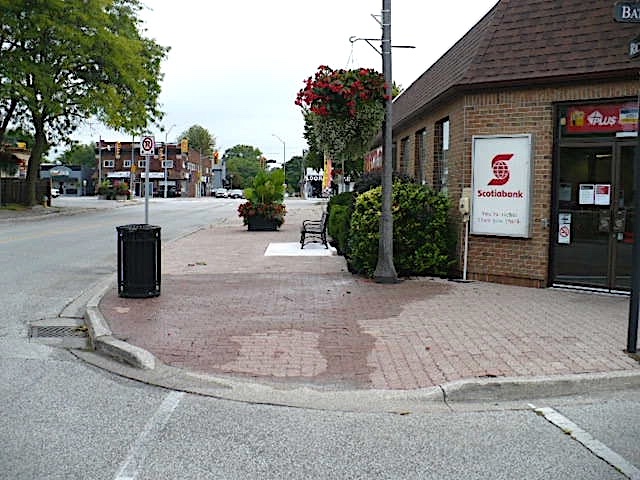
August 29: a reader sent me photos of the Richmond Street rest areas along with some comments: placing a bench on the “repair” by the Scotia bank totally blocks the normal flow of the sidewalk and we have no idea what the “curb” on the repair is for, unless it’s going to be for a bicycle rack. It also slopes downward toward Bathurst now. The repair farther down by the bank on Dalhousie is a bit better, as the bench sits closer to the building and doesn’t impede pedestrian traffic quite as much.
photo 1 by reader of Richmond St. sidewalk repairphoto 2 by reader of Richmond St. sidewalk repairphoto 3 by reader of Richmond St. sidewalk repairphoto 4 by reader of Richmond St. sidewalk repairphoto 5 by reader of Richmond St. sidewalk repair
August 30: emailed council to request an explanation for not consulting the public and people with disabilities regarding the design and placement of rest areas along Richmond Street.
August 30: Councillor Pouget responded that there was probably not any consultation at all. She said she raised the issue at a Council meeting and the clerk explained there was no rest area.
September 20: emailed council: I would still appreciate an answer to my August 30 question to council: what is the explanation for not consulting the public and persons with disabilities regarding the design and placement of rest area along Richmond Street?
September 27: emailed Critchley another week has passed and I would still appreciate answers.
October 2: CAO Critchley emailed, With respect to the rest areas along Richmond Street, these were created while doing a larger construction project that was subject to a timeline which unfortunately did not allow for consultation.
My delegation at last night’s council meeting as a person with disabilities, as a representative of residents who reached out to me with their concerns, and on behalf of the Amherstburg Residents Forum, regarding the adverse effect on the disability community of the closing of Murray Street was met with apathy.
Not that it ill have any more effect on council than mentioning, during last night’s delegation, the AODA and the UN Convention On The Rights of Persons With Disabilities, but I emailed council members anyway.
The lack of decorum at last night’s meeting was appalling. I urge you to update the procedural by-law to include a time limit on your speeches, a limit on the number of times you can speak, and a limit on the number of questions to admin. Other municipalities do it and I know you rely on comparators sometimes. Also, a meeting of council is where you, as decision-makers, debate the issues yet admin are invited to participate in debates.
I also urge you to post the council and committee meeting videos to youtube which is a good transparency initiative that other municipalities do.
it’s very disappointing, especially during National AccessAbility Week, that the town is promoting a flag raising or wearing red shirts while votes in favour of closing off yet another public space adversely affects people with disabilities. Shame on you.
in my opinion, it’s hypocritical to promote anything that may appear as tokenism. we already have plenty of awareness. what we need is a stronger commitment to ensuring we live in an inclusive community, free of discrimination and free of barriers that prevent our human right to equally participate. we need to ensure that we people with disabilities stop encountering attitudinal barriers and ableism. we need elected officials to take a stand and not vote in favour of barriers or spend taxpayer dollars on barriers.
we also need people to realize that input from residents like me, with disabilities, should be welcomed; it should not be met with examples like the attached. chris drew, an accessibility advisory committee member posted this yesterday to the town’s facebook page.
A reader reached out and I said I’d make inquiries, which I did yesterday. I sent the following questions to CAO Critchley and specifically mentioned I was making inquiries for my blog; I copied members of council.
what accessibility legislation/standard/guidelines/criteria were used for the newest sidewalks in Kingsbridge on Whelan for the tendering process?
what is the reason for the elevation changes at driveways?
who was responsible for inspection upon completion?
was the inspection upon completion satisfactory/dissatisfactory?
was public consultation held?
did any member of council visit the area of concern?
did any member of staff visit the area of concern?
what is the process to file a claim with the town for damage to assistive devices as a result of this situation?
I thought they were all generic questions but CAO Critchley’s response was, “As your email seems to indicate that the information you are seeking is connected to a possible insurance claim against the Town, we are unable to comment at this time. Should someone wish to file a damage claim, this can be down through the Municipal Clerk’s Office. (original typo).
I thanked her but wrote back that perhaps she would answer all the other questions.
Will council agree with its Accessibility Advisory Committee’s (AAAC) motion that this is not just about accessibility or with an administration report to council that accessibility funding should be used?
I shared my concerns with Councillor McArthur, council’s rep to the Committee, and Councillor Pouget who attended the AAAC meeting when the discussion occurred.
Shouldn’t rest areas be more important than more planters?
In my January email, I urged council to embrace the spirit of the AODA and consult the public regarding Richmond Street sidewalk repairs even though the report to council did not mention public consultation in accordance with the AODA’s Integrated Accessibility Standards Regulation regarding exterior paths of travel, rest areas:
‘Designated public sectors when constructing new or redeveloping existing exterior paths of travel that they intend to maintain, shall consult on the design and placement of rest areas along the exterior path of travel and shall do so in the following manner:
the public and persons with disabilities.
a municipal accessibility advisory committee if one exits.’
Why use AODA Compliance Reserve Fund?
The January 29 administration report recommended using funds accrued within the accessibility compliance reserve fund which are intended for repairs and improvements designed to reduce or remove barriers and promote greater access to public spaces, goods and services.
The May 13 administration report states the AODA compliance reserve fund was introduced in 2017 as an annual contribution to the reserves of the town of Amherstburg for municipal building and infrastructure improvements to eliminate barriers with regards to accessibility.
The August 2016 Accessibility Advisory Committee Minutes indicate the motion that administration develop a policy that the committee reviews and edits to ensure the town is promoting accessibility in the strategic plan and ask that $50,000 a year starting in the 2017 annual capital budget be set aside for promoting accessibility in public buildings.
Which recommendation should prevail?
The Accessibility Advisory Committee’s April 10 motion, following concerns that AODA Compliance Funds were to be used for the Richmond St. sidewalk repairs, was that council consider the reconsideration of the funding source for reduction by 50%.
The clerk advised the committee that his professional recommendation to council would be to use that fund because that is why that fund was created.
What type of motion is required?
At the April 10 committee meeting, Councillor McArthur asked, couldn’t council in that very meeting make a motion to reconsider it and then either Council says yes to 50% or no to 50% but it could proceed on the same timeline?
The clerk answered that yes, if the motion was carefully worded, where it asked for the funding consideration to be reviewed, he didn’t think there would be any reason why they couldn’t be shifted after they were already spent. If for example, it was 31,000 drawn out of the reserve but this recommendation was that it shouldn’t be funded from this reserve then Council could pull the funds from another reserve to replenish that; they do journal entries all the time.
The clerk repeated that if the committee wished to have council look at that and fund it from a different source if it was worded right the project could continue.
Councillor Donald McArthur stated if the committee is comfortable with 50% he’d happily go to council and ask them to reconsider the funding source.
The May report to council addresses a reconsideration. ‘It is debatable whether such a motion would be permissible though, as portions of the original motion which would be the subject of the reconsideration have already been acted upon, and as such, are not open to be reconsidered. The reconsideration of the funding source would need to be considered outside of the reconsideration on the consultation and/or whether the works should be undertaken. A less procedurally fraught motion would be to cause $16,000 worth of funding to be redirected to the AODA Compliance Reserve fund, from another funding source to offset the associated costs. That said, such a motion is not recommended by Administration as funding this $16,000 from another reserve creates a need to identify $16,000 of unbudgeted and unplanned expense which may have adverse impacts on other projects.’
Didn’t council approve $450,000. of unbudgeted and unplanned expense for pickleball?
There were the typical kudos to admin for getting the job done so quickly, to Deputy Mayor Gibb for raising the issue before he was elected, and to the Legion for their ‘sense of community.’
How appropriate is it to honour veterans but not ensure signs are large enough for them or other people with vision disabilities to read?
I emailed members of council in advance of the February 12 meeting and stated there is no mention in the report of accessible sign design or design standards. I urged members to consider the fact that Highway Gothic typeface is mainly used throughout Canada and Ontario, including on provincial highways and in cities including Windsor; it makes reading signs easier.
Mayor Prue did ask council to consider making the signs larger and mentioned that it didn’t cost any more money, but he could have made the motion himself especially since he passed the gavel.
Amid the claims that we are an inclusive community, possibly striving to become a designated ‘age friendly’ community, it was deplorable to hear a question about the cost of bigger signs and an answer that there is an assumption there will be some additional costs. Given the budget approval, how does anyone justify limiting funds for this expenditure? Besides, if the signs will slowly be replaced council could have directed administration to bring back a report on the cost with actual figures for larger and more readable signs.
When the town applied for a $100,000. grant for wayfinding signs, one of the project priorities it listed was ‘accessible, diverse, equitable and inclusive: The sign design will take into consideration AODA requirements, MTO roadway recommendations and eligibility standards.’ Did the town create a wayfinding plan? Consult the Ontario Traffic Manual? Consult the CNIB?
Why were those priorities not incorporated for the poppy street sign designs? I have asked that the town’s procurement policy be updated to include more than the consideration of AODA training. The AODA Integrated Accessibility Standard Regulation states designated public sector organizations shall incorporate accessibility design, criteria and features when procuring or acquiring goods, services or facilities.
Council needs to make a stronger and more consistent commitment to removing barriers in our community. Still, council’s motion will result in a celebration that will be a great photo op and a reminder to pay tribute to veterans even if the signs are too small for some to read.
Although I predicted the answer, I asked council members anyway due to a report to council for the January 29 meeting regarding Richmond Street sidewalk repairs. Also predictable was that only Councillor Pouget answered she would definitely question this issue and she did. More on that later.
email to council: I urge you to embrace the spirit of the AODA and consult the public regarding Richmond Street sidewalk repairs even though the report to council does not mention public consultation in accordance with the AODA’s Integrated Accessibility Standards Regulation regarding exterior paths of travel, rest areas:
‘Designated public sectors when constructing new or redeveloping existing exterior paths of travel that they intend to maintain, shall consult on the design and placement of rest areas along the exterior path of travel and shall do so in the following manner:
the public and persons with disabilities.
a municipal accessibility advisory committee if one exits.’
The report to council concludes with Financial Matters and admin’s recommendation to use Accessibility Compliance Reserve Funds that are ‘intended for repairs and improvements designed to reduce or remove barriers and promote greater access to public spaces, goods and services.’
Planters may create barriers for people with disabilities who rely on visual cues and space to travel along the sidewalks. Another concern is that there is no mention of what standards will be specified in the tender.
Some of you voted to keep the loading/unloading zone on Dalhousie Street for accessibility reasons, so why not commit to accessibility and persons with disabilities in this instance and hold public consultations?
Someone started a rant to me with ‘you people just want to complain’ and included ‘wheelers’ in response to a Facebook conversation about inclusivity of an event.
‘You people,’ like ‘those people’ implies, to me, that people with disabilities are a separate segment of society. And, historically, people with disabilities have been disadvantaged, not by disabilities, but by a society where ableism prevailed and the identification, prevention and removal of barriers hasn’t been a priority.
As a person with disabilities, the barrier that I encounter the most is the attitudinal barrier; it’s usually based on stereotypical beliefs that people using wheelchairs make up the majority of the disability community or that people are demanding extra.
Do you know anyone that has or has had cancer? diabetes? arthritis? MS? lung disease? heart disease? dyslexia? low vision? hearing loss? ADHD? depression? anxiety? Then you know someone that has a disability.
While there are legislative definitions of ‘disability,’ there are also various models of disability that describe attitudes toward people with disabilities and I can usually quickly spot and categorize where people fit in.
There is a longer list, but briefly, the medical model where members of the medical community need to ‘fix’ an individual. The charity model; I see photo ops of politicians at charity events where people with disabilities are depicted as victims of tragedy and are pitied. What I sometimes hear are political comments related to costs and how things take time. The social model, and more recently the human rights model, emphasizes that it’s the environmental and attitudinal barriers that prevent people with disabilities from equally participating in communities, even though everyone has the right to equality.
There is also preferable and inclusive language but people still use the outdated ‘handicap’ and other euphemisms.
Ignorance is no excuse in 2024. It’s also unacceptable to personally attack people with disabilities on social media for ‘complaining’ about a lack of access or pointing out attitudinal barriers.



 the burg watch