A Look Back – Candidate Aldo DiCarlo on Agenda Preparation

From a reader in 2014:

Question 4.  Council members currently receive their notes on the Friday before the council meeting, just days before to digest a large amount of information. In other municipalities council receives much more time to digest and are actually briefed on the several pages of documents they are responsible to read. Is it any wonder that there were several disagreements on partially understood information? How will you change the process at Town Hall to bring them in alignment with other municipalities? How will you design the process so it is less of a speed read and more of a conversation based on information that is well understood?

2014 then-candidate Aldo DiCarlo

This is a pretty easy question to answer, as it was also an issue with the members of the University Of Windsor Board Of Governors when I was a member. Everyone digests and understands at different rates and levels. I don’t believe that there is any concrete timeframe that applies to everyone. The next council should discuss and agree on what a ‘reasonable’ amount of time is. Then, they should stick to it. If information is not available within the prescribed time, post pone the meeting. I know there are those who might argue the inconvenience to those who have planned for the date posted, but then I ask, “Would you rather have a meeting with councillors who aren’t prepared to properly address issues now, or would you rather they deal with the issues when they fully understand the agenda, and have had time for proper consultation with any citizens necessary?” As a final thought, a mayor and council who are abreast of issues, and stay informed with ongoing issues, won’t likely be presented with much they don’t already understand. This is not to say that I, nor anyone else, can know everything or anything all of the time, but part of the job of council is know their municipality’s issues, citizens, concerns and needs. No one person can know the whole town, but if everyone on council knows something, collectively they can know quite a lot. This would include what they don’t know, and need to find out. I’m not someone who is afraid, or opposed, to admit when they need more information.

Amherstburg Vote 2022
A Look Back – Candidate Aldo DiCarlo on Full Audit

From a reader in 2014:

Question 3. There is no shortage of stories of lottery winners who go broke within 5 years of their big win. One reason they go broke is because they have not learned money management skills. With only a partial audit to learn from Amherstburg Town Hall and Administration are risking a repeat of their past mistakes. There has been a herculanian effort to avoid a full audit, how can we learn what really went wrong without a full audit? Do you support a full independent audit of the town’s finances over the past 5 years?

2014 then-candidate Aldo DiCarlo

This is a difficult question to answer with the understanding that the cost would not be cheap. On one hand, I agree wholeheartedly that a full audit should have been approved and done by the past council, since they were the elected representatives at the time, and they should be held accountable for whatever may have come from a full audit. Some reports and investigations have been done that elude to the lack of understanding of the past councillors when it comes to finances and budgets. It is not fair to say all councillors, but some, and I’m sure everyone has some in mind. What seems to be coming to light is that there really is no smoking gun, to coin a phrase. The trouble the town is in can only be explained by what appears to be a complete lack of understanding of what was going on, who was doing what, what they were supposed to be doing and what they were supposed to know. Outside of my bid for the mayor’s seat, as a tax paying citizen, I can’t believe that we had paid, and unpaid, people in town hall with so little understanding of what was going on. I believe this can begin to be rectified with a new council. If new councillors are elected who actually understand finances, budgeting and oversight, I’m not sure that we need to spend any more money on the past. The town still has plenty of issues to address, issues that will require money to fix, and that money would be better served going towards those issues. With no disrespect to all of the previous councillors, I don’t understand why it is being proposed that no one could have known what to ask or do. There were those who did, yet they were silenced. If a mayor and councillors are elected that were part of those who voted in favour of issues without the proper understanding, or at least accepting that they weren’t educated with the issue enough to proceed without more information, then I’d be demanding a full audit so they can see what went wrong more clearly. If a new council is elected with a proper balance of backgrounds, backgrounds related to the Town’s issues, I believe they can move us forward without having to spend money, as they would already understand most of what went wrong in the past.

Amherstburg Vote 2022

A Look Back – Candidate Aldo DiCarlo on Toxic Town Hall

Question 2. Generally when an organization has many Senior Management Team leave, transfer or get terminated there is a deep culture problem in the organization. So much staff turnover costs the organization money several thousand dollars and devastates employee morale. Do you believe that there is a toxic work culture at Amherstburg Town Hall and if you do how will you work with town Administration to make sure the work culture is fixed?

2014 then-candidate Aldo DiCarlo

This question seems to stem from question 1. To start, I believe there is likely a toxic work culture at Town Hall. If there isn’t, there’s definitely something wrong that needs to be addressed. As I stated in my answer to the first question, I believe the environment stems from the top. As mayor, I would definitely bring a new perspective and foster an environment of openness and congeniality that will hopefully trickle down. I believe in leading by example. Only by allowing people to share ideas, without fear of repercussions, can there be any movement to a positive and productive work environment. I can’t see dealing with this issue without a detailed review of the Town Hall staff structure.

Amherstburg Vote 2022

A Look Back – Candidate Aldo DiCarlo on Town Hall

The burg watch created an historic first when it facilitated residents’ questions to the candidates during the 2014 municipal election. Since 2022 is another election year, I thought it would be worthwhile to revisit then-candidates’ answers.

Question 1. Amherstburg Town hall has been losing senior employees at an alarming rate. It seems pretty obvious that there is a negative culture at Town Hall. If the culture is not changed we will continue to waste taxpayer dollars paying to resolve conflicts and re-train employees when adults can’t get along. How will you unearth the root causes and fix the toxic culture at Town Hall and save Amherstburg from this costly mess? We can no longer afford the costs of discontinuity.

2014 then-candidate Aldo DiCarlo:

In order to answer this question, I will assume that Town Hall does indeed have a toxic work environment. The first thing I would do is confirm this to be true. It has been my experience that toxic work environments originate from the top, at least more often than not. A good leader, regardless of their title or position, should always be aware it exists. Assuming competence and awareness of the environment, it has to be then that the toxic work environment is being allowed to fester. The alternative is that those who lead, that should know, don’t actually know the environment exists, and that becomes a question of competence. Therein lies the answer. Were/are the senior administrators aware of the issue and what are they doing about it? It is my position that the Council, like a board of directors, is an oversight body that governs and holds accountable those whose job it is to address such issues. If the issue is actually originating at the ‘top’, then the ‘top’ must be held accountable, whatever that means for the circumstances at the time. Hiring and/or retaining is the best way to stop the revolving door of staff, regardless of their position. With the recent hire of the latest CAO, hopefully the toxic environment will be dealt with. Unearthing the root causes of the toxic culture is the job of the CAO, that’s what they get paid for. As mayor and a member of council, I’d hold the CAO accountable for doing their job. If it turns out yet another CAO has been hired that can’t address this issue properly, sadly I don’t know that there would be any other alternative but to embark on the search for another. If this worst case happens, as mayor, I’d make sure the next hire isn’t hired the way the rest have been.

Amherstburg Vote 2022

Another Resident’s Wish Granted, Along With An Apology

Imagine the agony of having to wait nine months to have your wish granted. Resident Linden Crain proposed a rainbow crosswalk in June 2021 and had to wait until March 14, 2022 for Council to unanimously approve the installation of one.

Amherstburg Councillor Donald McArthur said he was sorry it took so long and acknowledged, “The wheels of government can grind excruciatingly slowly at times.” Whose fault is that?

Compared to the very short timeframe in Ask And Your Wish Might Be Granted and Mayor DiCarlo’s lone decision to grant that wish and extend the River Lights, this did take some time.

All things being relative, I hold the record of waiting two years for a Routine Disclosure Policy, to date, and tolerating the ten years of silence from the Town of Amherstburg in response to my requests to make the library accessible.

But, it’s an election year and hey, if a crosswalk that cost the town nothing creates the appearance of inclusivity, everyone’s happy.

Request For Routine Disclosure Policy Now Two Years Old

One might conclude there is a lack of willingness to be more open and transparent, given the lack of agenda reports, the lack of in camera resolutions, the incomplete information recorded in the minutes, the lack of reporting out from in camera information.

My request to council that a protocol for requests for information be created for taxpayers is now two years old.

Former CAO Miceli advised, in February 2020, that the Town of Amherstburg was in the process of creating a Routine Disclosure and Active Dissemination Policy and that I might wish to review the policy when it appears on the agenda for Council’s consideration and approval in the near future.

I repeated my request in April 2021 and council, instead of creating a policy, received the item under consent correspondence.

How long does it take to create a Routine Disclosure and Active Dissemination Policy that the Information and Privacy Commissioner revised in SEPTEMBER 1998?

What will it take for council to commit to being more open and transparent?

VOTE October 24, 2022 – hold candidates accountable.

Ask And Your Wish Might Be Granted

Amherstburg’s River Lights were to end January 3, 2022 but on December 31, 2021, at 2:26 p.m., am800 reported, Amherstburg’s River Lights To Stay On Until the end of January:

“Manager of Tourism and Culture Anne Rota says the town received several calls from the community requesting the displays be left on.

‘January is typically a long and cold and dark month and we thought if it can help just one person with that seasonal affective disorder. We want people to come out, enjoy the fresh air and walks are safe and healthy and River Lights does just that.’

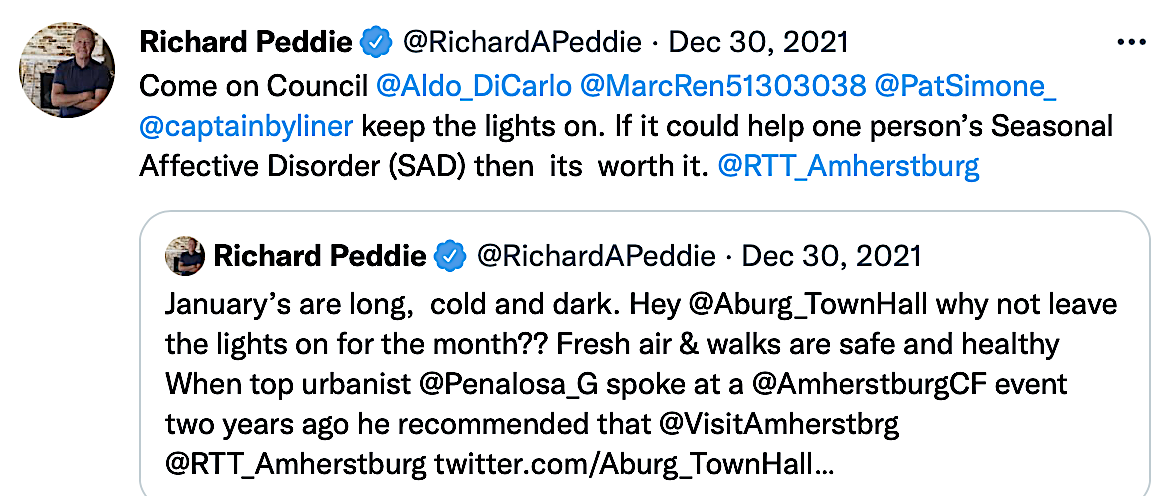
Richard Peddie tweeted similar comments the day before:

Richard Peddie tweet about extending river lights

As reported on the burg watch, Mayor Aldo DiCarlo Lone Decision-maker of River Lights Extension.

Anne Rota did not respond to these questions:
how many calls did you/thetown receive from the community requesting the displays be left on?
in what way do you think the extension could “help just one person with that seasonal affective disorder?”
what would the extension cost?

Lack of Reporting Out Information = Lack of Transparency?

In its January 2012 Report, TOWN OF AMHERSTBURG – “BEHIND CLOSED DOORS,” the Ombudsman stated, paragraph 79:

I encourage municipalities to report publicly in open session on what transpires in closed session, at least in a general way.  In some cases, public reporting might simply consist of a general discussion in open session of subjects considered in closed session, similar to the information in the resolution authorizing the session together with information about staff directions, decisions and resolutions.  In other cases, however, the nature of the discussion might allow for considerable information about the closed session to be provided.

A sample of minutes containing REPORTING OUT FROM SPECIAL IN-CAMERA COUNCIL MEETINGS
June 28, 2021:
Special In-Camera Meeting at 3: 34 p.m.
Item A – was heard under Sections 239(2)(d)&(f) of the Act. There is nothing further to report.
Item B – was heard under Section 239(2)(f) of the Act. There is nothing further to report.
Item C – was heard under Section 239(2)(i) of the Act. There is nothing further to report.
The Clerk advised that Item D will be heard this evening after Regular session.

REPORT OUT FROM IN-CAMERA SESSIONS
August 8, 16 & 25,
& September 13, 2021

August 8, 2021 a Special In-Camera Meeting at 2:00 p.m.
Item A was heard under section 239(2)(b)(d) and (f). There is nothing further to report at this time.

August 16, 2021 a Special In-Camera Meeting at 5:30 p.m.
Item A was heard under section 239(2)(b)(d) (e) and (f). There is nothing further to report at this time.

August 25, 2021 a Special In-Camera Meeting at 5:03 p.m.
Item A was heard under section 239(2)(b)(d)(e) and (f). There is nothing further to report at this time.

September 13, 2021 a Special In-Camera Meeting at 4:36 p.m.
Item A was heard under section 239(2)(f). There is nothing further to report at this time.

Town Clerk Valerie Critchley’s response: The “report out” simply notes that there is nothing further to report publicly and that any further resolutions were made in accordance with section 239(6).

Lack of In-camera Information = Lack of Transparency?

In its January 2012 Report, TOWN OF AMHERSTBURG – “BEHIND CLOSED DOORS,” the Ombudsman stated, paragraph 73:

“In my view, the council’s resolutions authorizing closed sessions, which were reviewed during this investigation were deficient and failed to provide adequate notice to the public, as well as individual members of council, as to the nature of the proposed subject matter and the justification for having an in camera meeting.”

Council’s resolutions today typically cite the applicable Municipal Act section; the June 28, 2021 SPECIAL IN-CAMERA COUNCIL MEETING Resolution# 20210628-210:

That Council move into an In-Camera Meeting of Council at 3: 34 p.m. pursuant to Section 239 of the Municipal Act, 2001, as amended for the following reasons:

Item A – Section 239(2)(d) – Labour relations or employee negotiations; and, Section 239(2)(f) – Advice that is subject to solicitor-client privilege, including communications necessary for that purpose.

Item B – Section 239(2)(f) – Advice that is subject to solicitor-client privilege, including communications necessary for that purpose.

Item C – Section 239(2)(i) – A trade secret or scientific, technical, commercial, financial or labour relations information, supplied in confidence to the municipality or local board, which, if disclosed, could reasonably be expected to prejudice significantly the competitive position, or interfere significantly with the contractual or other negotiations of a person, group of persons, or organization.

Item D – Section 239(2)(c) – A proposed or pending acquisition or disposition of the land by the municipality or local board.

Clerk Valerie Critchley’s Response:

Regarding the In Camera Minutes, you noted examples from June 28, 2021, August 8, 2021, August 16, 2021, August 25, 2021, September 13, 2021, September 16, 2021, November 16, 2021 and December 13, 2021. I would note that the November 16, 2021 and December 13, 2021 minutes have not yet been approved by Council and will be on an upcoming Agenda.

With respect to the other meetings, s. 239(4)  of the Municipal Act  states that:

s. 239(4) Before holding a meeting or part of a meeting that is to be closed to the public, a municipality shall state by resolution:

(a)   the fact of the holding of the closed meeting and the general nature of the matter to be considered at the closed meeting.

As a result, Notice is given in the manner that you have set out below and a resolution is passed which cites the allowable exception pursuant to the Municipal Act which the Municipality is relying on to move camera. That allowable exception also serves to provide the “general nature of the matter to be considered”.

Further, sections 239(5) (6) and (7)  Municipal Act states as follows:

s. 239(5) Subject to subsection (6), a meeting shall not be closed to the public during the taking of a vote;

s. 239(6) Despite section 244, a meeting may be closed to the public during the taking of a vote if,

(a) subsection (2) or (3) permits or requires the meeting to be closed to the public; and

(b) the vote is for a procedural matter or for giving directions or instructions to officers, employees or agents of the municipality, local board or committee or either of them or persons retained by or under a contract with the municipality or local board.

VOTE October 24, 2022 – hold candidates accountable.