Update: Amherstburg’s CAO Defends Closed-Door Training—And Mayor-Elect Gibb Stays Silent

By: Linda Saxon, The Burg Watch

In my previous post, I shared that Amherstburg’s incoming council has five separate orientation and training dates scheduled—November 24, November 30, December 1, December 3, and December 7—and every single one is being held behind closed doors.

Following that email, I sent a formal reply to Chief Administrative Officer (CAO) Valerie Critchley and copied both the town clerk and Mayor-elect Chris Gibb, who were included on the CAO’s original message.

In my follow-up, I reminded administration that the Ontario Ombudsman’s April 29, 2024 report explicitly suggested Amherstburg formalize the practice of treating training sessions as open public meetings to improve transparency. I also asked two direct questions:

  1. Whether council will pass open-session resolutions disclosing the general nature of the training topics beforehand, as required under the Municipal Act.
  2. Which of the five dates covers mandatory training under the Accessibility for Ontarians with Disabilities Act (AODA) and the Ontario Human Rights Code, and who is delivering the curriculum.

What the CAO’s Reply Actually Revealed

CAO Critchley replied to defend keeping the sessions closed. Her response—sent in red coloured text, despite my explicit request to her in August 2025 not to use coloured text —revealed three major takeaways:

  • A Sudden Legal Pivot: In her first email, the CAO stated the sessions would be closed “in accordance with section 239 (3.1) of the Municipal Act.” Yet when asked about the open-session resolutions required under that rule, she changed her argument. She claimed that because educational sessions do not materially advance council business, they do not meet the legal definition of a “meeting” and require no public resolution at all. She ignored the Ontario Ombudsman’s transparency recommendation completely.
  • Recycling the Outdated 2022 Training Package: Regarding mandatory AODA and Human Rights education, she wrote: “This training is provided separately from the Council orientation dates and via the Town’s training software. I believe you have a copy of the version of that training already in your possession from the last Council orientation.” That confirms our incoming council is still receiving the exact same outdated curriculum from 2022—the one that required a Freedom of Information request to uncover and featured a 30-minute Folk Music Ontario video from July 2014.
  • Ignoring Digital Accessibility Requests: Answering an accessibility watchdog’s email in red text—after being asked in August 2025 not to use coloured text—shows how lightly basic digital accessibility is treated at the top of Town Hall.

Mayor-Elect Gibb’s Silence Speaks Volumes

Just as telling as the CAO’s defence is the complete silence from Mayor-elect Chris Gibb.

Gibb was copied on the entire email exchange. He saw administration’s plan to lock the doors for five training sessions. He saw the reminder about the Ontario Ombudsman’s 2024 transparency advice. And he saw the CAO defend keeping taxpayers out before the new term even begins.

So far, he has said nothing.

During the recent election campaign, Gibb defended traditional municipal processes. By remaining silent while administration shuts the public out of council orientation, our incoming mayor is effectively condoning business as usual before even taking the oath of office.

Transparency Is a Choice

Even if administration argues these orientation sessions fall outside formal meeting rules, keeping the doors locked remains a choice, not a legal requirement. Other Ontario municipalities—like the City of Cambridge—actively welcome residents to observe open portions of council-elect training on governance and community priorities.

Ultimately, staff do not own the council table—elected officials do. Once the new council is sworn in, any member can put forward a motion to open these sessions to the public and formally adopt the Ontario Ombudsman’s April 29, 2024 report recommendation into the town’s Procedure By-law.

The Burg Watch will continue tracking how our newly elected officials handle transparency and accessibility from day one. When lawmakers start their term behind closed doors using decade-old training materials, taxpayers deserve to know.


Closed Doors Before Day One: Amherstburg’s New Council Training Sessions Shut Out the Public

By: Linda Saxon, The Burg Watch

Before our newly elected council even settles into their chairs for the next four years, Town Hall is already locking the doors.

Recently, I emailed Amherstburg’s Chief Administrative Officer (CAO) Valerie Critchley asking to be notified of the upcoming orientation and training sessions for the incoming council. Here is the exact response I received:

“Good Morning:

There will be internal training and education sessions held on November 24 and 30, December 1, 3 and 7. These sessions will not be public meetings in accordance with section 239 (3.1) of the Municipal Act.

Regards,”

Five separate training dates—November 24, November 30, December 1, December 3, and December 7—and every single one of them is being held behind closed doors.

Notably, the CAO copied both the Town Clerk and Mayor-elect Chris Gibb on the reply—meaning our incoming mayor is already aware that these sessions are being closed to the public.

We Have Seen This Exact Playbook Before

This is not the first time administration has put up unnecessary roadblocks around council training.

Following the 2022 municipal election, I asked CAO Critchley when council received accessibility training. She told me it happened on November 29, 2022—yet I could not find accessibility listed on that day’s Council Workshop Agenda. When I asked her to simply email me copies of the training materials provided to council, her response was:

“With respect to your request for documents, please file a Freedom of Information Request.”

I filed that formal FOI request. When I finally received full disclosure, the “secret” training package consisted of just three items:

  • Accessible Customer Service Standard (a public policy already posted on the town’s website)
  • Integrated Accessibility Standards Regulation Policy (another public policy already posted on the town’s website)
  • AODA – Accessibility for Ontarians with Disabilities Act 2023 (a slide deck that referenced a 30-minute Folk Music Ontario AODA Customer Service Video from July 2014)

Forcing a resident through an FOI process just to hand over two public town policies and a decade-old music organization video proves that closing these sessions has nothing to do with protecting confidential municipal secrets. It is simply a barrier to transparency—and it raises serious questions about the quality of education our lawmakers are actually receiving.

Legal Does Not Mean Mandatory

Let’s be clear about what the law actually says. Under Section 239(3.1) of Ontario’s Municipal Act, a municipality is permitted to close a meeting to the public for the purpose of educating or training council members, provided no member discusses or advances municipal business or decision-making.

However, closing those doors is a choice, not a legal requirement.

Nothing in the Municipal Act forces a town to hide council orientation from taxpayers. In fact, other Ontario municipalities—such as the City of Cambridge—actively invite residents to observe open portions of their council-elect training on governance and community priorities.

Even more telling is Amherstburg’s own track record. Following a previous closed training session here in town, the Ontario Ombudsman issued a formal report on April 29, 2024, explicitly suggesting that the Town of Amherstburg formalize the practice of treating training sessions as open public meetings to improve transparency.

Two years later, administration is ignoring that recommendation and keeping the doors locked.

The Rules Town Hall Still Has to Follow

Even when a municipality chooses to use the Section 239(3.1) loophole to exclude the public, the law still sets strict boundaries:

  • No Policy or Decision-Making: The Ontario Ombudsman interprets the training exception very narrowly. These five sessions cannot be used to review policy options, debate upcoming town files, or lay the groundwork for future council votes.
  • Mandatory Public Notice: Unlike the missing agenda item in November 2022, council is legally required to pass a resolution in an open public meeting beforehand stating the fact of the closed session and the general nature of the subject matter being covered.
  • Mandatory Accessibility Training: Under provincial law, newly elected officials must receive training on the Accessibility for Ontarians with Disabilities Act (AODA) and human rights obligations. Taxpayers have a right to know how our new council is being educated—especially in a town where the outgoing mayor openly admitted we are not compliant.

What The Burg Watch Will Be Tracking

Transparency is not something politicians should only talk about during an election campaign. It starts with letting residents see how their elected officials are being trained to govern.

I have already sent a follow-up email to the CAO—with the Town Clerk and Mayor-elect Gibb copied or informed—reminding administration of the Ontario Ombudsman’s 2024 transparency recommendation and asking which of these five dates covers mandatory AODA training and who is delivering the curriculum.

The Burg Watch will also be checking the upcoming council agendas to ensure formal public resolutions are passed disclosing the general topics for all five dates. The new term hasn’t even officially started, and the habit of operating behind closed doors is already back in full swing.


Beyond the Ballots: What the Election Results Mean for Amherstburg’s Disability Community

By: Linda Saxon, The Burg Watch

Now that the initial election excitement has settled and elected officials have been certified, we need to talk about what these results actually mean for the everyday lives of Amherstburg residents with disabilities.

Looking past the victory speeches and the political spin, last week’s vote completely reshaped our local council and brought the town’s structural approach to civic accessibility into sharp focus.

First, let’s look at the tremendous victory. Jen DeLuca capturing the absolute top spot in the councillor race with 5,597 votes is not just a personal win—it is a historic public mandate.

The community voted for change, sending a clear signal that table-level accountability matters.

With Keith Boussey also securing a seat, the disability community now has two clear, verified allies holding actual legislative power to introduce motions, demand compliance, and challenge municipal barriers from day one.

However, because Jen DeLuca owns the Waterfront Ice Cream parlour downtown, she will have to declare a conflict of interest under the Municipal Conflict of Interest Act whenever Open Air street closures or downtown business layouts are discussed or voted on.

This means that while she is a powerful ally for town-wide policy, the specific fight for downtown sidewalk layouts and Open Air barriers will require Keith Boussey to take the lead, backed by the pressure of public watchdog tracking.

But we must also face the stark reality of the rest of the ballot.

The Burg Watch accessibility audit concluded that Mayor-elect Gibb and Councillor-elect Ewer chose to defend the traditional status quo – passing files back to a powerless accessibility advisory committee or waiting for staff reports before acting.

This defensive script played out on Wes Ewer’s campaign page. When The Burg Watch commented about his willingness to maintain a 24-year-old accessibility committee structure and the outgoing Mayor’s declaration that the town failed to be compliant, Ewer seemed impatient.

Instead of addressing the structural failure of the status quo, he chose to tone-police the scrutiny.

He then relied on the ultimate establishment shield, arguing that the watchdog does not speak for every person with a disability and pointing to the volunteers on the town’s Accessibility Advisory Committee who believe in the process.

This is a classic example of toxic positivity in Amherstburg politics. Weaponizing local volunteers to defend a system that has failed for 24 years is just a shield, not a solution.

When an elected official claims they want to work together but treats baseline policy criticism as a personal attack or a semantic disagreement, it proves how deeply entrenched the gatekeeping remains. Listening doesn’t mean passing the buck back to a powerless advisory loop.

The real mystery of this council lies with the block of candidates who chose to ignore The Burg Watch accessibility audit entirely.

Together, Bill Petruniak, Molly Allaire, and Peter Courtney command a huge portion of the voter turnout, yet they chose not to make any concrete accessibility commitments. Courtney committed to participating in the accessibility audit but failed to do so.

We are already seeing what this wall of silence and conditional empathy looks like in practice.

Looking back to her previous term on council, Allaire raised public concerns regarding accessibility issues at our local library. Yet she repeatedly ignored direct questions seeking the actual factual basis for those library statements and has continued to ignore some community comments on her Facebook page.

When directly questioned in an email regarding downtown Open Air barriers, her written response was a shocking admission of political avoidance, stating: “Open air does remain a contentious issue. You mention barriers that deny people with disabilities equal access to the community. I do not know of these specific barriers you speak of. Could you please explain so I can make an educated response.”

The irony here is alarming. Allaire is the councillor who previously made the motion to refer the town’s Open Air resident survey to the accessibility committee—a survey where accessibility was explicitly listed as the number one complaint in town.

Furthermore, Allaire sat at that council table for four years while I delegated and sent detailed emails explicitly pointing out systemic physical barriers, including emails to CAO Critchley regarding the Movati pool barriers.

She had full access to years of data that remained unaddressed until she personally experienced a temporary injury and needed crutches.

The recent River Town Times article regarding park washrooms exposes the flaw in this approach.

In a CTV interview during her campaign, Allaire explicitly stated, “I started by focusing on improving our parks and green spaces, and now I’m ready to take on bigger priorities like roads and infrastructure.”

Despite spending four years on council focusing on parks, handling surveys where access was the top complaint, receiving emails regarding barriers, and Mayor Prue declaring the town was not compliant by the 2025 AODA deadline, Allaire’s surgery suddenly made her realize how “inaccessible our town is.”

Even more frustrating is the bureaucratic response from town hall. According to town staff, the accessibility advisory committee is a “legislated committee” that will continue to meet if there is a triggering condition.

Let’s be completely clear: being a legislated committee simply means the town is legally required by the province to have one. It does not change the fact that it remains a purely advisory body. It has zero legal authority to pass by-laws, enforce budgets, or order a single door button to be installed. Its only role is to advise.

Instead of council simply using its own actual legislative power to order the automated buttons installed, the file was bounced down to a committee under the guise of conducting a parkland audit.

The director of parks even admitted that administration already knows exactly which buildings lack automated door openers.

Why are we sending an advisory committee on a washroom-by-washroom mission when administration already possesses the data?

Public records reveal that on May 4, 2022, the Amherstburg Accessibility Advisory Committee explicitly discussed these parkland audits, with the town clerk stating at the time that creating the resource was a goal of his.

Bouncing the file back down over four years later to “study” it is the ultimate delay tactic.

When an elected official claims they “do not know” about systemic barriers that have been presented to them via public surveys, emails and delegations for years, it raises a massive red flag about true transparency.

Taxpayers did not elect individuals to sit in silence, plead ignorance, or hide behind endless audits. Since these non-participants chose to remain quiet during the campaign, The Burg Watch will be documenting their very first council-table votes with absolute transparency.

So, what does this mean for the next four years?

It means the issue of physical and digital access in Amherstburg is now directly on the council floor. Voters have placed specific individuals at the table who have publicly committed to change, but whether those commitments translate into real action remains to be seen.

Because the council remains deeply divided on these issues, The Burg Watch will be keenly watching every single vote.

Every infrastructure budget, every sidewalk configuration, and every transit review will be tracked by its actual impact on residents with disabilities—not by political rhetoric.

The election is over, but the tracking of our new lawmakers starts today.

The Shocking Deputy Mayor Upset: Petruniak Out-Polls the Mayor

Let’s talk about the absolute biggest story of election night in Amherstburg—and it isn’t the Mayor’s race.

In a massive political upset that has left Town Hall insiders completely stunned, newcomer Bill Petruniak soundly defeated the heavily favoured Linden Crain for the Deputy Mayor seat.

Petruniak didn’t just win; he captured the second-highest seat in our municipality with an overwhelming 5,146 votes, leaving Crain far behind at 3,590.

But if you look closely at the data, the real story is the staggering gap between our top two new leaders.

As a newcomer to the council table, Petruniak actually out-polled our incoming Mayor, Chris Gibb, by a massive 1,218 votes.

Think about that for a second. While Gibb managed to squeeze through a three-way mayoral race with 3,928 votes, Petruniak walked away with a dominant, town-wide mandate from over 5,000 taxpayers.

This enormous gap sends a clear message about the true mood of Amherstburg voters.

By completely rejecting incumbent platforms like Crain’s, voters demanded independent, new leadership at Town Hall.

Chris Gibb may hold the Mayor’s gavel, but Bill Petruniak holds the true mandate of the people.

The Burg Watch will be watching very closely to see how this dynamic plays out at the council table!

OPINION: Chris Gibb Wants a Campaign ‘Wingman’ But No Voter Scrutiny

Chris Gibb can’t have it both ways—showcase his family and call his wife his ‘wingman,’ only to tell a curious voter to “leave my family out of it.”

Under standard media rules like the Society of Professional Journalists (SPJ) Code of Ethics, private citizens deserve their privacy. But the rules change when a family member decides to step into the public spotlight.

If a politician’s spouse runs a public blog, gives opinions on town decisions, or acts as a political partner, they aren’t just a private family member anymore. They have joined the political game, and that means facing the same public criticism as anyone else.

Sarah Gibb, the wife of Deputy Mayor and mayoral candidate Chris Gibb, has been blogging for ten years. As the self-proclaimed ‘Amherstburg’s local blogger,’ she analyzes and comments on town council proceedings and agenda items.

In fact, she has long been a visible part of the local political scene; she was prominently featured in a 2015 Windsor Star news photograph alongside other ‘Council watchers’ after challenging town hall’s transparency protocols during closed-door sessions.

The “Wingman” Label

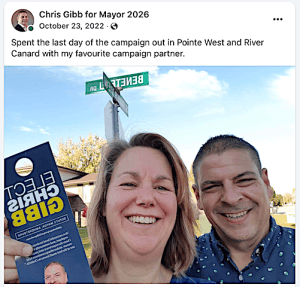
Right before the 2022 municipal election, the then-deputy mayoral candidate explicitly showcased his wife on Facebook as “my favourite campaign partner,” featuring a photo of the couple holding an Elect Chris Gibb door hanger.

A photo of Chris  and Sarah Gibb during Amherstburg municipal campaign 2022 with an Elect Chris Gibb door hanger.
October 23, 2022 Facebook ‘my favourite campaign partner’ post.

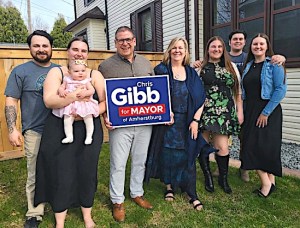
He kicked off his 2026 mayoral run on May 2, 2026, with a family photo on his campaign Facebook page.

Photo of Chris Gibb with family and his mayoral election campaign sign.
Chris Gibb’s family photo and 2026 candidacy for mayor announcement on his Facebook page.

Just two weeks later, on May 16, 2026, he published a campaign video using his marriage timeline to establish his local roots before he even touched on his work credentials. With his wife physically behind the lens, he tells the camera:

“Something stereotypically Amherstburg about me is I met my fantastic wife and current camera person at Shooters in Amherstburg. So that’s that’s pretty Amherstburg right there. We bought our first house in the Monopoly subdivision. Then a few years later, we built a house in the Crown Ridge subdivision where we raised our children.”

By late summer, the double standard became undeniable. On August 20, 2026, The Burg Watch left a comment on Chris Gibb’s campaign page asking a straightforward question:

“I’d like to know how involved your family will be in your campaign and, if elected, your position as mayor.”

Instead of answering, Gibb snapped: “How about we leave my family out of it.” The comment appears to have since been deleted.

Screenshot of Chris Gibb’s August 20 leave my family out of it comment

Yet, that defensive boundary vanished just six days later. On August 26, 2026, Chris Gibb responded to a different Facebook commenter by doubling down on his wife’s public campaign status, casually writing: “LOL that’s my wife. She’s my wingman out there.”

Chris Gibb laughing off his spouse’s public role on August 26, 2026, less than a week after snapping at an independent voter’s inquiry.

To ensure the family messaging stuck with voters heading into the final stretch of the election, Gibb re-posted his identical May 2 family launch photo on October 1, 2026.

He doubled down on this exact narrative just a few days later. On October 8, 2026, during the Amherstburg Chamber of Commerce Candidate Night, Gibb took to the microphone and repeated his family timeline script almost word-for-word to the local business community:

“I’m an Amherstburg guy. I’ve lived my whole life here… I met my wife in Amherstburg, probably in the most Amherstburg way possible. I met her at Shooters on a Friday night. We got married. We’ve raised three children here. They all still live here. We now have another generation—a granddaughter who’s going to be a year old—here in Amherstburg.”

Journalism experts at the Poynter Institute agree that when a politician names a relative as a key partner and features them in campaign media, that relative’s role becomes a matter of public interest. A candidate cannot use their “wingman” to boost their public image on one hand, and then shut down a fair voter’s question about her political involvement on the other.

Selective Access as a Campaign Strategy

This “wingman” label isn’t just for show—it is a clear strategy for how Chris Gibb handles local media. Look at the numbers from the 2022 municipal election. Candidate Chris Gibb answered every single campaign question his wife’s blog sent to the candidates. How many did he answer for The Burg Watch? Zero.

This isn’t about sour grapes; it’s a matter of fact. When a candidate uses their spouse’s platform to push their campaign message while completely shutting out independent local outlets, that blog stops being a private hobby. It becomes a direct arm of the campaign.

Open Air, Belle Vue, and Public Influence

During a past council debate regarding taxpayer spending on the Belle Vue property, Gibb publicly confessed to a major policy flip-flop. He stated he had originally promised never to spend taxpayer money on the site, but explained his change of heart by telling council that his wife had reminded him many times throughout their marriage that stubbornly sticking to your point when things change isn’t the wisest idea.

The couple also heavily promotes Amherstburg’s Open Air Weekends—an event that has deeply divided our town, especially for local businesses trying to survive. Yet, Deputy Mayor Chris Gibb always votes to keep the 14-weekend setup, while Sarah Gibb uses her blog to defend it online.

Coordinated Talking Points and the Use of “We”

The political synergy between the candidate and the blogger is most visible in how they defend Open Air Weekends. When the public raised serious concerns about accessibility, both Gibbs deployed the exact same highly specific family anecdote to public forums.

During a February 22, 2023, council meeting, Deputy Mayor Chris Gibb used his official speaking time to defend the event’s accessibility. He stated that his in-laws live at Richmond Terrace, noting:

“I’ve personally pushed a wheelchair from Richmond, well, one of their each wheelchairs from Richmond Terrace downtown, and I’ll tell you, you cannot believe the relief to be able to get off of our uneven sidewalks… To me, Open Air makes the downtown more accessible for people… in at least in wheelchairs. …So we enjoy bringing them for Open Air because we don’t have to worry about trying to maneuver the wheelchair on a narrow uneven sidewalk so that’s I just want to put my two cents in there.”

Fast forward to September 2026, and Sarah Gibb was on candidate’s campaign Facebook page echoing her husband’s council speech. She commented: “I also have parents and other relatives with mobility issues, ranging from needing a cane, to a walker, to a wheelchair. In our experience, Open Air makes it much easier to navigate the downtown core.”

Look closely at the pronouns chosen by both public figures: his collective “we” in the council chamber and her matching “our” on the campaign trail.

The choice of the word “we” in the council chamber is notable. In municipal governance, an elected official holds an individual seat, an individual vote, and individual accountability. Yet, in defending a controversial town policy on the council floor, the Deputy Mayor used his family’s personal routine—their collective “we”experience—as the primary evidence to validate his political stance.

When a public official relies on a collective family dynamic to justify a policy position at town hall, and his prominent blogger spouse echoes that exact narrative framework using “our” on a campaign page, the boundary naturally blurs. A candidate cannot easily bring their family’s shared experiences to the microphone to score points or defend a vote, and then claim that same dynamic is entirely insulated from voter scrutiny.

The Cost of Rough Politics

During a past town scandal over leaked documents, journalist Anne Jarvis reported in a prominent Windsor Star article that town blogger Sarah Gibb was “calling for more blood on the floor.”

If Sarah Gibb were just a regular resident venting on Facebook, people might ignore it. But she is an influential blogger of ten years married to a man running for the highest official seat in town.

Amherstburg politics affect real local businesses and real families. The Burg Watch believes we shouldn’t treat powerful political partners as untouchable private citizens. If you choose to step onto the playing field, feature yourself on campaign pages, and shout through a megaphone, you have to be ready for people to talk back.

What are the candidates’ position on Open Air? Chris Gibb

Sometimes they play favourites and don’t answer my questions. But I’m continuing the tradition I started in 2014. For now, I’m only asking about Open Air and will set aside a page just for their Open Air answers – IF they answer.

the burg watch: As you know, Open Air remains a contentious issue, especially because of Councillor Crain’s motion to not revisit it until the end of this term. Will you remove barriers that deny people with disabilities equal access to the community when streets are closed during Open Air weekends?

Chris Gibb: As the town’s Accessibility Committee has not identified any barriers, I would need you to be more specific and advise me as to which barriers you have identified. I would then be able to address your concerns.

note: I delegated to council on Open Air barriers; I’ve submitted over a dozen emails to council members and I’ve written several letters to the editor about the exclusion.

the burg watch: Would you direct me to the minutes of Accessibility committee meetings where the committee did not identify any barriers to open air?

Chris Gibb: Sorry but I do not recall the exact date of the particular meeting. Perhaps one of the committee members would be able to help.

the burg watch: I asked Tony Pietrangelo, candidate and accessibility committee member, did the Accessibility Committee identify any barriers at Open Air? It’s a simple yes or no question. 

Pietrangelo did not respond.

NOTE: Gibb answered his wife’s 2022 question about Open Air:

“Personally, I am a huge fan of the Open Air program and I hope to see it continue. I see Open Air as a unique way for the whole “Amherstburg Family” to get together and strengthen our connections with each other, and also develop new connections with new people. If we are going to maintain our small town sense of community as we grow, we have to find ways to gather together and celebrate our fantastic town. We will be seeing a tidal wave of new growth in the next 5 to 10 years with many residents who are new to Amherstburg, if we want to keep our small town charm, we need to have opportunities for those new people to be welcomed into the “Amherstburg Family”, Open Streets is one of those opportunities.”

Windsor Police Negotiations: Councillor Pouget’s Inquiry

Councillor Pouget emailed questions pertaining to a River Town Times article about Councillor Crain’s and Deputy Mayor Gibb’s meeting with Windsor Mayor Drew Dilkens to Mayor Prue, CAO Critchley and council on June 11.

Critchley provided information to which she is privy, set out below Pouget’s questions.

Pouget: I am corresponding with you this morning, regarding an article that appeared in the River Town Times on June 10, 2026, written by Ron Giofu.

As you are aware, I was in a Conflict of Interest, regarding policing, due to a close family member working for the Windsor Police Service.  I publicly declared this conflict each and every time, that policing was discussed.  When Amherstburg announced, that we were no longer negotiating with Windsor Police, I was no longer in a conflict.

However, on March 9, 2026, I discovered at an In-camera Meeting, that I was once again in a conflict, regarding Item E – Negotiations associated with policing services in the Town of Amherstburg, and I declared accordingly.  I did not know the outcome of that meeting, nor should I.

Since then, my close family member has retired effective May 1, 2026 from Windsor Police/Amherstburg and I am no longer in conflict.

I am only aware of police negotiations through the media.  I was surprised and very concerned to learn, that 2 members of Council met with Windsor Mayor Drew Dilkens to discuss policing, even though it states, that our Council voted twice to discontinue talks with Windsor Policing.

With all due respect, I am requesting the following information regarding said article:

  1. If either person requests a reconsideration regarding policing, will I be provided all pertinent information, so that I may speak and vote on all policing issues? Gibb’s statement: “We will just have to wait and see what Council decides.  I am looking forward to having the discussion publicly.”

    Critchley: Yes, as you no longer have a conflict, you will be provided with all information on the matter.
  1. I find Deputy Mayor Gibb’s statement demoralizing for the Mayor: “Why the mayor (Prue) didn’t talk to Mayor Dilkens, you’ll have to ask him.”  There is no mention of former dialogue exchanged between our 2 municipalities, that led to this conflict.

    Critchley: I do not have any information on this item.
  2. Crain and Gibb refer to a an Amherstburg resident on board, that makes a debate worth happening.  When time permits, will you please advise, who the resident is and how many times he or she has corresponded with the Town of Amherstburg, regarding our mutual agreement with Windsor Policing?  What information has he or she supplied, if any?

    Critchley: There is a Provincial Appointee on the Board named David Hammond whom I believe lives in Amherstburg. I have never received any correspondence from him.

    related: Amherstburg Resident On Windsor Police Service Board

RECAP Council Meeting May 11, 2026

I knew they couldn’t do it. They couldn’t get through the meeting without personal anecdotes, posturing, and not so subtle campaign plugs: I coached baseball (Courtney), when I first got elected, I advocated for baseball (Courtney), I heard when I was knocking on doors last election (Crain), and I played ball as a kid (McArthur). Campaign points deducted for Prue’s mansplaining to Pouget and Allaire’s offhand comments about Kingsbridge traffic – just distracted, there’s accidents everywhere. The hot topic was the concerted effort to avoid public disclosure of the number of lawsuits pending against the town and the associated legal fees.

These are council meetings to discuss council business, but they appear to be meetings between council and admin, who are welcome to participate. Admin whispers into the mayor’s ear and he announces they have something to say.

The perception in the community is that admin directs council – not the other way around.

Shawn Wilkie certainly gave the impression that admin deserves to be recognized, even before members of council. Delegates are there to address council, but Wilkie, a Royal Canadian Legion Fort Malden Branch 157 delegate, greeted, “honourable mayor, deputy mayor, CAO, town of Amherstburg administration and esteemed councillors for the residents of Amherstburg.” (Only serving MPPs are honourable).

Admin are not elected officials – they can’t ask delegates questions, they can’t grant or deny a delegate’s request. Civil servants serve the public by implementing council’s decisions.

Wilkie requested perpetuity for the annual Legion Week parade event permit requirement and all fees associated with the annual event.

Councillor Pouget did not ask if waiving the fees in perpetuity meant forever, as was erroneously written elsewhere.

VERBATIM TRANSCRIPT:

Councillor Pouget: just one question – the Legion is requesting it to be waived in perpetuity, forever; is that correct?

Prue: I believe that’s what’s been requested, yes.

Pouget: okay, thank you.

Prue waited almost five seconds and then mansplained: What that means is it never has to come back again. It doesn’t mean that council, 30 years from now might say, no, we don’t want to do this anymore. That’s still within that realm of possibility, but up until then, it just keeps going. Okay, all right.

Listen to the audio.

I don’t recall Prue doing this to his male colleagues. Same for when he tells Pouget, “I don’t know if that was a question or simply a statement.”

Borrowing By-law and Delegation of Authority By-law

Prue invited Deputy CAO Melissa Osborne to make a presentation that might’ve been meant to reassure everyone that all is well with town finances. Confusion followed.

Councillor Crain was the first to raise his hand. Of course he offered kudos to “Deputy CAO Melissa: very helpful report, very positive report. I think online, we see a lot of misinformation. I have lately a lot of AI driven, and it’s very helpful to see the stats on screen. I think this council, past councils, have been making great strides,” said Crain.

There will always be misinformation; I’ve seen it from admin too. For example, when the town erroneously advertised for appointments to the accessibility committee, which I repeatedly pointed out to admin and council, including Crain; he never responded.

Artificial Turf Fields, Premier Baseball Diamond issue. As he usually does, Prue asks if there are any questions of staff before members of council debate the issue. (I’ve watched other municipal council meetings and they are so much more efficient and professional).

  • Councillor Crain questions the impact of not approving the project on baseball Canada standards and public use.
  • Admin (didn’t say his name) confirms the field would still be usable for general play but not for hosting tournaments or official leagues. The field is used by the University of Windsor, Windsor Select, North Star High School, and local minor baseball teams.

Crain said I’m not sure I can make a decision, which seems inconsistent given that Crain, along with the majority of council, approved almost $500,000.00 for pickleball. In fact, council waived rules of order to hear the plea for pickleball in June 2023 when it wasn’t on the radar. Prue even asked the audience what their preferred location was. And then, “the motion has passed; now the thorny issue of how do we pay for it?” said Prue.

Almost a half hour later, after all the ‘what if’ questions, the motion to approve staff recommendation carried.

Kingsbridge Traffic Calming Review

Prue once again asks if there are any questions of staff before members of council debate the issue.

Councillor Allaire said she had a follow up, although there was no initial question.

“It was an old report, so we didn’t have new numbers. We did look at the numbers and asked how many new accidents have happened near and around this intersection? And it was quite high. We have received nine since like 2025 however, I want to back that up with eight of the nine were people just either distracted driving or just hitting cars, parked cars, one backed into a boat; I mean a parked boat, I might add. So I think when you look at things as a whole and as an intersection, it didn’t meet any of these policy standards. …great now that we have a policy, we can see where we should increase the speed and decrease it. So now that we have a baseline, this is great to see, but there’s accidents everywhere, and people are distracted everywhere. So I think enforcement is a huge thing that we could step up on and hopefully work on. But I’m going to move the staff recommendation,” said Allaire.

“Just distracted driving. Just hitting cars.” Sounds dismissive.

A pedestrian was hit; several people were taken to hospital.

According to data from Transport Canada’s National Collision Database, distracted driving contributed to an estimated 22.5% of fatal collisions and 25.5% of serious injury collisions in 2021. These statistics are part of an upward trend of distracted driving-related collisions, up from 21.3% of fatal collisions and 23.8% of serious injury collisions a decade earlier(2011).

“There’s accidents everywhere. People are distracted everywhere.“

Exactly. Reason enough to take action. Distracted driving is a leading cause of traffic collisions in Ontario, with one person injured in a related collision every 30 minutes. In 2022, 105 deaths were recorded in the province due to distracted driving, and about 25% of all fatal collisions in Canada involve distracted drivers.

But Allaire moved admin’s recommendation to receive the report from the Director of Infrastructure Services regarding the 2025 Kingsbridge Traffic Calming Review.

Of course, Crain offered kudos to staff. “Appreciate staff sharing the report. We definitely face traffic issues across town, not just in Kingsbridge. And I understand that the based on the study Kingsbridge Drive, McClellan, Lavers, Whalen did not meet the 35 point threshold. However, what I am hearing from residents, and I know there’s no recommendations to come out of this inside of Kingsbridge, but what I’ve heard when I was knocking on doors last election, I’m hearing it now is a three way stop at Texas, and I believe it’s not maybe Knobb Hill if I’m not mistaken; that intersection is, is there, is it possible on the south end for a three way stop to be there? Is it warranted?”

Admin’s answer was that three or four way stops fall under provincial regulations and a different warrant system, but it’s council’s prerogative.

Crain asked about a third exit out of Kingsbridge and admin said they’ve looked at that a few times with previous councils. It is a very costly endeavor. I don’t recall the number, but it was in the millions of dollars. And those traffic studies did not warrant a third exit. And so when that was presented to previous councils, it was determined that we would not move forward with that expenditure. Once again, council’s prerogative to take a look at it again, but I know that in my time here, we’ve looked at it at least twice, and just the cost and the warrants that didn’t dictate that we required it. Councils decided not to go forward with it.

Pouget responded. I believe one of the objections, or when we did try to get another exit from Kingsbridge was an objection from the Canada Railway Company, because they said it was either we were going to have to have them cross over to exit out of the second concession, or when we are trying to have another exit off Texas. I believe the railway interfered with that also, so I think that was why we couldn’t get the second exit on that. My other concern is that Amherstburg Police is well aware of all the problems within this community and the speeding and the distracted driving, there is nothing here that stops us from requesting them to do more surveillance in those areas, to try and get people to be more knowledgeable about how they should be driving and more aware of the safety factors in that community.

“I don’t know if that was a question or simply a statement,” said Prue. (It would be so refreshing, and fair, if he would do that to McArthur, Gibb and Courtney).

Pouget asked if a letter could be sent to Amherstburg Police, asking them to be more aware of the situation and to periodically send out more patrol cars. Appropriate action taken, as opposed to the usual ‘support the recommendation of administration.’ Motion amended and carried.

Unfinished Business

Pouget wondered when the illegal driveway on Dalhousie Street was going to come before council. She said they dealt with that in planning, it’s got to be a couple months ago,

Osborne very concisely said, it’s coming back on May 25.

Pouget then asked about the 208 St. Arnaud Street issue (the warehouse turned arena).

Osborne very briefly said, as per the question at the last meeting, we advised Council in an email of what the status update is and that an application is to be received from the property owner for a minor variance.

(Council received an email, but the public is not privy to it).

Pouget asked but when will that be held? Because committee of adjustment just had their meeting.

Osborne said administration has to review the application to make sure it’s a complete application, and then they will schedule it for the meeting. Once they do, the proper notices will go out.

Allaire said she “received like three or four emails this past week with regards to the closing of Murray Street. Is there an update coming back on that anytime soon?”

Osborne’s answer was a little bit more forthcoming than her answer to Pouget:

“No, there is not. This matter came up at the Economic Development Committee meeting as well, and what we clarified is with the new unexpected project associated with closing Richmond, that’s going to be a substantial one. We’re focusing first on the businesses associated with that required closure. It will also help to inform how we approach the businesses on Murray at some point in the future when we have that discussion,” said Osborne.

Prue asked if there were any notices of motion but then realized he skipped new business.

New Business

Crain mentioned an email to all Council and staff but wanted to ask publicly for feedback. With regards to incentives for ADUs, permit fee rebates, development charge exemptions, reductions, forgivable loan programs, community improvement incentives and streamlined approvals for compliant units; have they considered any incentives for ADUs?

Osborne answered; again, a little more forthcoming than her very brief answers to Pouget:

“So if Council will recall, there was housing accelerator funding which had come to council in that particular incentive program, those funds were allotted to municipalities that were willing to make adjustments in their zoning by laws unilaterally to allow for buildings as of right and other provisions. So this council in advance of the official plan amendment that was going to happen, as well as the zoning elected to allow those to happen, rather than making a decision on those matters at that meeting in order to apply for those funding sources. So we’ve not put forward any new incentive programs. And the email you’re referring to, the municipalities that they’re talking about did make those changes in their communities. They’re not funded directly only from the municipality. They’re part of the housing accelerator funding.”

So, no.

Courtney gave a speech about supporting Amherstburg Minor Baseball Association and said he had a question, but he continued his speech. Then he said he had a question, continued speaking and finally asked, what does staff need to let them know, to put this back on the radar? And, more speech.

(Prue didn’t announce it was a statement like he did for Pouget).

Osborne answered: the current capital budget does have identified in future years funding under the parks master plan so that council can determine which next set of amenities as approved in the parks master plan should move forward. It is a place holder values, so I would suggest that there is opportunity in the next capital budget cycle for those directions to be provided.

Courtney asked for help in wording a motion, which Osborne supplied: if I may assist in that – that council direct administration to identify for the 2027-28 year capital budget, funding currently in the parks master plan, placeholder values which would address washroom and canteen facility at that park.

Pouget read a prepared motion: to direct administration to provide council with a full report at our next public council meeting, the status of a motion that was passed unanimously in May of 2016 for the town of Amherstburg to fund and erect a plaque in front of the former Senator Eugene Whelan and his wife Mrs. Elizabeth Whelan’s home on Front Road North for their role in hosting the former Soviet Ambassador Alexander Yakovlev and Mikhail Gorbachev while visiting our historic town, marking the location of the historic, historically known as ‘the walk that changed the world.’

Pouget mentioned this motion was passed in May of 2016 and it was unanimous. And somehow or other, this motion got lost. It was never reconsidered, and I’m asking for a full report to come back to council regarding the status of this motion, I do have all the documentation that was presented at that time, all the newspaper reports, the actual pictures of them with Senator Whelan, and what brought it to light is that Kirk Walstedt, who used to work for Senator Whelan and is Deputy Mayor of Lakeshore, asked county council to provide that information. I went back and received it all, contacted the Whelen family, and also Paul Hertel’s wife for her permission to forward it, because he did all the research, and I’m prepared to present it so that you, the clerk, may look it up and see why we haven’t acted on that thing from 10 years. It’s only been 10 years and it was passed; it was unanimous.

Also see: In 1983, Gorbachev took a stroll in small-town Ontario that helped shape the future of the Soviet Union – TVO.

Admin said they could bring back that information and mentioned there was a plaque installed in the Navy Yard Park.

Pouget said they only recognized Senator Whelan that day with a rock, and the rock remains in the park. But this was to be put up at the beginning of the driveway of his house, because he actually took the two Soviet Union leaders at a time that there were a lot of problems in that area, and that’s when they claimed that it was the ‘walk that changed the world.’ I think that’s really, really important, that we acknowledge that historical function in the town of Amherstburg.

Prue said it was a fairly simple request, just bring back something that’s 10 years old and find out what happened to it. Motion carried.

And then the mood changed.

Pouget said she had a motion to direct administration to provide council with a complete report of any pending lawsuits against the town of Amherstburg, the estimated cost to date to defend our town and how we will pay for these possible expenses.

Allaire seconded the motion.

Alarms sounded, security doors closed, and window bars were activated. No, not really, but that’s how the scene played out.

Pouget explained in the past few weeks, she’s been getting the same question over and over again – how many lawsuits do we have? And they are specifically referring to the lawsuit that is being brought before us in the Superior Court Toronto on May 15, filed October 2025. It currently says the town of Amherstburg is unrepresented, and I think it’s very unfair that the public knows about this, and yet I as a councillor, have to say I know nothing about it, and that’s why I’m asking for this report to come back to council. I think we are entitled to know when we have major lawsuits against us.

(Of course council is entitled to know; so is the public).

Prue’s dissuasion seemed obvious.

“I mean, I don’t know whether this, we live in the litigious society, and I’m not sure whether the staff can report on every person or group of persons who wants to sue us. Very often, they just end up being there for years, and there’s nothing to them, and they’re not defended, and they’re eventually thrown out…but I’ll let staff answer this question. I think Mr. Clerk has something to say, and I think Madam Deputy CEO also has something to say on this,” said Prue.

Clerk: “I have heard from a resident about, you know, claims that exist, that they say are before the courts, for which the town has no notice and no record previously, when we received that months ago, you know, we investigated that. We sent somebody down to the courts. We looked into it. There was no validity to the claims. So certainly, you know, happy to look into this again and pursue it, but sometimes, you know, there’s some mistakes that are made in terms of what people believe might be before the courts. We are required by law to receive formal notice that does come to me as the clerk. So if something were to be filed with the courts, they would have to duly serve notice and prove that they had served that notice upon me. So if that notice hasn’t been provided, then you know they wouldn’t have met the requirements in law.”

Pouget said she had the case in front of her and will send it to him, and it says it was filed the 29th day of October, 2025; the file is active. And it it goes on to say, well, who the parties are and it says the town of Amherstburg is currently not being represented at this time, and it’s before the courts on the 15th in Toronto, Superior Court.

Prue asked, is it just the one case?

Pouget said she only had the one case be in front of her.

Prue: “Well, I mean, the motion is asking for a staff report on all the cases, so it’s just one case. I think the clerk can clear it up whether we’ve actually been served, and sometimes in these court cases, if it’s a damage claim, they will sue everything from the King down to the school board and everybody in between, you know. And if that’s what it is, I don’t know. I just don’t know what this one is. But is it all right just for the clerk to answer your question?”

Pouget thought it should come back to the public, to council; “if it’s a public document and we have to pay fees for representation, I think public business is public business”, said Pouget.

Prue: “okay, but we wouldn’t pay a fee. I’m just trying to understand this. We would not pay a fee if we have not been served. So first of all, I need to find out from the clerk whether we’ve been served, and if we’ve been served, who our solicitor is and how much it’s going to cost. That would have to come back in camera as well.”

(Pouget asked for a report, so admin would’ve obtained all the information requested. In-camera would maintain confidentially; however, public disclosure of the number of lawsuits and associated legal fees would be allowed and would be transparent).

Pouget said no.

Prue asked, should that be the report?

Pouget said no.

Prue said, “I’m not trying to stop it. I’m just trying to tell you. But you have to finesse it a little bit. You ask the clerk to find out. You look at it if we have, if we have been served, he will, he will tell you. And so, and then, and then, then we’ll have to determine if we’re hiring a solicitor to defend us, and then Council will be informed in camera of the cost and the likelihood of success, as we do other in camera.”

Clerk: rather than the motion that’s before us tonight, you know, happy to provide a confidential email to council on the status of the particular one that is of concern. The motion before us is rather vast and would take a lot of time to gather all the potential lawsuits. As you know, anybody can sue anybody for anything. It doesn’t mean it has merit. And I think probably in this case, you have a more pointed answer, happy to provide those details to council.

(If anyone is to determine if a motion is appropriate, it’s the chair, in this case Prue – it’ s not admin’s role. If a duly moved and seconded motion is vast, then it is what it is and it gets voted on).

Prue asked, is that sufficient?

“I guess it has to be,” said Pouget.

“Well, it doesn’t have to be. I mean, if you and the seconder wanted to proceed to a vote, it can; you risk it not being passed, but, but you also risk, but you also have the potential of Council, all of Council, wanting this, or you can just get the information you want with no risk at all. So it’s your choice,” said Prue.

(Yes, Pouget, consider your options with an emphasis on the risk).

“No, I would like this to be made public,” said Pouget.

“All right, then we have a motion moved and seconded. Any other discussion? All those in favour? Opposed; the motion is lost,” said Prue.

(I can imagine the sigh of relief).

McArthur thought “it would it be in order to make a motion that the clerk respond to Councillor Pouget’s specific email about a specific case, because that’s something that can assuage concerns without wasting a significant amount of resources. If that’s proper, considering the vote just failed, I’ll make that motion. That’s what I offered.”

(I wonder what significant amount of resources would be required, given a computer search should return results within minutes).

(Pouget’s motion was in order; it just lacked the political will to commit to transparency).

Prue didn’t think he could do that again today on the same issue. (Why not? New motion).

Pouget appreciated McArthur’s effort but said if the clerk provides her with his legal opinion about this, she can’t share it with anybody.

McArthur told Pouget she could share the public document with anyone. (technically, copyright of court documents belongs to the Queen’s Printer so you need permission to publish).

Gibb chimed in with, “we could have talked about it tonight. It’s a public document. You know, I don’t know why there’s any secrecy to it. We could have just discussed what was in that document. So I’m not sure why it’s gone this far, but I guess we’ll wait to hear back from the clerk.”

(If Gibb doesn’t know why there’s any secrecy to it, why didn’t he vote in favour of Pouget’s motion to get a report back on ALL lawsuits against the town?)

Meeting adjourned at 7:52 pm.
Same Old In Person Voting For 2026

If I could give out awards for last night’s council dumpster fire, Deputy Mayor Gibb would be the recipient but there would be some runner ups. It would be so refreshing to listen to council members who would demonstrate they’ve conducted independent research. Instead, ableism was on full display, along with the race to ‘support the recommendation of administration.’

Gibb said he wanted to stick with in-person voting, “you can’t get more accessible than that.” Because two dozen people used in home voting? He said accessibility options have been addressed. And I have strongly encouraged him to take more training in accessibility and human rights.

Councillor Crain mentioned cybersecurity and believed the in-person method should be continued. Okay, then stop being on social media and meet all the constituents in person. Oh, and get rid of the town’s Talk the Burg online surveys.

Councillor Allaire said in-person voting gave residents at Seasons a sense of independence. She doesn’t get it and has a lot to learn. Her statement that online voters could be influenced if others are looking over their shoulders was what convinced me.

Councillor Courtney said it was a hybrid option already with the in-home option for people with accessibility needs. I don’t think he gets it either.

Councillor Pouget thought the decision could be deferred pending more consultation. The clerk said a bylaw needs to be passed prior to May 1, 2026, but resources need to be secured as quickly as possible. But admin is to blame for not bringing the report back by mid-term as the CAO mentioned. (Shhh; no kudos for admin). Like the policing renewal contract that was delayed until there was no choice but to stay with Windsor, oh, time ran out to consult the public so stick with the same old and stay comfortable with that.

Councillor Don McArthur agreed with Pouget. He said voting at the polls is “democracy in action” but acknowledged it is harder for some to get to the polling stations than others. I think democracy in action is the voting process, not the voting method.

Mayor Prue said “I’m a little nervous about going with the computer system until I get a little more safeguards than I saw in the report.” But I mentioned the accredited standard that wasn’t mentioned in the report. Did he not catch that when I spoke?

A post-election survey was mentioned, along with the 73% in favour of in person voting. I support taxes being put toward calculators for members of council. A man was asking voters at the Libro how they liked to vote and used tally marks. When I asked him when the survey was decided he said that day he was given pen and paper.

As I advised council, the 73% represents only about 16% of eligible voters in town. Using 2022 eligible voters’ data, about 9000 residents have a disability or have a family member with a disability. Remember how council members voted before you vote in 2026.