Open Air: Sonya Elliott on “Adjusting the White Barricades”

As our tracking of candidate stances on the downtown summer street closures continues, today we look at a highly revealing exchange with council candidate Sonya Elliott.

After emailing the remaining candidates on the ballot to ask if they would commit to removing the barriers that deny residents with disabilities equal access during Open Air, Elliott’s initial response was a brief, two-word reply: “Good question.” When pressed directly with a follow-up asking for her actual answer, she sent a response that exposes a misunderstanding of physical accessibility.

Elliot’s Position: Widening the Barricades for Wheelchairs

“Good morning. If by barriers you are talking about the white barricades that block the streets, I see no problem in having them adjusted so that a wheelchair could easily go around them and yet still block the traffic.”

Key takeaways from her response include:

  • A Literal Interpretation of “Barriers”: Elliott assumes that when residents with disabilities talk about “barriers” during Open Air, they are referring exclusively to the physical barricades used to close the roads.
  • The Wheelchair Workaround: Her proposed solution to making the four-month event footprint accessible is to simply widen the gap between the road-closure barricades so that a person using a wheelchair can physically bypass them on the street.

The Reality: It is difficult to overstate how concerning this response is. Elliott’s only suggestion for barrier removal is literally to slide a road barricade over a few inches to let a wheelchair squeeze past.

For many people with disabilities, their vehicle is their assistive mobility device.

The barrier of Open Air has absolutely nothing to do with whether a wheelchair can roll around a barricade. The barrier is that the entire street grid is entirely locked down to vehicles. When you ban cars from Dalhousie and its intersecting streets for 16 weeks, you immediately strip away essential curbside parking, accessible drop-off zones, and direct proximity to pharmacies, banks, and businesses.

Telling a person with a severe mobility challenge that they are welcome to roll around a barricade completely ignores the fact that they cannot even get downtown in the first place because their vehicle has been banned from the core. It treats a pedestrian-only zone as a mandatory default, and assumes that people with disabilities are perfectly capable of navigating a sprawling outdoor festival footprint on foot or by wheel—so long as the town leaves a gap in the barriers.


What Do You Think?

Sonia Elliott believes that adjusting the physical road barricades to let a wheelchair pass is a sufficient solution to the Open Air accessibility crisis.

Does this response show a fundamental failure to understand how vehicle-reliant residents navigate our town? Let me know your thoughts in the comments below. .

Open Air: Bill Fryer Says “It’s Done”

As we continue tracking candidate positions on Open Air, today’s post features mayoral candidate Bill Fryer’s position on the summer street closures.

When asked about barriers surrounding Open Air, Fryer responded with a clear, direct message:

“Good morning and my response to your question and concerns that apparently have not been addressed will be taken care of as part of my plan to address all of the issues you have been fighting for, for who knows how long. Open air is a matter the entire community wants input and at this point has been a burden for many residents. I believe I have mentioned this issue a few times already.”

This aligns closely with his official campaign profile published by the River Town Times, where he went on record stating bluntly: “Open Air, as far as I’m concerned, is done.”

Fryer’s position:

  • An Unaddressed Burden: Fryer explicitly identifies the recurring summer layout as a burden for many local residents.
  • Opposing the Main Thoroughfare Closure: In his public campaign statements, he has criticized the weekly closure of a critical thoroughfare like Dalhousie Street, noting it creates severe traffic and accessibility issues.
  • A Promise for Direct Action: Fryer notes that these ongoing community concerns “will be taken care of” under his platform.

By calling the recurring closure an unaddressed “burden,” he reflects the frustration felt by residents who are locked out of their own downtown core for four months every summer.


What Do You Think?

Bill Fryer states that the weekly closure of our main artery has run its course and promises that these accessibility barriers will be taken care of under his leadership.

Do you agree with Fryer that the current Open Air footprint is an unnecessary burden on the community, or do you prefer the scaled-back compromises proposed by other candidates? Let me know in the comments.

Open Air: Dhaval Prajapati’s Pivot to “I Support Open Air”

As we continue tracking candidate positions on Open Air, today’s post features Dhaval Prajapati’s pivot from neutrality to endorsing closed streets.

When I originally shared Prajapati’s response to my inquiry here on the blog back in June, he took a very safe, middle-of-the-road reply. He claimed to be completely neutral, publicly telling us that it was important to “take the time to review the facts before forming a position.”

However, his campaign platform has since taken a completely different direction. After maintaining that public stance of neutrality for nearly three months, Prajapati posted an official “WHERE I STAND” declaration on his Facebook page on September 18, explicitly stating: “I like Open Air” and “I support Open Air.”

The Candidate’s Position: The Business Model and Superficial Inclusions

In his new public policy statement, Prajapati shifts entirely away from his previous “fact-finding” persona and lays out a clear plan to entrench the event by turning it into a self-sustaining business model.

Key takeaways from his updated position include:

  • Definitive Support for the Footprint: Prajapati openly praises the festival, writing: “From June to September, we close part of downtown on weekends and turn it into a pedestrian area… I like Open Air.”
  • The Fiscal Focus: His primary goal for the event is financial sustainability. He wants a full accounting of staff hours, expenses, and revenues, with the objective of securing more vendors and corporate sponsorships so that the event stops relying on taxpayer subsidies.
  • An Afterthought on Accessibility: After dedicating the majority of his platform to revenue generation, sponsorships, and vendor opportunities, he closes with a brief, single-sentence about accessibility: “I want to make it better… while also making sure accessibility, including accessible parking and access to downtown businesses, is part of the planning.”

The Reality: A Complete Reversal of Platform Promises

Prajapati’s swift pivot exposes a frustrating trend in campaigning. When a candidate tells an accessibility community publicly that they are “still learning” and “haven’t formed a position,” only to turn around months later and fully endorse the event, it breaks the trust established with voters who are looking for genuine consultation.

Furthermore, his updated platform reveals exactly where his priorities lie. Accessibility is treated as an optional checkbox to be tossed into the “future planning” phase, while the structural decision to lock down the street grid is treated as a done deal.

As a candidate, Prajapati claims he wants to ensure “access to downtown businesses,” yet he openly supports a pedestrian-only footprint that completely eliminates vehicle navigation. For residents who use their vehicles as non-negotiable assistive mobility devices, you cannot “plan” accessibility into a closed street. The closed street is the barrier. By declaring his unyielding support for a four-month vehicle ban after previously claiming he needed to study the facts, Prajapati proves that able-bodied entertainment and revenue generation remain his true priorities.


What Do You Think?

Dhaval Prajapati started his campaign by publicly stating he was neutral and looking at the facts, then turned around on September 18 and told the public he firmly supports Open Air.

How do you feel about a candidate changing their core position mid-campaign after previously committing to neutrality? Let me know your thoughts in the comments below, and stay tuned as we continue to put candidate positions on the record.

Open Air: Molly Allaire and the Illusion of Forgotten Barriers

As we continue tracking where local candidates stand on the downtown summer street closures, today we feature a deeply troubling response from incumbent Councillor Molly Allaire.

Allaire is seeking re-election to Amherstburg Town Council. When asked if she would commit to removing the barriers that deny residents with disabilities equal access during the Open Air weekends, she attempted to plead ignorance.

The Candidate’s Position: Feigning Unawareness

In her reply, Allaire acknowledged that Open Air remains a deeply contentious community issue, but claimed a total lack of awareness regarding its accessibility failures:

“You mention barriers that deny people with disabilities equal access to the community. I do not know of these specific barriers you speak of. Could you please explain so I can make an educated response.”

On the surface, this might look like a candidate open to learning. However, public records and direct email archives tell a completely different story.


The Reality: A Meticulously Documented Paper Trail (2022–2024)

Let’s be entirely clear: Molly Allaire knows exactly what these barriers are, because she has been emailing me about them for four years.

The claim that she needs to be educated on this topic is a massive deflection that is entirely disproved by the written record. Allaire not only sat through my numerous public delegations, but she has also maintained a direct, multi-year correspondence on this exact subject.

My personal records show a clear timeline of her direct engagement with these barriers:

  • September 5, 2022: Allaire responded directly to the burg watch candidate questions regarding Open Air and its community impact.
  • February 18, 2023: Allaire initiated contact regarding Richard Peddie’s comments and a subsequent blog post following his interview on am800.
  • November 10, 2023: Allaire emailed me with the explicit subject line “Open Air,” actively initiating a discussion on how the town could minimize or eliminate the physical barriers caused by the event’s barricades.
  • November 13, 2023: Just days after that email, Allaire officially made the motion to send the Open Air footprint to the Accessibility Advisory Committee following receipt of the residents’ survey noting accessibility concerns.
  • January 11, 2024: Allaire emailed regarding the physical signage blocking sidewalks during the summer festival months.
  • September 12, 2024: Allaire sent an email explicitly regarding “Open Air Accessibility.”

To have written multiple emails over several years, reviewed survey data, and drafted an official council motion regarding the event’s footprint limitations—only to now tell a voter “I do not know of these specific barriers”—is political amnesia at its worst.

When an incumbent politician pretends a well-documented barrier is brand-new information, they are avoiding accountability. The Open Air footprint—which eliminates close-proximity curb side parking and cuts off vehicle navigation—is inherently ableist. Council has known this for years, and Molly Allaire has the sent emails to prove it.


What Do You Think?

Molly Allaire’s own email history shows she was fully aware of the Open Air footprint flaws and accessibility gaps as far back as 2022. Yet, her current campaign strategy is to ask a resident to explain the problem to her all over again.

Is it acceptable for an incumbent councillor to claim ignorance on an issue they have a multi-year paper trail discussing? Let me know your thoughts and stay tuned as we continue holding candidates accountable.

What are the candidates’ position on Open Air? Bill Petruniak

Sometimes they play favourites and don’t answer my questions. But I’m continuing the tradition I started in 2014. For now, I’m only asking about Open Air and will set aside a page just for their Open Air answers – IF they answer.

the burg watch: As you know, Open Air remains a contentious issue, especially because of Councillor Crain’s motion to not revisit it until the end of this term. Will you remove barriers that deny people with disabilities equal access to the community when streets are closed during Open Air weekends?

Bill Petruniak: I sent a proposal to council last year as a compromise solution. They did not respond. The reason given is that they could not discuss Open Air until 2027.

I proposed to open up Dalhousie street for one way traffic from North to South and only block off the east vehicle lane. This would allow more parking, access to at least a couple of handicap parking spaces, and make it possible for people who are physically challenged to be dropped off right at Richmond and Dalhousie. I offered to pay for all signage and to even make the sign posts. No reply. This would not satisfy all AODA requirements but at least it would be a start. I asked that a dialogue be started regarding making Richmond more accessible during Open Air but no response either. None of them seem to care. May 25.

Answers and questions back from other candidates will be posted in future posts.

Candidates that haven’t answered to date:
Frank Cerasa

What are the candidates’ position on Open Air? Michael Prue

Sometimes they play favourites and don’t answer my questions. But I’m continuing the tradition I started in 2014. For now, I’m only asking about Open Air and will set aside a page just for their Open Air answers – IF they answer.

the burg watch: According to the Windsor Star article about Malden Centre Park playground, you said accessible outdoor spaces are important for supporting local families and building community connections. Why did you support Open Air which creates barriers to outdoor spaces? As a mayoral candidate, what is your position on Open Air? May 20. Follow up May 23.

Prue: Open Air is a fully accessible venue, and every effort is made to make it barrier free. As a mayoral candidate I will review the current guidelines for Open Air and vote for appropriate modifications. The new Council – when constituted has this responsibility. May 25.

Answers and questions back from other candidates will be posted in future posts.
Candidates that haven’t answered to date:

Frank Cerasa
Lena Lazanja

What are the candidates’ position on Open Air? TJ Botsford

As I’ve done since 2014, I’ve emailed questions to the candidates. For now, I’m only asking about Open Air and will set aside a page just for their Open Air answers – IF they answer. Sometimes they play favourites and don’t answer my questions.

May 19 question to TJ Botsford: Will you remove barriers during Open Air weekends that block people with disabilities from driving to the bank, local stores, bars, and generally driving through town?

May 22 followed up.

May 23 answer: The town of Amherstburg relies on an excellent Accessibility Advisory Committee to look into these matters. It is my understanding that the Accessibility Advisory Committee ensures all events including Open Air are accessible for residents in Amherstburg. If you have concerns, I would suggest that you contact the Accessibility Advisory Committee.

Answers and questions back from other candidates will be posted in future posts.

Candidates that haven’t answered to date:

  • Frank Cerasa
  • Lena Lazanja

Confusing Downtown Parking Signs in Amherstburg: A Disgraceful Situation

On Friday, June 7, I emailed CAO Critchley and copied council members.

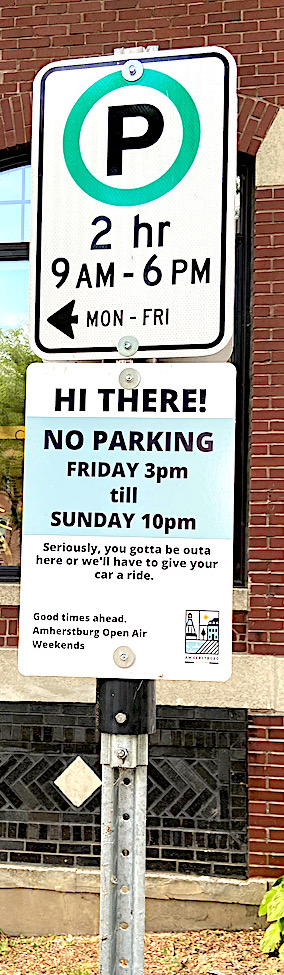
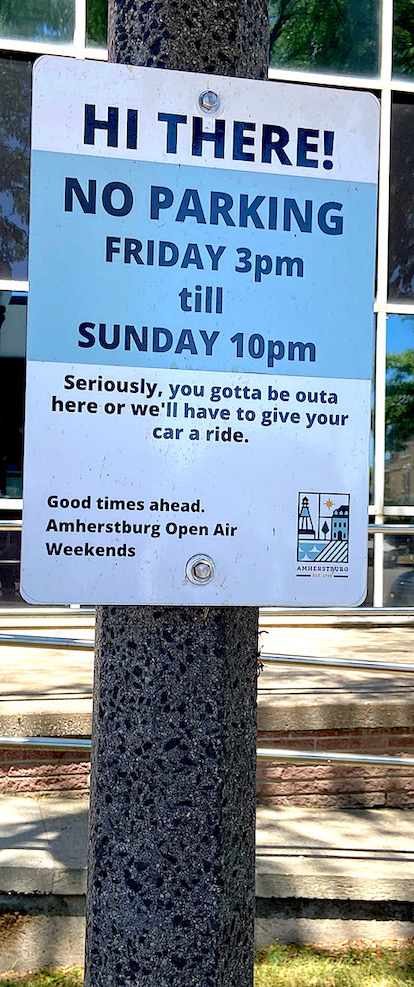
Is this funny? this is disgraceful; the attached photo was taken yesterday. the downtown is littered with these open air signs that do not even look like they can be enforced, even if people can read the fine print. this can be extremely confusing for people with disabilities trying to park only to encounter a sign disallowing them to park in a legitimate accessible parking space.

please confirm that this particular sign will be removed.

An August 2022 post showed the contradictory signs downtown.

Parking But No Parking Signs in Amherstburg

Downtown Amherstburg signs during ‘Open Air’ weekends are confusing. This is a no parking sign in a no parking zone in front of the post office that you can’t get to anyway.

This sign contradicts itself: no parking Friday at 3 pm but you can park until 6 pm Friday. Neither has any by-law number stated.

Open Air – If They Vote How Will They Vote?

The Open Air Report is on tonight’s meeting agenda and I predict another majority vote in favour, not necessarily a 4-3 vote.

Everyone on council knows about the accessibility issues because everyone is aware of the number of times I complained, despite the rebuttals; but now the survey results indicate more people have noted the accessibility and parking concerns.

Councillor Crain: I’ll start with the sole opposition to this survey. In August, Crain said he can’t grasp why Open Air specifically; they’ve done an Open Air survey for residents and businesses so he felt a survey just on Open Air seems to be wasting staff time.

CAO Critchley confirmed in an email that they have surveyed visitors and the businesses inside and outside the footprint but not a resident wide survey.

On February 22, Crain asked staff, hasn’t the past Council already looked at ways to refine open air and that’s why some of the barricades were moved in closer? This feels a bit redundant to me if this has already been looked at by council. And from last night and from what we’ve been hearing, it’s pretty clear that the format is great. But based on my understanding, council’s already looked at this.

Crain was part of the team that created the THRIVE Open Air white paper; from the THRIVE website, ‘We believe that it should be a permanent summer feature.’ 

On March 13, Crain said he didn’t even think Open Air should have been a topic of discussion. He also thought they shouldn’t even be discussing this every year because eventually it’s going to be nothing.

On September 16, I asked Crain if he considered declaring a conflict of interest for Open Air discussions involving the event itself and the survey? No response.

As a candidate, in answer to one of the burg watch 2022 campaign questions to the candidates asking if they will remove barriers during Open Air weekends, Crain said yes. He voted in favour.

Councillor McArthur: has happily and consistently championed Open Air. As council’s rep to the Accessibility Advisory Committee, I expected he would advocate to remove barriers. He spewed out the statistics from an admin report on the number of parking spaces within a six-minute walking radius. ‘If there are persisting issues with accessibility, let’s work collaboratively to address them in consultation with the Town’s Accessibility Advisory Committee.’ But he’s on the committee. He voted in favour.

Deputy Mayor Gibb: wears a few hats: business owner, chamber of commerce member, family member, elected official but he publicly admitted he’s a huge fan. While he emailed, as Deputy Mayor, that he was ‘proud to say that I did complete the ADOA training that was offered to all members of council and I hope to put what I learned into practice not only in my “municipal life” but also in my personal life. And then he said, Open Air makes the downtown more accessible for people with in at least in wheelchairs because his mother-in-law and father-in-law both live at Richmond Terrace and he’s personally pushed a wheelchair from Richmond Terrace downtown. He voted in favour.

Mayor Prue: has given a few speeches at council meetings about being in the legislature when the AODA was introduced decades ago. He stated he has never seen any problem with access and cited his wife as Chair of the Accessibility Committee. I have discussed it with her, she has never once said that there was any accessibility problem brought to that committee or anyone on the committee. He acknowledged one complainant, but he doesn’t necessarily agree with what’s being said; so it is accessible.

Prue asked council to find it in their hearts to compromise with the other side; he broke the tie vote in favour.

Councillor Pouget: has consistently acknowledged the town’s obligation to remove barriers that prevent people with disabilities from equally participating in the community.

Councillor Courtney: has also acknowledged the importance of accessibility, removing barriers and considering the interests of the whole community.

Councillor Allaire: considered pros and cons and seemed to want to compromise in favour of a shorter time frame.

Councillor McArthur’s Open Air Comments Appalling

I was appalled by Councillor McArthur’s comments during the February 22 Open Air discussion.

I missed part of the meeting because the agenda and link to livestream were not posted on the town’s website but I did check in and found council was discussing the tourism budget.

McArthur’s speech lasted about 5 minutes; Open Air, programming, hotel, the February 21 delegates/ businesses wanting to give the town $20,000, the reception given to them and he was shocked.

How did anyone act like they were urinating on the rug? Listen to the audio. Weren’t members of council just asking the delegates questions?

During the February 21 meeting, Councillor McArthur said everybody he talked to loves Open Air the way it is. He also said he didn’t think that now was the time for speeches on Open Air, that there was no motion on the floor when Councillor Pouget spoke about it.

I emailed him questions: did he not give a speech about the bike trails when there was no motion on the floor? Did he not recall emails I sent to members of council in opposition because it creates barriers to persons with disabilities? Did he only consider the views of people he ‘talked to’ and not consider emails? As council’s rep on the accessibility advisory committee, how will he represent the interests of the disability community?

Councillor McArthur did not respond by the time of writing.