The Burg Watch Launches the 2026 Municipal Candidates Accessibility Audit

The Burg Watch has officially issued a formal written accountability audit invitation to certified candidates running for Mayor, Deputy Mayor, and Town Council in Amherstburg with an email.

For too long, municipal accessibility barriers have been brushed aside with generic campaign platitudes or buried in procedural runarounds at Town Hall. This audit is designed to force candidates to put their actual governance positions on the record before you vote.

How the Audit Works:

  • October 2 (5:00 PM): The firm deadline for candidates to RSVP and publicly commit to participating.
  • October 14: The exact, hard-hitting questions are released to all participating candidates simultaneously.
  • October 16 (5:00 PM): A strict 48-hour window for candidates to submit their unedited, 200-word responses.
  • October 17: The final Audit Results Guide will be published right here, side-by-side, coinciding with the town’s final advance voting day.

We will be testing them on four critical local governance themes:

  1. Downtown Infrastructure & Public Space Access
  2. Digital Communications & Public Feedback Mandates
  3. Municipal Committee Governance & Policy Accountability
  4. Local Transit Mobility & Residential Housing Supply

Any candidate who chooses to ignore the invite or misses the deadline will be permanently marked on our public voter guide as 🟥 FAILED TO RESPOND / REFUSED TO PARTICIPATE.

Stay tuned. On October 3rd, we will publish the official list of exactly which candidates agreed to be transparent with the disability community, and who opted out.

Open Air: Bill Fryer Says “It’s Done”

As we continue tracking candidate positions on Open Air, today’s post features mayoral candidate Bill Fryer’s position on the summer street closures.

When asked about barriers surrounding Open Air, Fryer responded with a clear, direct message:

“Good morning and my response to your question and concerns that apparently have not been addressed will be taken care of as part of my plan to address all of the issues you have been fighting for, for who knows how long. Open air is a matter the entire community wants input and at this point has been a burden for many residents. I believe I have mentioned this issue a few times already.”

This aligns closely with his official campaign profile published by the River Town Times, where he went on record stating bluntly: “Open Air, as far as I’m concerned, is done.”

Fryer’s position:

  • An Unaddressed Burden: Fryer explicitly identifies the recurring summer layout as a burden for many local residents.
  • Opposing the Main Thoroughfare Closure: In his public campaign statements, he has criticized the weekly closure of a critical thoroughfare like Dalhousie Street, noting it creates severe traffic and accessibility issues.
  • A Promise for Direct Action: Fryer notes that these ongoing community concerns “will be taken care of” under his platform.

By calling the recurring closure an unaddressed “burden,” he reflects the frustration felt by residents who are locked out of their own downtown core for four months every summer.


What Do You Think?

Bill Fryer states that the weekly closure of our main artery has run its course and promises that these accessibility barriers will be taken care of under his leadership.

Do you agree with Fryer that the current Open Air footprint is an unnecessary burden on the community, or do you prefer the scaled-back compromises proposed by other candidates? Let me know in the comments.

Open Air: Dhaval Prajapati’s Pivot to “I Support Open Air”

As we continue tracking candidate positions on Open Air, today’s post features Dhaval Prajapati’s pivot from neutrality to endorsing closed streets.

When I originally shared Prajapati’s response to my inquiry here on the blog back in June, he took a very safe, middle-of-the-road reply. He claimed to be completely neutral, publicly telling us that it was important to “take the time to review the facts before forming a position.”

However, his campaign platform has since taken a completely different direction. After maintaining that public stance of neutrality for nearly three months, Prajapati posted an official “WHERE I STAND” declaration on his Facebook page on September 18, explicitly stating: “I like Open Air” and “I support Open Air.”

The Candidate’s Position: The Business Model and Superficial Inclusions

In his new public policy statement, Prajapati shifts entirely away from his previous “fact-finding” persona and lays out a clear plan to entrench the event by turning it into a self-sustaining business model.

Key takeaways from his updated position include:

  • Definitive Support for the Footprint: Prajapati openly praises the festival, writing: “From June to September, we close part of downtown on weekends and turn it into a pedestrian area… I like Open Air.”
  • The Fiscal Focus: His primary goal for the event is financial sustainability. He wants a full accounting of staff hours, expenses, and revenues, with the objective of securing more vendors and corporate sponsorships so that the event stops relying on taxpayer subsidies.
  • An Afterthought on Accessibility: After dedicating the majority of his platform to revenue generation, sponsorships, and vendor opportunities, he closes with a brief, single-sentence about accessibility: “I want to make it better… while also making sure accessibility, including accessible parking and access to downtown businesses, is part of the planning.”

The Reality: A Complete Reversal of Platform Promises

Prajapati’s swift pivot exposes a frustrating trend in campaigning. When a candidate tells an accessibility community publicly that they are “still learning” and “haven’t formed a position,” only to turn around months later and fully endorse the event, it breaks the trust established with voters who are looking for genuine consultation.

Furthermore, his updated platform reveals exactly where his priorities lie. Accessibility is treated as an optional checkbox to be tossed into the “future planning” phase, while the structural decision to lock down the street grid is treated as a done deal.

As a candidate, Prajapati claims he wants to ensure “access to downtown businesses,” yet he openly supports a pedestrian-only footprint that completely eliminates vehicle navigation. For residents who use their vehicles as non-negotiable assistive mobility devices, you cannot “plan” accessibility into a closed street. The closed street is the barrier. By declaring his unyielding support for a four-month vehicle ban after previously claiming he needed to study the facts, Prajapati proves that able-bodied entertainment and revenue generation remain his true priorities.


What Do You Think?

Dhaval Prajapati started his campaign by publicly stating he was neutral and looking at the facts, then turned around on September 18 and told the public he firmly supports Open Air.

How do you feel about a candidate changing their core position mid-campaign after previously committing to neutrality? Let me know your thoughts in the comments below, and stay tuned as we continue to put candidate positions on the record.

What are the candidates’ position on Open Air? Stephanie Pouget-Papak

Question: As you know, Open Air remains a contentious issue, especially because of Councillor Crain’s motion to not revisit it until the end of this term. 

Will you remove barriers that deny people with disabilities equal access to the community when streets are closed during Open Air weekends?

Stephanie POuget-Papak answer: Thank you for your patience as I work through my emails.

Open Air is a contentious issue that has left our community divided. The answer to your question is not as simple as “yes” or “no.” I have had the opportunity to experience Open Air from several different perspectives:

– As a family member: I have visited the downtown with my family and enjoyed the activities.

– As someone enjoying an evening out: I have experienced the restaurant scene with my spouse and had positive experiences.

– As a historian: I designed the Sunday Heritage Tours and led several Coffee and Culture discussions that received positive feedback from both tourists and local residents.

– As a business owner (speaking only from my own experience): I witnessed a decline in daytime visitation, difficulties for some seniors in accessing the building, and the financial impact that accompanied those challenges.

– Through an accessibility lens: Having had to learn how to walk again at age 15 following bilateral knee surgery, I understand that accessibility needs are not always visible. There are still days when I experience mobility challenges, and the lack of nearby parking had at times made it difficult for me to reach my former workplace, forcing me to work from home or take the day off. I think people sometimes forget that not everyone with accessibility needs qualifies for, or has, an accessible parking permit.

– As a citizen: I have also experienced the frustration of being unable to access side streets and becoming stuck in traffic on the main road when trying to run unexpected errands.

I have seen the benefits that Open Air brings in the evenings, particularly for our restaurants. These businesses employ many local youth and contribute to job creation in our community. In the tourism and hospitality sector, the revenue generated during peak season often helps businesses survive the slower off-season months. When businesses remain strong, they contribute to the tax base, which helps reduce pressure on residential property taxes.

This weekend I spoke with a family whose grandparent uses a wheelchair. They told me that they look forward to visiting downtown during Open Air because it helps their loved one “get out of the house” and enjoy being around people. At the same time, I recognize that not everyone has the support of a caregiver or the same ability to navigate the event comfortably.

I believe our lived experiences shape our opinions, needs, and emotions. Because of that, Open Air is unlikely ever to be an issue on which everyone agrees completely.

Would I advocate for eliminating Open Air? No. However, I also do not believe the current model fully reflects the diverse needs of our community. I think it can be improved in ways that better support accessibility while continuing to benefit businesses, tourists, and residents who enjoy the program.

Realistically, any new or long-term decision should be informed by a review of the 2026 season’s data, including attendance, economic impact, accessibility concerns, and associated costs. With that in mind, here are a few ideas worth exploring (not promises):

– Keep the same number of weekends, but limit closures to Friday and Saturday evenings, when foot traffic is highest.

– Convert Dalhousie Street to one-way traffic during Open Air, allowing one lane for restaurant patios and the other for accessible drop-off and pick-up areas, subject to safety and cost assessments.

– Reduce the overall number of Open Air weekends to create a stronger concentration of activity and demand, although this option may not adequately address the accessibility concerns being raised.

With more than 23,000 residents, we have more than 23,000 different needs and perspectives. My challenge is not to choose one group over another, but to find a balanced approach that supports accessibility, local businesses, (in this case) tourism, families, youth, elderly, and the overall well-being of the community.

I would be interested in hearing your personal experience and what specifically makes Open Air difficult for you to navigate (for example, the parking, walking, distance etc…) this could help form a better argument should the opportunity arise.

Thank you again for reaching out and sharing your concerns.

Candidates that haven’t answered yet:

Molly Allaire
Frank Cerasa
Mickle Park Playground – How Useable?

As posted in June 2023. Amherstburg’s accessibility committee ENDORSED this playground, despite the barriers.

Below is an email to Councillor Pouget and Councillor McArthur on June 12 in advance of the council meeting.

After watching the June 5 Amherstburg Accessibility Advisory Committee Meeting, and reading some of the documents, I have some concerns regarding the recommendation to ENDORSE the playground design proposed for Warren Mickle Park’s playground redevelopment.

I’m writing to both of you because Councillor McArthur is council’s rep on the AAAC and Councillor Pouget consistently represents the interests of people with disabilities.

Ms. Heidi Baillargeon advised the AAAC an RFP resulted in three proposals that went through a Review and Scoring committee, and this was the design that was selected for installation at Warren Mickle Park. Ms. Baillargeon also advised the AAAC that it is partly a ramp structure, there are a number of accessible components, and that ‘a wheelchair can only go up to the first deck.’

It is preferable to use person first or identity first language and not refer to the assistive device alone.

How did a Review and Scoring committee approve this proposal?

What Makes a Playground Inaccessible? (aoda.ca)

  • Multilevel platforms
  • Stairs
  • Narrow walkways
  • Monkey bars
  • Bucket swings
  • Swings
  • Slides (plastic or metal)

Would someone please explain how the proposed Warren Mickle Park will be AODA compliant and inclusive if children with disabilities can’t access or use all the equipment? 

From the Parks Master Plan 2018, “It is essential that parks are inclusive and barrier-free, as guided by the Accessibility for Ontarians with Disabilities Act (AODA). To ensure that the parks system is able to serve people from all segments of the community, accessible seating, washrooms, shade (structures and trees), parking, connections to key destinations and safety must be prominent considerations.”

While Ms. Baillargeon mentioned the CSA Z614:20, a safety standard, there was very little discussion regarding the AODA, Regulations, inclusive playground guidelines and mandatory public consultation.

The Integrated Accessibility Standards Regulation of the AODA mandates public consultation as follows:

“When constructing new or redeveloping existing outdoor play spaces, obligated organizations shall consult on the needs of children and caregivers with various disabilities” and shall do so in the following manner: 

1. designated public sector organizations and large organizations must consult with the public and persons with disabilities. (emphasis added).

2. Municipalities must also consult with their municipal accessibility advisory committees, where one has been established in accordance with subsection 29 (1) or (2) of the Act. 

Outdoor play spaces, accessibility in design 

80.20 When constructing new or redeveloping existing play spaces that they intend to maintain,obligated organizations shall,

(a) incorporate accessibility features, such as sensory and active play components, for children and caregivers with various disabilities into the design of outdoor play spaces; and

(b) ensure that outdoor play spaces have a ground surface that is firm, stable and has impact attenuating properties for injury prevention and sufficient clearance to provide children and caregivers with various disabilities the ability to move through, in and around the outdoor play space. O. Reg. 413/12, s. 6.

There was also no discussion regarding the 2021 survey that no children under the age of 18 participated in. 

Will the four benches be accessible? Will the bike racks be accessible? Will there be any braille elements? Will accessible washrooms be installed? Will accessible parking spaces be available? Will accessible signage and wayfinding be installed? The concept plan 2021 included a picnic area and in answer to the question, What park amenities would you like to see at Warren Mickle Park, 50 (74.6%) said picnic table: will accessible picnic tables be installed?

Also of concern is an AAAC member’s comments regarding the slide: he could only see one problem with it – that is you put it in this park and people find out about it, they’re gonna want it in all the other parks and that means retrofitting. Then the member asked about the cost for that.

In is my understanding that AAAC members identify barriers and ‘provide advice and recommendations to Council on accessibility issues within our community’ and council makes budgetary decisions for what accessible projects it prioritizes.

What are the candidates’ position on Open Air? Saurabh Katara

Question: As you know, Open Air remains a contentious issue, especially because of Councillor Crain’s motion to not revisit it until the end of this term. Will you remove barriers that deny people with disabilities equal access to the community when streets are closed during Open Air weekends?

Saurabh Katara:

Thank you for reaching out and for asking this important question.

Yes—I will work to remove barriers that deny people with disabilities equal access to the community when streets are closed for Open Air. Open Air is valuable to our community, and accessibility should be part of it—not something residents have to give up for the event to work.

I’m not going to pretend I already know the exact operational solution without first understanding the barriers people are experiencing. During the campaign, I intend to speak directly with residents affected by these closures so I understand what changes would make the biggest difference.

Candidates that have not answered yet are listed below. I emphasize yet since Lena Lazanja incorrectly stated, “I would appreciate you removing my/other candidates names from a “did not respond” section.

As I informed Lazanja, I listed “candidates that haven’t answered to date.”

Candidates that haven’t answered yet:

Molly Allaire
Frank Cerasa
Stephanie Pouget-Papak

RECAP Accessibility Advisory Committee Meeting July 23, 2026

The committee didn’t accomplish much. The only agenda item, the 2026 Municipal Elections Accessibility Plan was just to receive for information – 51 one minutes and 39 seconds until adjournment.

Chair Shirley Curson Prue rarely reads the land acknowledgement but this time she did; she usually just hands everything over to staff.

Tony Pietrangelo, current committee member and councillor candidate provided two memorable moments:

1.Pietrangelo asked if they were having internet voting.

    Council voted to continue with the costliest, most labour intensive and least accessible in person voting on September 8, 2025. 

    Had it not been for my December 2022 delegation, council would have voted back then for in person voting.

    Pietrangelo was present at the October 23, 2025 accessibility committee meeting when admin advised it of council’s in person voting decision.

    Of course, the committee moved to endorse the 2026 Municipal Elections Accessibility Plan.

    Members still seem unsure of whether to make motions. Typically, the committee limits motions to receive minutes and adjourn but not to receive updates, direct admin to report back, or to take action.

    I did delegate to the committee in 2022 and offered suggestions for the committee to be strong advocates and follow procedural rules, but they disregarded my input as usual.

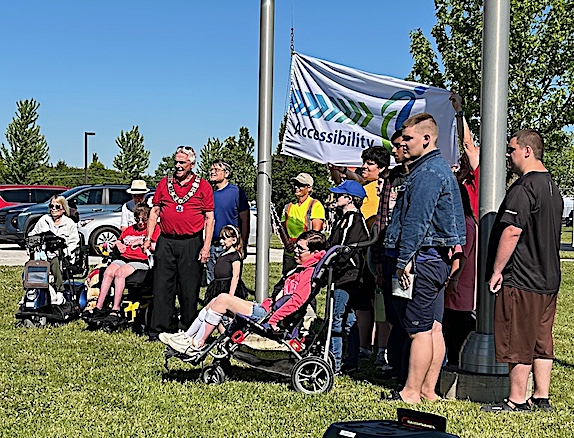
    2. The second memorable moment was when Pietrangelo enthusiastically praised the National AccessAbility Week flag raising. 

      It was a performative gesture. 

      If I were to describe this event to anyone not in attendance, I’d say a small crowd gathered, Prue read a speech, and a staff member raised a flag – that’s it. 

      small crowd gathered for National AccessAbility Week flag raising at Amherstburg park in 2026.


      This minimal effort is typical of communities that lack a strong commitment to inclusion and accessibility.

      “It’s now part of our standard practices,” advised admin.

      It’s a low standard.

      The town wants to know about voting barriers – at least that’s what the committee was advised. But my input on voting barriers has been disregarded for a few elections by both council and the accessibility committee.

      Councillor Pouget’s motion on December 12, 2024 was that my submission regarding voting barriers be sent to the committee. Of course, the committee didn’t discuss my submission any more than it discussed my previous submissions or my delegations about barriers.

      The town wants more people to vote – at least that’s also what the committee was advised. But staff recommended, and council approved, the most inaccessible traditional in person voting which may limit voter turnout. 

      No one should be surprised that barriers can repress voter turnout and influence feelings of efficacy for voters with disabilities (Schur et al., Reference Schur, Ameri and Adya2017).

      Admin should have recommended a greater variety of voting methods to meet the needs of a variety of voters to increase voter turnout. It’s counterproductive to limit choices and then complain of limited results.

      Of course, council should have directed admin to report on the costs of each voting method in December 2022. 

      Very briefly, the committee mentioned a library audit.

      The library was to have been audited in January 2024. 

      An inoperable push button at the hub, future sidewalk repairs, and pickleball parking were noted.

      Almost an hour for business that could have been addressed probably within 15 minutes.

      Meeting adjourned.