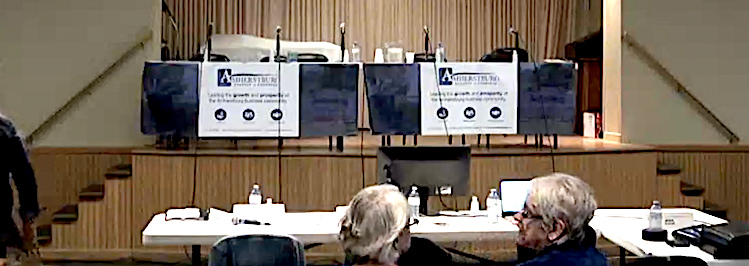
RECAP Accessibility Committee Meeting February 26, 2026

My defamation lawsuit against the town clerk and town of Amherstburg followed my January 2022 critique of the draft multi-year accessibility plan.

Some of my answers to the multi-year accessibility plan survey questions that I completed in January 2026 are missing from the documents and verbal report on the survey findings.

Memorable Meanderings:

Shirley Prue said she’s intrigued about the federal standards; “took only 20 years but there you go.”

(As I keep pointing out, Mayor Prue stood up in the provincial legislature just over 20 years ago to vote in favour of the AODA. In 2025, he said this town has not been compliant). 

Tony Pietrangelo asked, “where are the definitions as to what a public space is and a private space is? Where is that definition? Is there a standard that’s put out by the Government of Ontario?”

(The Design of Public Spaces Standards under the AODA were enacted on January 1, 2013). 

Centennial Park redevelopment

Council already approved option 1 at its February 23 meeting so Heidi Baillargeon presented a recap on zoom:

  • consultations with the tennis club, sports organizations, and North Star High School. (no mention of mandatory consultation with people with disabilities).
  • two dedicated tennis courts and two basketball courts, with one set of tennis courts fully fenced and the other non-fenced.
  • A multi-use trail, accessible parking spaces, and tree planting are also part of the design, with a focus on maintaining Russell Renaud Hill.
  • The design includes rest stations every 100 meters, with some as close as 50 meters apart, and connections to accessible parking spots near the tennis and basketball courts.

Baillargeon mentioned the intention is to start the build in the winter for a spring completion.

Tony Pietrangelo gave Baillargeon his blessings and asked if the parking lot would be paved. Baillargeon explained only the accessible parking spaces would be paved – the rest will remain gravel.

(So, a million dollars for courts and yet another walking trail but people with disabilities will still encounter barriers trying to navigate through a parking lot. Priorities).

Pietrangelo asked what was budgeted for the project. Councillor Donald McArthur said it was just over a million.

Chris Drew said, I think you guys did a fantastic job. He mentioned some criticism about the trail system, but he thought the people in the area need that. He said a lot of them don’t have any way to get out to the Libro and they don’t have a way to get to the green away trails. 

(The criticism I saw was related to the fact that over a million dollars is being spent on another amenity like a walking trail while infrastructure is crumbling, there are sidewalks to walk on, and sidewalks and roads are in desperate need of repair).

Baillargeon provided more details. The trail length is around 800 meters in total, 2.4 metres wide. Bench station spacing is an average maximum of 100 but the average spacing in this design here is around 75. We have 10 benches in total around the trail, with a cross slope is 2% on the trail. So that’s 2.5 inches in 10 feet. The parking spaces: four type A parking spaces 3.4 metres wide for a van, ten Type B parking spaces 2.4 metres wide for a car with a 1.5 metre wide shared aisle between the spaces.

Prue said we always think about, how do we get onto the trail if we’re in a chair.

(Maybe Prue should spend more time thinking about all the barriers in town that prevent people with disabilities from equally participating. Mayor Prue, her husband, did say in 2025 this town has not been compliant. That’s right – the town failed to meet the January 1, 2025 AODA deadline).

Accessible On-Street Parking Space

Prue said okay, 7.2 accessible on street parking space. What’s that one about?

(The agenda description is an aerial of Briar Ridge. The committee discussed this at the January 22 meeting: create an accessible on-street parking space at Briar Ridge Park, for approximately $500 for paint and signage and conduct public consultations for on street parking. This was to be one of the highlighted projects during National AccessAbility Week).

The committee was advised that the traffic by-law would need to be amended to have parking only on one side.

There seemed to be some confusion about where people would park and if they would be exiting their vehicle onto grass.

Multi-Year Accessibility Draft Plan and Survey Results

Prue said, okay, moving on to 7.3, which is the multi-year Accessibility Plan, draft. What you got?

(Just like her husband, she hands items over to staff. The meetings are for members to discuss items; staff should only be called on for clarification).

Admin said at a high level, the survey was successful in promoting some discourse in the community. 

(I wonder how success was measured. I saw percentages, one document with pie charts and another document with bar graphs. It was later revealed that 17 people participated. Given the approximate 6400 Amherstburg residents with disabilities, that’s a poor result in my opinion).

Admin continued – if results indicate there’s some dissatisfaction there may be further need to refine and focus on those areas to understand what those concerns are. 

(There was plenty of time to refine questions because the multi-year plan wasn’t due until December 2026).

Admin said responses were received from a variety of individuals, including people with disabilities and caregivers, although no breakdown was given.

(There should’ve been a breakdown given because the question was, ‘Do you wish to identify as… a person with a disability. The percentages indicate eight people identified as a person with a disability).

Admin then reviewed the survey questions and answers. 

(Not all the answers; I noticed some of mine were missing).

Do the Town parks, including multi-use paths and trails, playground structures, and other amenities, meet your accessibility needs?

Admin said generally, they seem to be meeting the need for a vast majority of the respondents (11 people) but 25% (4 people) said no. 

Admin said now that they know, they can use that to guide some of the focus of further inquiry on the plan. 

(The questions should’ve been more comprehensive now. Again, there was plenty of time to refine questions because the multi-year plan wasn’t due until December 2026).

Have you encountered barriers at any Town parks, trails, or amenities?

38% (7 people) said yes.

One survey document does not list the barriers.

Another survey document lists top barriers:  

  • Parking
  • Pathways
  • Rest areas

Admin echoed the barriers that were identified were parking, pathways and rest areas. And, since the committee just discussed those items in Centennial Park, the conclusion was, ‘it seems like the committee is focused on the right things in that regard. And what we’re hearing from the respondent survey is that that’s where the attention should lie.’ 

(Should the focus really be based on seven responses?).

Does town recreation programming meet your accessible needs?

Once again, admin said that’s where more refined questions around what sort of programming is missing out. Admin mentioned sledge hockey and the Miracle League.

Do the town sidewalks meet your accessibility needs?

About 24% (4 people) said no. Reasons: the age and design of the infrastructure or maintenance standards. 

Do the transportation options available in Town meet your accessibility needs?

The question about what would enhance the accessibility of transportation options within the Town wasn’t reported on or included in the reports. Again, admin mentioned further future questions to find out more.

A couple of questions about customer service: 12% (2 people) used the accessible customer service kiosk in the past year; of those that use them, 100% (2 people) said that they did meet their accessible needs. Admin said that’s a significant finding, it indicates that the kiosks are currently meeting the need. 

(The kiosks are currently meeting the need of two people; that’s not a significant finding or indication that it’s accessible to the disability community).

How do you access information shared by the Town?

76% (13 people) use the town website, 76% (13 people) use the town social media, and 53% (9 people) word of mouth. 

Pietrangelo asked how many people took the survey.

Admin said 130 people interacted with the talk the burg site, 61 accessed the areas that have the survey, only 17 of them completed the survey.

Pietrangelo emphasized the difference between percentages and real numbers. He wondered why they don’t get more people participating, especially under 18 years old. 

Admin said if a barrier affects one person, they have that same standard to meet it. 

(But the number one complaint in the residents’ OpenAir survey is accessibility and nno meaningful action was taken).

Pietrangelo asked who designed the questions and was told the communications team.

Drew said one thing that bothers him is these open houses are made available, surveys are made available, and people sit at home and don’t bother to do anything, but then they come out of the woodwork later with all kinds of stuff, like the Centennial Park. People are coming out saying, oh, they should be putting a swimming pool in, they should be doing putting a splash pad in, they should be doing this, they should be doing that; they don’t need the walking trails and stuff like that. Where were they when we had these open houses and the surveys for them?

(Drew also complained on my facebook page, saying most people are too lazy or don’t care).

Instead of blaming or shaming, the committee should’ve reviewed where the survey was advertised, how many times, and asked if there were any barriers to participation. I did point out to admin that if surveys can be emailed out, they should be able to email them back instead of having to take them in person to the town hall).

Prue asked if there were any other questions. 

(It would be so refreshing to have decorum at meetings).

Projects and Initiatives in the Accessibility Plan

  • Admin outlined the projects and initiatives in the multi-year accessibility plan, drawn from existing documents: the town’s seven-year capital projects, transportation master plan, and parks master plan.
  • The plan will be open for public feedback and will be revised based on the committee’s input and the survey results.

Admin mentioned the federal standards. Prue said she’s intrigued; took only 20 years but there you go.

(As I keep pointing out, Mayor Prue stood up in the provincial legislature 20 years ago to vote in favour of the AODA. In 2025, he said this town has not been compliant). 

Unfinished Business and New Business

  • Admin provided updates on unfinished business, including the funding for accessible parking spaces at the Libro and Briar Ridge.
  • The committee discussed the donation of a temporary accessible ramp to the Co-An Park Board for use at their stage.
  • The motion to donate the ramp passed, and the committee agreed to review the multi-year accessibility plan and provide feedback at the next meeting.
  • Meeting adjourned.

Repeating Request For Patio Policy

While council will discuss temporary patio user fees at its February 24, 2025 meeting, it has yet to enact a patio policy, despite my emailing council and/or delegating about it seven times to ensure AODA compliance. I even provided resources.

So, for an eighth time, I’ve emailed council but this time I reminded them of their promises by Mayor Prue during the January 27, 2025 council meeting:

“this town has not been compliant. And I have promised, as mayor, and the council has promised, that we will hence for hence forward, going forward, always be AOD compliant. And I want people to know that the those who have disabilities have every right to use every one of the services in this town, the same as everyone else.”

I also quote the Municipal Act, section 14 (1):

A by-law is without effect to the extent of any conflict with,
(a) a provincial or federal Act or a regulation made under such an Act; or
(b) an instrument of a legislative nature, including an order, licence or approval, made or issued under a provincial or federal Act or regulation.  2001, c. 25, s. 14.

I also reminded them about Prue’s October 15, 2024 comment: “I am sorry that some people are not getting out of the way when someone comes by with a cane or a walker or a wheelchair, but what difference would it make if there was two cars there instead of the patio? If they won’t get out of the way on the sidewalk, they won’t get out of the way. And so I think that this is a business case has been made, and I do believe that is in the best interest of the town to be a welcoming and friendly place for people to sit out and have a meal in the sun. So I, will not be supporting the motion.”

I advised them that many municipalities have enacted patio policies that include AODA compliance and barrier removal and asked, will you keep your promises to do the same?

This council has proven how business friendly it is. Making a strong commitment to removing barriers and being AODA compliant is long overdue.

Will Street Signs Meant To Honour Veterans Be Readable?

There were the typical kudos to admin for getting the job done so quickly, to Deputy Mayor Gibb for raising the issue before he was elected, and to the Legion for their ‘sense of community.’

How appropriate is it to honour veterans but not ensure signs are large enough for them or other people with vision disabilities to read? 

I emailed members of council in advance of the February 12 meeting and stated there is no mention in the report of accessible sign design or design standards. I urged members to consider the fact that Highway Gothic typeface is mainly used throughout Canada and Ontario, including on provincial highways and in cities including Windsor; it makes reading signs easier.

Mayor Prue did ask council to consider making the signs larger and mentioned that it didn’t cost any more money, but he could have made the motion himself especially since he passed the gavel.

Amid the claims that we are an inclusive community, possibly striving to become a designated ‘age friendly’ community, it was deplorable to hear a question about the cost of bigger signs and an answer that there is an assumption there will be some additional costs. Given the budget approval, how does anyone justify limiting funds for this expenditure? Besides, if the signs will slowly be replaced council could have directed administration to bring back a report on the cost with actual figures for larger and more readable signs. 

When the town applied for a $100,000. grant for wayfinding signs, one of the project priorities it listed was ‘accessible, diverse, equitable and inclusive: The sign design will take into consideration AODA requirements, MTO roadway recommendations and eligibility standards.’ Did the town create a wayfinding plan? Consult the Ontario Traffic Manual? Consult the CNIB?

Why were those priorities not incorporated for the poppy street sign designs? I have asked that the town’s procurement policy be updated to include more than the consideration of AODA training. The AODA Integrated Accessibility Standard Regulation states designated public sector organizations shall incorporate accessibility design, criteria and features when procuring or acquiring goods, services or facilities. 

Council needs to make a stronger and more consistent commitment to removing barriers in our community. Still, council’s motion will result in a celebration that will be a great photo op and a reminder to pay tribute to veterans even if the signs are too small for some to read. 

Amherstburg Candidates And Accessibility: Chamber of Commerce

I appreciated Mayoral Candidate John Laframboise holding his meet and greet at the K of C Hall in Amherstburg, while several other candidates held meet and greets in locations with barriers.

I was just as disappointed that the Chamber of Commerce used the stage, with its stairs, for the Mayoral and Deputy Mayoral Candidates’ Night on October 12, 2022.

stairs leading up to stage in hall for municipal candidate night in Amherstburg, Ontario 2022

Amherstburg Candidates And Accessibility: Meet And Greets

The following candidates should have known better than to hold meet and greet session in these locations since the town was to provide them with accessibility information.

Downtown Espresso Cafe wouldn’t allow my comment to be posted, but it was advertising the following candidates’ meet and greets. step up barrier into Downtown Espresso Cafe Amherstburg, Ontario

Linden Crain launch July 14

Frank DiPasquale August 30 6 to 8 pm
September 27 6 to 8 pm

Lori Wightman September 13 6 to 8 pm

Molly Allaire September 22 6 to 8 pm

Patricia Simone October 2 11am to 2 pm

Donald McArthur October 3 6 to 8 pm

Gregory Moore October 5 6 to 8 pm

Holger Kretschmann October 6 6 to 8 pm

Artisan Grill

step up barrier into Artisan Grill Amherstburg, Ontario

Michael Prue  October 3 7 to 9 pm

Speck’s

step up barrier into Speck's restaurant Amherstburg, Ontario

Nancy Atkinson September 21

CBC: Municipal election candidates need to make accessibility part of their platforms

In this CBC News Opinion, Kevin McShan writes, The city of Windsor is at an inflection point, and there’s one fundamental question left for the candidates to answer in the upcoming municipal election: who’ll make accessibility a cornerstone of their platform?

The burgwatch’s candidate questionnaire included, what does accessible mean to you?Of the twenty five Amherstburg candidates, two answered.

If ‘those’ campaigning to represent everyone will be responsible for preventing and removing barriers but will not commit to doing so, no votes from me.

Amherstburg Accessibility Advisory Committee Could Use Tips

I watched today’s rescheduled Amherstburg Accessibility Advisory Committee meeting.

Committee members still stray off topic, but did finally have a discussion regarding keeping track of money allocated to projects and decisions regarding the same. For quite some time I have wondered why resolutions were not passed and recorded in the minutes for reference. In the future, an unfinished list of sorts will be used. Why it took so long I have no idea, especially when a few members sit on other town committees.

I didn’t hear the committee members deal with an AODA Alliance tips for committee members that I forwarded through town clerk Valerie Critchley. I also sent it to members of council so they would be better informed; see below.

“This Update gives members of AACs and SEACs practical tips on how to give as strong a voice as possible to disability issues. We identify seven areas of concern and then provide a fuller explanation for each point below. In summary, here is what all members of AACs and SEACs should know:

1. AACs and SEACs should set their own meeting agendas! Don’t let city staff or school board staff set their advisory committee’s agenda or tell them what topics are “in order.”

2. Members of AACs and SEACs must remain free to also be disability advocates in private and public.

 3. Inaccessible virtual meeting platforms and application forms are not allowed.

 4. Public deputations to an advisory committee should not be artificially limited to five minutes.

 5. Municipal and school board bylaws cannot hog-tie the work of an AAC or SEAC.

 6. Members of the public are free to talk to or exchange emails with advisory committee members about accessibility issues, including those on the advisory committee’s agenda. (emphasized for council’s attention).

 7. AACs and SEACs have an absolute right to have their recommendations and advice shared directly with all the city council or school board trustees whom they are appointed to advise, and not just to a sub-committee.

Please share this Update with members of the AAC and SEAC in your community. Urge your member of city council and school board trustee to read this and to send it to all members of their AAC or SEAC.”

Amherstburg Requests Website Compliance Deadline Extension – Follow Up Questions to Council

Members of Amherstburg town council were asked to provide the reasons for voting in favour of the Resolution on September 14, 2020.

The following responded.

Councillor Michael Prue: Please view the tape or the video. I was very passionate about why this should not be done. If this is not possible call me.

Councillor Patricia Simone: After reading the report provided in the agenda, discussion with administration and staff and research I conducted before the meeting.

Follow up question: What kind of research did you conduct and would you cite the sources you relied on to reach your decision?

No response.

Councillor Donald McArthur: I voted the way I did because I believe the extension request was earnest and made in good faith by staff, who are diligent, dedicated and hard-working.

As the report to Council makes clear, the Town’s robust response to the COVID-19 pandemic has had a significant impact on operations and established work plans.

“The work plan to address website accessibility did not anticipate the interruptions and redeployments caused by the declared pandemic, COVID-19,” said the report. “The demands of addressing the emergency declaration have devoted key resources away from other projects to ensure the safety of the community and staff, continued operations and new procedural changes to how the municipality ensures the provision of its services during a pandemic.”

Follow up question: regarding your comment at the meeting that amherstburg is not the only one of the 444 municipalities asking for this extension: would you know the numbers or names of those other municipalities?

McArthur: I based my comments off the report: ‘The Town of Amherstburg is not alone in finding it difficult to meet this timeline. Other municipalities have stated that they understand they may not be able to meet this target, especially given that there have been no funding announcements from the provincial government.’

Related postsTown of Amherstburg Requests Website Compliance Deadline Extension.

Amherstburg Requests Website Compliance Deadline Extension – The Recommendation.

Town of Amherstburg Requests Website Compliance Deadline Extension – The Resolution

Town of Amherstburg Requests Website Compliance Deadline Extension – The Vote

More to follow.

Amherstburg Requests Website Compliance Deadline Extension – The Vote

On September 14, 2020, the following members of Amherstburg town council voted in favour of the Resolution to request the province to extend the compliance deadline ‘to meet the compliance standards, by a minimum of one (1) year to at least January 1, 2022.’

  • Deputy Mayor Leo Meloche and
    Councillors
  • Michael Prue
  • Peter Courtney
  • Patricia Simone
  • Marc Renaud
  • Donald McArthur.

A discussion was held and is summarized below; disclaimer – this is not an official transcript.

Councillor Michael Prue spoke first and recalled his involvement with the Accessibility for Ontarians with Disabilities Act (AODA) enacted in 2005. Prue wondered if they were doing the right thing to attempt to delay the website when the town has known since 2005 it had to be done and since the 2011 schedule saying it had to be done in 2020. He didn’t think they were doing a service to persons with disabilities or that it was in the municipality’s best interest.

Paula Parker, town clerk, agreed they were aware of the deadline for some time but COVID became a priority and they requested the extension to prevent the order or fines if they are non-compliant.

Councillor Michael Prue responded to Paula Parker: he didn’t understand why they would need a year extension when they only lost 5 months.

Councillor Donald McArthur disagreed and thought it was a bit of a cry for help from staff and that they should listen; that they’re not the only one of the 444 municipalities asking for this extension and he thought it was reasonable in light of COVID.

Councillor Patricia Simone asked about the possibility of a third party that deals specifically with websites and weigh that against staff time needed to be in compliance.

CAO MICELI mentioned Kevin Fox advised they can’t comply because of third party vendors and their information and those parties don’t follow the same rules.

Councillor Peter Courtney would support the extension on advice of administration and hope they have some compassion for them and hope the town doesn’t face any consequence.

Councillor Michael Prue asked if the matter went before the disability committee and wondered what people think of the town not meeting the deadline.

Councillor Marc Renaud, council’s representative on the Accessibility Advisory Committee, remained silent.

Paula Parker responded that it had been dealt with by the committee on a number of occasions and believed most recently at the end of last year. Parker responded to Courtney’s comments and pointed out the town’s website does meet the WCAG level 2.0 not only single A but double A. Parker mentioned the problem is with PDFs and some third party vendors who are responsible for such things as the tourism website and the fire website.

Councillor Michael Prue acknowledged the consensus but wasn’t sure if politically it was wise.

Deputy Mayor Leo Meloche agreed they need to get this done and mentioned part of the problem for years is administration puts in requests for help and council denies and they all just have two hands and can’t do the work of 4.

More to follow.

Related postsTown of Amherstburg Requests Website Compliance Deadline Extension.

Amherstburg Requests Website Compliance Deadline Extension – The Recommendation.

Town of Amherstburg Requests Website Compliance Deadline Extension – The Resolution

Amherstburg Requests Website Compliance Deadline Extension – The Resolution

The following was included in the report to council for its September 14, 2020 meeting:

It is recommended that:

  1. WHEREAS Section 14(4) of O.Reg 191/11 under the Accessibility for Ontarians with Disabilities Act requires designated public sector organizations to conform to WCAG 2.0 Level AA by January 1, 2021;
  2. AND WHEREAS the municipality remains committed to the provision of accessible goods and services;
  3. AND WHEREAS the municipality provides accommodations to meet any stated accessibility need, where possible;
  4. AND WHEREAS the declared pandemic, COVID-19, has impacted the finances and other resources of the municipality;
  5. AND WHEREAS the Accessibility for Ontarians with Disabilities Act contemplates the need to consider the technical or economic considerations in the implementation of Accessibility Standards;
  6. BE IT THEREFORE RESOLVED THAT the municipality requests that the Province of Ontario extend the compliance deadline stated in Section 14(4) of O.Reg 191/11 to require designated public sector organizations to meet the compliance standards, by a minimum of one (1) year to at least January 1, 2022;
    AND,
  7. BE IT THEREFORE RESOLVED THAT the municipality requests that the Province of Ontario consider providing funding support and training resources to meet these compliance standards.

More to follow.

RelatedTown of Amherstburg Requests Website Compliance Deadline Extension.

Amherstburg Requests Website Compliance Deadline Extension – The Recommendation.